Someone dies and leaves a will.
The family knows the will exists, but nobody immediately opens a probate estate. Perhaps the deceased person's spouse continues living in the house. Perhaps the family informally divides personal property. Perhaps nobody realizes that probate is necessary until years later, when someone tries to sell real estate.
Then an uncomfortable question arises:
Can a will become too old to probate in Texas?
Generally, yes.
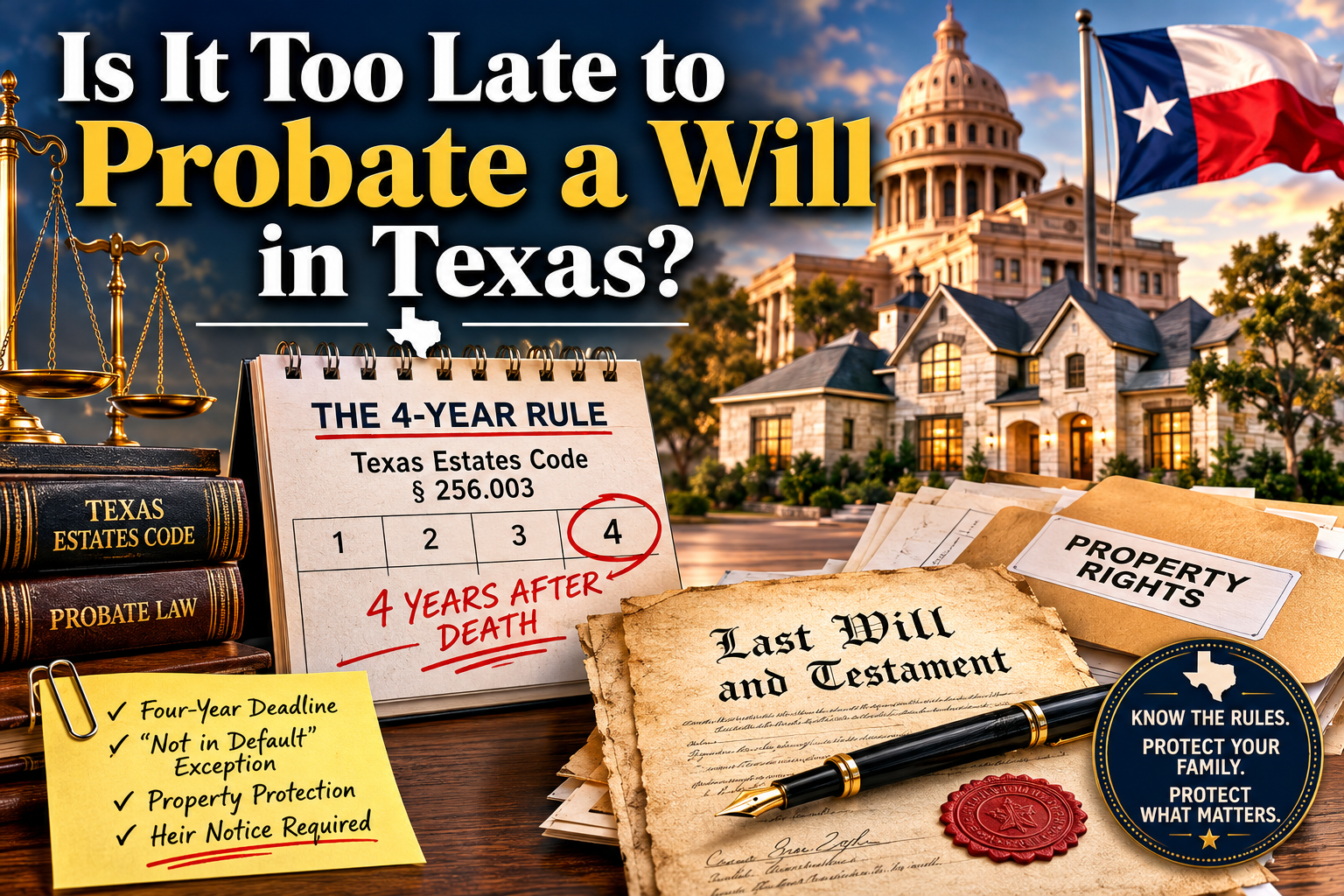
Texas law establishes a four-year period for admitting most wills to probate. But unlike an ordinary statute of limitations, the rule contains an important exception.
In certain circumstances, a Texas court may admit a will to probate even more than four years after the testator died if the person seeking probate can prove that he or she was not in default for failing to present the will earlier.
That distinction can determine whether property passes under a person's will or under Texas intestacy law.
Texas Generally Gives You Four Years to Probate a Will
Texas Estates Code § 256.003(a) establishes the basic rule.
The statute provides that:
“a will may not be admitted to probate after the fourth anniversary of the testator's death”
unless the statutory exception applies. Tex. Est. Code § 256.003(a). (Texas Legislature Online)
The clock therefore ordinarily begins on the date of death.
For example, suppose someone dies on June 1, 2026, leaving a valid Texas will.
As a general matter, an application to probate that will should be filed no later than the fourth anniversary of the person's death.
Waiting beyond that date can create substantial complications.
This deadline is particularly important because a will does not necessarily transfer record title simply because it was properly signed before death.
Texas Estates Code § 256.001 states that, subject to an exception involving certain foreign wills, a will is not effective to prove title to or possession of property disposed of by the will until the will is admitted to probate. (Texas Legislature Online)
In other words, keeping Grandma's signed will safely in a filing cabinet for ten years is not necessarily the same thing as legally establishing the property rights created by that will.
But Four Years Is Not Always the End of the Story
Section 256.003 contains an unusually important qualification.
The complete statutory rule provides that a will may not ordinarily be admitted after four years:
“unless it is shown by proof that the applicant for the probate of the will was not in default”
for failing to present it within the four-year period. Tex. Est. Code § 256.003(a). (Texas Legislature Online)
That language creates what can be an extremely important escape hatch.
The statute does not simply say:
Four years passed, therefore the will is dead forever.
Instead, it asks why the particular applicant failed to present the will within four years.
If that applicant can establish that he or she was not in default, late probate may still be possible.
What Does “Not in Default” Mean?
This is where the issue becomes considerably more fact-specific.
The statute itself does not provide a simple checklist defining every circumstance that constitutes default.
The important question is generally whether the applicant lacked reasonable diligence in presenting the will for probate.
Someone who possessed a will, understood its significance, and simply chose not to probate it for many years may face a very different situation from someone who did not discover the will until long after the four-year period expired.
That distinction matters because the Texas Supreme Court has emphasized that § 256.003 focuses on the conduct of the applicant.
The Texas Supreme Court Clarified Whose Default Matters
A particularly interesting example arose in Ferreira v. Butler, a 2019 Texas Supreme Court case.
The underlying will was offered for probate approximately nine years after the testator's death.
The dispute eventually required the Texas Supreme Court to determine whose failure to timely probate the will mattered under § 256.003.
The Court focused closely on the statutory phrase “the applicant for the probate of the will.”
It ultimately held that when someone seeks late probate in an individual capacity, the relevant inquiry concerns that applicant's own conduct:
“only the applicant's conduct is relevant”
to determining whether the applicant was not in default. Ferreira v. Butler, 575 S.W.3d 331 (Tex. 2019). (Justia Law)
That holding is significant.
It means that another person's earlier failure to probate a will does not necessarily doom every later applicant.
The identity and legal capacity of the person seeking probate can matter enormously.
Discovering an Old Will Can Therefore Create a Real Probate Question
Consider a simplified example.
A woman dies in 2018.
Her family believes that she died without a will, and her property is treated accordingly.
In 2026, a relative cleaning out an old storage unit discovers a signed will that nobody knew existed.
The four-year period has plainly expired.
But that does not necessarily answer whether the will can still be admitted to probate.
The person seeking probate may be able to argue that he or she was not in default because the existence of the will was unknown despite the circumstances.
Whether that argument succeeds depends on the particular facts and the applicant's conduct.
That is very different from an applicant who knew about the will throughout the four-year period and simply decided that probate could wait indefinitely.
Late Probate Can Affect People Who Thought They Already Inherited
The four-year rule also serves an important title-protection function.
Suppose someone dies without any will being probated.
Under intestacy law, the decedent's heirs may appear to own the property.
Years pass.
An heir then sells the property to an unrelated purchaser.
A previously unknown will suddenly appears.
Texas Estates Code § 256.003(c) specifically addresses this situation.
The statute protects a person who, for value, in good faith, and without knowledge of the will, purchases property from the decedent's heirs after the fourth anniversary of death.
Such a purchaser obtains good title to the interest the heirs would have owned if there had been no will, even against a devisee claiming under a will subsequently offered for probate. (Texas Legislature Online)
That is a major qualification to the late-probate exception.
Texas law may permit an old will to be probated in some circumstances while simultaneously protecting innocent purchasers who relied on the apparent intestate ownership of the property.
Late Probate Does Not Necessarily Mean Letters Testamentary Will Be Issued
There is another wrinkle hidden in § 256.003.
Admitting a will to probate and obtaining letters testamentary are related concepts, but they are not always identical.
Section 256.003(b) provides that, subject to the statutory exception concerning certain foreign wills:
“letters testamentary may not be issued”
when a will is admitted after the fourth anniversary of death unless the application for probate was filed within the four-year period. (Texas Legislature Online)
Thus, someone dealing with an old will must consider more than simply whether the document itself can still be admitted.
The availability of an estate administration and appointment of an executor may present a separate issue.
That distinction can become especially important when the principal objective is establishing ownership of real estate rather than conducting an ordinary estate administration.
Late Probate Also Requires Notice to the Heirs
Texas law imposes additional procedural protections when someone seeks to probate a will after the ordinary four-year period.
Texas Estates Code § 258.051 generally requires the applicant seeking late probate under § 256.003(a) to provide service of process to the testator's heirs whose addresses can be determined through reasonable diligence.
The required notice must explain, among other things, that the testator's property will pass to the heirs if the will is not admitted and that the person offering the will may contend that he or she was not in default for failing to probate it during the original four-year period. (Texas Legislature Online)
If an heir's address cannot be ascertained through reasonable diligence, § 258.052 provides for appointment of an attorney ad litem to protect the interests of unknown heirs. (Texas Constitution and Statutes)
So late probate is not merely a matter of walking into court with an old will and asking the judge to stamp it.
The people whose inheritance may be displaced by the will are entitled to procedural protections.
Why Waiting Four Years Can Cause Serious Property Problems
Families sometimes delay probate because nothing appears to require immediate action.
If the surviving spouse remains in the house, bills are being paid, and nobody is fighting about personal property, opening an estate may seem unnecessary.
The problem often appears years later.
Someone wants to sell the house.
A title company examines the chain of title.
The deceased owner is still in the records.
Someone produces an old will.
Now the family must determine whether the will can still be admitted, whether the applicant was in default, whether heirs must be served, and whether third parties have acquired intervening rights.
A relatively straightforward probate that might have been handled soon after death can become a complicated title dispute.
An Old Will Should Not Simply Be Assumed Worthless
Perhaps the most important practical point is that the four-year anniversary should be taken seriously—but it should not automatically be treated as the end of the analysis.
Texas Estates Code § 256.003 creates a general four-year deadline.
But it also expressly recognizes that a will may sometimes be admitted later when the applicant proves that the failure to timely present it was not the applicant's fault.
And after the Texas Supreme Court's decision in Ferreira v. Butler, the identity and capacity of the particular applicant can be especially important when analyzing that exception. (Justia Law)
Accordingly, finding a will five, ten, or even more years after someone died does not necessarily mean the document should be thrown away.
It may still have substantial legal significance.
The Bottom Line
In Texas, a will ordinarily should be offered for probate within four years after the testator's death.
Missing that deadline can dramatically complicate the estate.
But Texas law does not impose an absolute four-year bar in every circumstance. Section 256.003 allows late probate when the applicant can prove that he or she was not in default for failing to present the will on time.
At the same time, the law protects certain good-faith purchasers and restricts the issuance of letters testamentary after the four-year period.
The practical lesson is simple: probate a will promptly whenever possible.
But if an old will suddenly turns up years after a death, do not assume that it is legally worthless merely because four years have passed. Texas law leaves room for a much more interesting—and fact-dependent—answer.
At David C. Barsalou, Attorney at Law, PLLC, we help clients navigate business, family, tax, estate planning, and real estate matters ranging from document drafting to litigation with clarity and confidence. If you’d like guidance on your situation, schedule a consultation today. Call us at (713) 397-4678, email barsalou.law@gmail.com, or reach us through our Contact Page. We’re here to help you take the next step.
