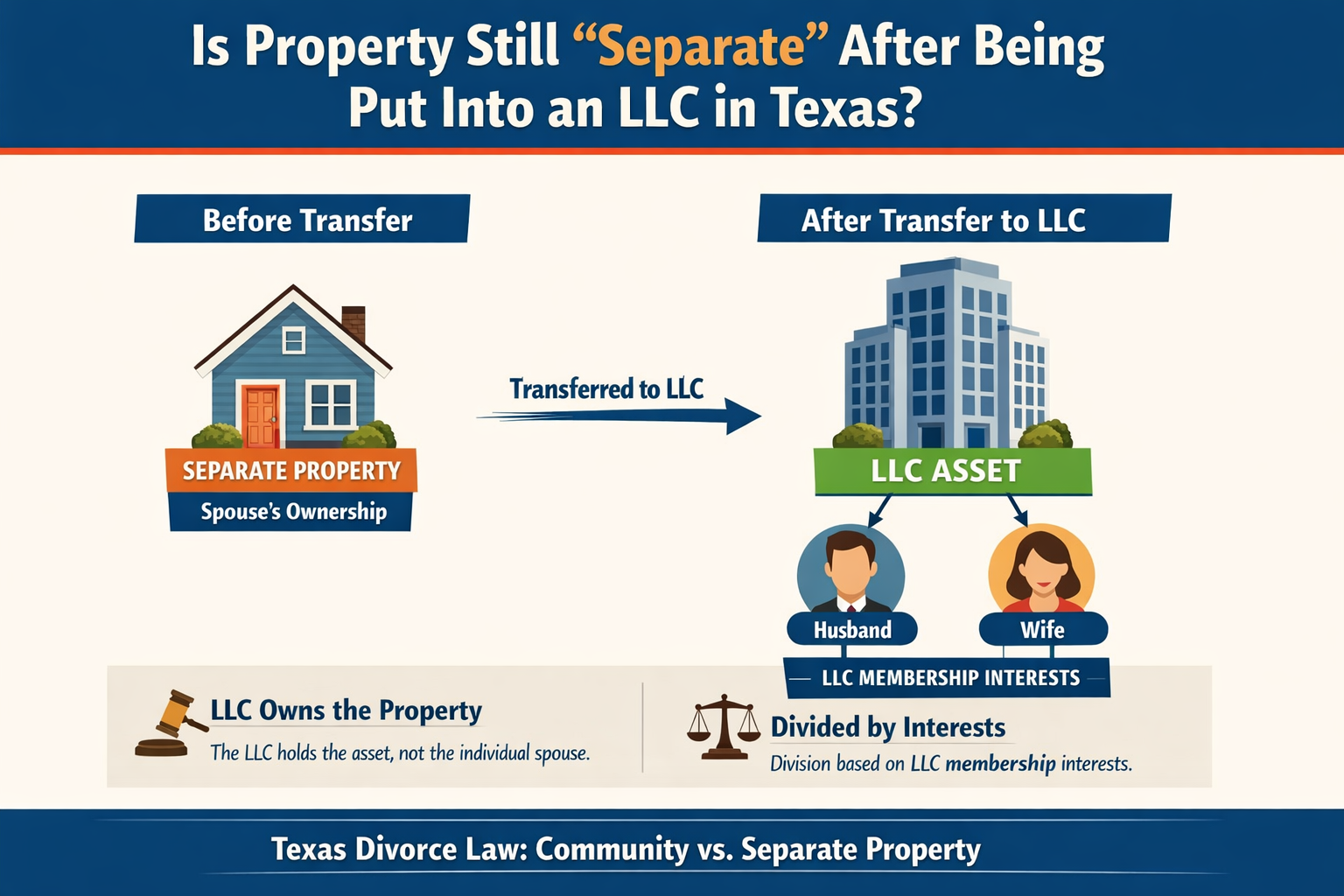
How Texas Law Treats LLC Interests in Divorce
One of the most common misconceptions in Texas divorce cases is this:
“I owned the property before marriage, so even if I transferred it into an LLC during the marriage, it’s still my separate property.”
Texas law does not work that way.
When real estate or other assets are transferred into a limited liability company (LLC), the character of the property—and what a court can divide—changes in ways many spouses do not expect.
This article explains how Texas courts analyze LLC interests, separate property claims, and community property when assets are transferred into an entity during marriage.
1. Texas Community Property Basics (The Starting Point)
Texas is a community-property state. Under the Texas Family Code:
- Community property is all property acquired during marriage other than separate property
- Separate property includes:
- Property owned or claimed before marriage
- Property acquired during marriage by gift, devise, or descent
- Recovery for personal injuries (with limited exceptions)
Authority:
Texas Family Code § 3.001; § 3.002
However, the character of property can changedepending on what the owning spouse does with it.
2. What Happens When Property Is Transferred Into an LLC?
Under Texas law, an LLC is a separate legal entity. Once property is deeded into an LLC:
- The individual spouse no longer owns the real estate
- The LLC owns the asset
- The spouse owns a membership interest, not the property itself
Texas courts have been explicit on this point.
“When property is transferred to an LLC or partnership, the contributing individual no longer owns that property—the entity does. The individual’s interest becomes an ownership interest in the entity itself.”
In re Marriage of T., No. XX-XX-XXXXX-CV (Tex. App.—Amarillo Aug. 2025) (mem. op.) (reversing property division where separate property had been transferred into an LLC).
This distinction is critical in divorce.
3. Separate Property Does Not Automatically Survive an Entity Transfer
A spouse can contribute separate property to an LLC—but doing so may extinguish the separate-property character of the asset itself.
Why?
Because Texas law does not allow a spouse to retain direct ownership of property that has been conveyed to a business entity. Once transferred:
- The real estate belongs to the LLC
- The spouse’s interest is an intangible ownership interest
- That interest must be separately characterized as separate or community
Courts therefore analyze the membership interest, not the underlying asset.
This principle is well-recognized by Texas family-law authorities and practitioners.
4. Why Timing Matters: LLCs Formed During Marriage
When an LLC is:
- Formed during marriage, and
- Capitalized during marriage,
the default presumption is that the LLC membership interests are community property, unless clearly traced and proven otherwise.
Texas law imposes a clear and convincing evidence standard on any spouse claiming separate property.
Authority:
Texas Family Code § 3.003(b)
That means:
- Deeds alone are not enough
- Operating agreements alone are not enough
- Assertions of “intent” are not enough
Tracing is required, and it must be precise.
5. Tracing Problems: The Achilles’ Heel of LLC “Shielding”
Even when separate property is used to capitalize an LLC, problems arise if:
- Community funds later pay expenses
- Mortgage payments are made during marriage
- Properties are refinanced
- Additional assets are contributed
- Income from the LLC is commingled
Texas courts are unforgiving when tracing fails.
If tracing fails, the interest is presumed community, and the court may divide it just and right under Texas Family Code § 7.001.
6. Reimbursement vs. Ownership (A Common Confusion)
A spouse who contributes separate property to an LLC may still have a reimbursement claim, even if the asset itself is no longer separate.
But reimbursement is not ownership.
- Ownership affects division
- Reimbursement affects equitable adjustment
Authority:
Texas Family Code §§ 3.402–3.409
Courts routinely distinguish between:
- Loss of separate property character, and
- Potential reimbursement claims
They are not the same remedy.
7. Practical Takeaway: LLCs Are Not Divorce-Proof
Transferring property into an LLC:
- Does not freeze separate-property character
- Does not prevent division in divorce
- Often creates more exposure, not less
In many cases, forming an LLC during marriage and transferring property into it converts a clean separate-property claim into a complex, litigated community-property dispute.
Final Thoughts
Texas courts focus on substance over labels. If property is placed into an LLC during marriage, courts will look at:
- Who owns the entity
- When it was formed
- How it was capitalized
- Whether tracing is possible
- Whether community funds enhanced the asset
Assuming an LLC automatically preserves separate property is a costly mistake.
At David C. Barsalou, Attorney at Law, PLLC, we help clients navigate business, family, tax, estate planning, and real estate matters ranging from document drafting to litigation with clarity and confidence. If you’d like guidance on your situation, schedule a consultation today. Call us at (713) 397-4678, email barsalou.law@gmail.com, or reach us through our Contact Page. We’re here to help you take the next step.