Why This Quirky Rule Quietly Wins Lawsuits in Texas
Most lawyers obsess over pleadings, discovery, and trial strategy. But one of the most quietly decisive moments in a case happens before the defendant even appears: service of process.
And when traditional service fails, Texas Rule of Civil Procedure 106 becomes one of the most powerful—and underutilized—tools in your arsenal.
The Problem: When Defendants Avoid Service
You’ve seen it before:
- The defendant won’t answer the door
- The address is valid, but no one responds
- Process servers make multiple attempts with no success
At some point, you’re burning time and money while the case stalls.
That’s where Rule 106 comes in.
The Law: What Rule 106 Actually Says
Under Texas Rule of Civil Procedure 106(a):
“Unless the citation or an order of the court otherwise directs, the citation shall be served by (1) delivering to the defendant… or (2) mailing… by registered or certified mail…”
But the real power is in Rule 106(b):
“Upon motion supported by affidavit stating the location of the defendant’s usual place of business or usual place of abode… and stating specifically the facts showing that service has been attempted… the court may authorize service…
(1) by leaving a copy… with anyone over sixteen years of age… or
(2) in any other manner that the affidavit or other evidence shows will be reasonably effective…”
Why This Rule Is More Powerful Than It Looks
1. “Any Other Manner” Is Extremely Broad
That phrase—“any other manner”—is where things get interesting.
Texas courts have approved substituted service by:
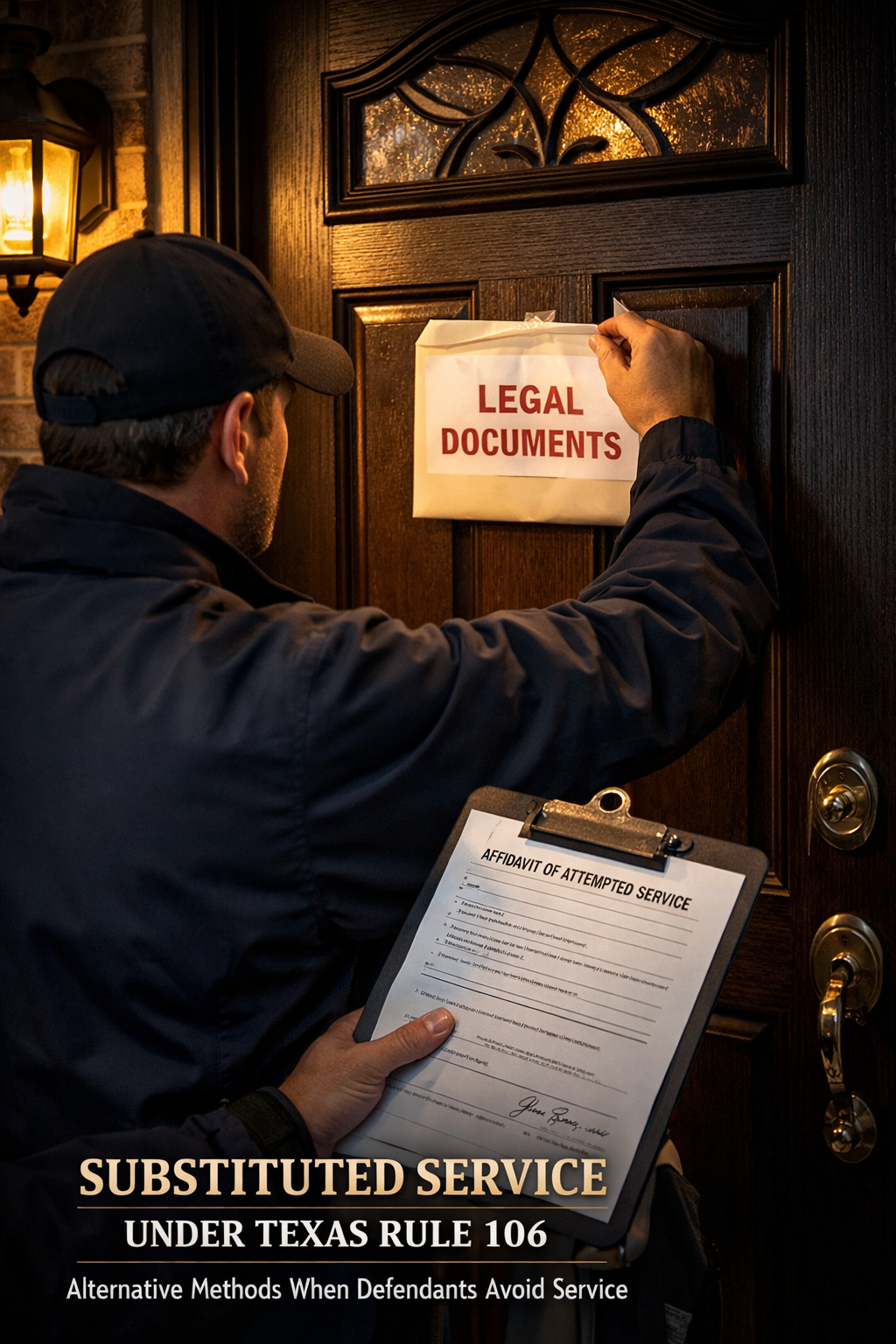
- Posting on the front door
- Social media (in rare cases)
- Delivery to a co-occupant
- Even leaving documents in a conspicuous place
If you can show it’s “reasonably effective,” courts have wide discretion.
2. It Turns Evasion into a Losing Strategy
A defendant who dodges service often thinks they’re buying time.
In reality, they may be setting themselves up for:
- Substituted service
- A valid default judgment
- Limited ability to challenge service later
Once the court approves your method, the defendant’s avoidance becomes irrelevant.
3. The Affidavit Is Everything
Rule 106(b) hinges on your affidavit.
A weak affidavit = denied motion.
A strong affidavit = green light.
Your affidavit should include:
- Exact address used
- Dates and times of attempts
- Observations (cars present, lights on, etc.)
- Confirmation it’s the defendant’s residence or business
This is where many lawyers lose the motion—they’re too vague.
Strategic Use in Real Cases
Scenario 1: The “Ghost Tenant” in an Eviction-Related Suit
A tenant disappears but still technically occupies the unit.
→ Substituted service via posting may move the case forward without delay.
Scenario 2: The Contractor Who Won’t Answer the Door
You’ve got a solid breach claim, but service is stalled.
→ After multiple attempts, you move for substituted service and proceed to default.
Scenario 3: The High-Conflict Family Law Case
A party dodges service to delay proceedings.
→ Rule 106(b) cuts through the gamesmanship and gets the case moving.
Common Pitfalls (That Can Kill Your Case)
Even though Rule 106 is powerful, mistakes can be fatal:
- ❌ Insufficient attempt history (e.g., only 1–2 tries)
- ❌ No clear link to the defendant’s address
- ❌ Generic affidavits with boilerplate language
- ❌ Failure to strictly comply with the court’s order
Remember: service defects can void a default judgment.
A Subtle but Critical Connection: Due Process
At its core, Rule 106 is about balancing:
- The plaintiff’s right to move forward
- The defendant’s right to notice
That’s why courts require the method to be:
“reasonably effective to give the defendant notice of the suit.”
If your method feels like a shortcut, it probably won’t survive scrutiny.
Why This Topic Matters (Even If It Feels “Procedural”)
This is one of those rules that:
- Doesn’t sound exciting
- Rarely gets discussed outside litigation circles
- But can decide cases outright
A properly executed Rule 106 motion can turn a stalled file into:
- A default judgment
- A fast resolution
- Or serious settlement leverage
Final Thoughts
Substituted service under Rule 106 is a perfect example of how procedural law creates real-world outcomes.
The lawyer who understands it deeply doesn’t just “serve papers”—they control the tempo of the case.
And in litigation, tempo is everything.
At David C. Barsalou, Attorney at Law, PLLC, we help clients navigate business, family, tax, estate planning, and real estate matters ranging from document drafting to litigation with clarity and confidence. If you’d like guidance on your situation, schedule a consultation today. Call us at (713) 397-4678, email barsalou.law@gmail.com, or reach us through our Contact Page. We’re here to help you take the next step.
