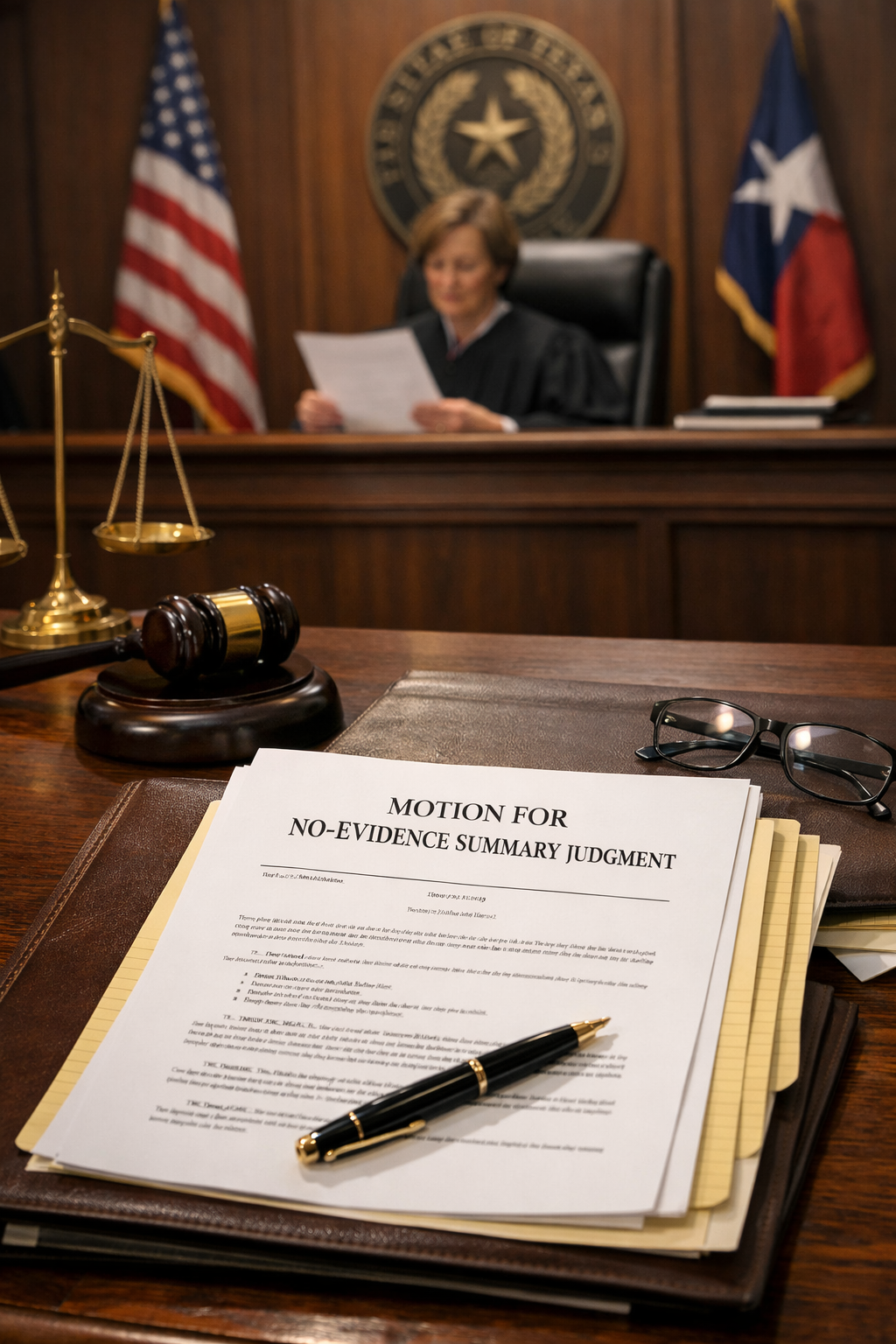
What Is a No-Evidence Motion for Summary Judgment in Texas? Rule 166a(i) Explained
A no-evidence motion for summary judgment allows a party in a Texas lawsuit to challenge a claim or defense on the ground that the opposing party has no evidence of one or more essential elements.
Under Texas Rule of Civil Procedure 166a(i), the party filing the motion generally does not have to produce summary-judgment evidence of its own. Instead, after adequate time for discovery, the motion identifies the elements for which the opposing party allegedly has no evidence. The burden then falls on the nonmovant to produce enough evidence to raise a genuine issue of material fact.
That makes Rule 166a(i) important from both sides of a Texas lawsuit. A properly drafted motion can dispose of unsupported claims or defenses before trial. A party who receives one, however, must understand exactly what has been challenged and produce competent evidence in response.
For businesses, landlords, contractors, and other Texas litigants, a no-evidence motion can therefore become one of the most consequential events in a civil case.
What Is a No-Evidence Summary Judgment?
Texas Rule of Civil Procedure 166a(i) provides, in relevant part:
“After adequate time for discovery, a party without presenting summary judgment evidence may move for summary judgment on the ground that there is no evidence of one or more essential elements of a claim or defense…”
This is fundamentally different from a traditional motion for summary judgment under Rule 166a(c).
In a traditional summary-judgment motion, the movant generally attempts to establish its entitlement to judgment through evidence. A no-evidence motion instead attacks the opposing party's evidentiary support.
In simplified terms, the argument is:
You have the burden of proof on this element. After adequate time for discovery, you have no evidence to prove it.
If the motion properly challenges an essential element and the nonmovant cannot produce sufficient evidence in response, the challenged claim or defense may be resolved without a trial.
When Can You File a No-Evidence Motion for Summary Judgment in Texas?
Rule 166a(i) permits a no-evidence motion only “after adequate time for discovery.”
There is no universal number of months that automatically constitutes adequate time in every lawsuit. Whether the parties have had adequate time for discovery can depend on circumstances such as the length of time the case has been pending, the discovery that has already occurred, applicable scheduling deadlines, and the nature and complexity of the case.
This limitation matters.
A defendant generally cannot answer a lawsuit and immediately demand that the plaintiff produce all of the evidence necessary to prove the case before the plaintiff has had a reasonable opportunity to conduct discovery.
Likewise, a party opposing a no-evidence motion should not simply assume that the motion is premature. If additional discovery is genuinely necessary to respond, the issue needs to be properly presented to the court.
What Must a Texas Rule 166a(i) Motion Say?
A no-evidence motion must specifically identify the elements for which the movant contends there is no evidence.
For example, suppose a plaintiff brings a breach-of-contract claim. Depending on the circumstances, a defendant might specifically challenge whether there is evidence that the defendant breached the agreement or whether the plaintiff suffered damages caused by the alleged breach.
A motion should not merely announce:
“The plaintiff has no evidence to support the lawsuit.”
Rule 166a(i) requires specificity. The purpose is to identify the particular evidentiary deficiencies that the nonmovant must address.
This is important to both sides. The movant needs to identify the challenged elements properly, while the nonmovant needs to read the motion carefully and respond to each element actually challenged.
How Does the Burden Shift Under Rule 166a(i)?
The burden-shifting mechanism is what makes a no-evidence motion unusual.
The movant can file the motion “without presenting summary judgment evidence.” Once a legally sufficient motion challenges an essential element on which the opposing party bears the burden of proof, attention shifts to the nonmovant's evidence.
The nonmovant must produce more than a scintilla of evidence raising a genuine issue of material fact on the challenged element.
Texas courts commonly describe more than a scintilla as evidence that would enable reasonable and fair-minded people to differ in their conclusions.
That is not necessarily an enormous evidentiary burden—but it is a real one.
The responding party cannot survive merely because the pleadings contain detailed allegations or because counsel insists that the claim has merit.
How Do You Defeat a No-Evidence Motion for Summary Judgment in Texas?
For someone who has just received a Rule 166a(i) motion, this may be the most important question.
The first step is to identify every element challenged by the motion. The response should then direct the court to competent summary-judgment evidence raising a genuine issue of material fact as to each challenged element necessary to preserve the claim or defense.
Depending on the case, summary-judgment evidence may include:
- affidavits or declarations that satisfy the applicable requirements;
- deposition testimony;
- authenticated or otherwise admissible documents;
- discovery responses and admissions; and
- other evidence that may properly be considered at the summary-judgment stage.
Simply attaching a mountain of documents and expecting the judge to locate the relevant evidence is a dangerous approach. The response should connect the evidence to the particular element it is offered to support.
Most importantly, pleadings themselves generally are not summary-judgment evidence. A factual allegation in a petition or answer does not become evidence merely because it was stated confidently or in considerable detail.
That distinction can decide the motion.
What Does “More Than a Scintilla” of Evidence Mean?
A party responding to a no-evidence motion does not ordinarily have to conclusively prove the entire case at the summary-judgment stage.
The question is whether there is more than a scintilla of evidence creating a genuine issue of material fact on the challenged element.
Evidence that does no more than create a mere surmise or suspicion may be insufficient. On the other hand, evidence that would allow reasonable and fair-minded people to reach different conclusions can be sufficient to create a fact issue for trial.
This is why the quality and relevance of the evidence matter more than the sheer number of pages attached to a response.
A hundred pages of irrelevant exhibits do not necessarily establish a fact issue. A single piece of competent evidence directly addressing the challenged element may be much more important.
What Happens If There Is No Evidence of One Essential Element?
Many civil claims consist of several required elements, and the plaintiff ordinarily must establish all of them.
Consider a breach-of-contract claim. A plaintiff may have substantial evidence that an agreement existed but no competent evidence of recoverable damages. If damages are an essential element and a no-evidence motion properly challenges that element, evidence proving the existence of the contract does not solve the problem.
Similarly, a fraud claimant might have evidence of a representation but insufficient evidence concerning reliance or damages.
This makes Rule 166a(i) particularly powerful in complicated lawsuits. The movant does not necessarily need to attack every factual dispute in the case. A properly targeted challenge to a single indispensable element can potentially dispose of an entire claim.
What Evidence Can Be Used to Respond?
The precise evidence will depend on the lawsuit, but common forms of summary-judgment evidence include deposition excerpts, affidavits or declarations, documents, admissions, and other properly presented evidence.
The response should do more than simply attach evidence.
It should explain what the evidence establishes and which challenged element it supports.
For example, if a no-evidence motion attacks damages in a contract case, the response should identify the evidence supporting damages rather than merely attaching every invoice, email, and bank statement produced during discovery and leaving the court to reconstruct the argument.
Precision matters.
Practical Uses of No-Evidence Summary Judgment
Rule 166a(i) can arise in many types of Texas civil litigation.
In a contract dispute, a party might challenge the evidence of breach, causation, or damages.
In business litigation, a no-evidence motion might target an essential element of a fraud, tortious-interference, or fiduciary-duty claim.
In real-estate or landlord-tenant litigation, the procedure may be used when a party asserts a claim or defense for which discovery has produced insufficient evidentiary support.
The procedure may also arise in certain family-law property disputes, although its usefulness and applicability depend heavily on the particular claims and procedural posture.
The common feature is the same: a party bearing the burden of proof must eventually have evidence supporting each essential element of the claim or defense.
Common Mistakes When Filing or Responding to a No-Evidence Motion
One mistake is filing too early. Rule 166a(i) expressly requires adequate time for discovery.
Another is challenging the opponent's case too vaguely. A no-evidence motion must identify the particular elements for which evidence is allegedly absent.
For the responding party, one of the most dangerous mistakes is relying on allegations rather than evidence. The fact that something appears in a petition does not ordinarily make it summary-judgment evidence.
Another mistake is failing to direct the court to the evidence that actually creates the fact issue.
Finally, deadlines matter. A party facing a summary-judgment motion should immediately determine the applicable response deadline and hearing date rather than waiting until shortly before the hearing to assemble evidence.
A Practical Example
Suppose a plaintiff sues a Texas business for breach of contract.
The plaintiff alleges that an agreement existed, the defendant breached the agreement, and the plaintiff suffered $100,000 in damages.
After adequate time for discovery, however, the plaintiff has produced evidence concerning the agreement but no competent evidence supporting the claimed damages.
The defendant could potentially file a Rule 166a(i) motion specifically challenging the damages element.
At that point, repeatedly alleging $100,000 in damages would not be enough. The plaintiff would need to direct the court to competent summary-judgment evidence raising a genuine issue of material fact concerning damages.
If the plaintiff cannot produce more than a scintilla of evidence on an essential element specifically challenged under Rule 166a(i), the court must grant summary judgment on the challenged claim or defense.
Why No-Evidence Summary Judgment Matters in Texas Litigation
A no-evidence motion can dramatically change the posture of a lawsuit.
For the movant, it can expose claims or defenses that survived the pleading stage but never developed evidentiary support during discovery.
For the nonmovant, it forces the party to identify the evidence that actually supports the case.
That can narrow the issues for trial, eliminate unsupported claims, affect settlement negotiations, and sometimes resolve substantial portions of a lawsuit altogether.
Rule 166a(i) therefore is not merely a technical procedural device. It represents an important point in Texas litigation when allegations must be supported by actual evidence.
Conclusion
A Texas no-evidence motion for summary judgment under Rule 166a(i) allows a party, after adequate time for discovery, to challenge an opposing claim or defense because there is no evidence of one or more essential elements.
The movant must identify the challenged elements with sufficient specificity. The nonmovant must then produce more than a scintilla of competent summary-judgment evidence raising a genuine issue of material fact.
For parties filing these motions, precision is essential. For parties responding to them, understanding exactly what has been challenged—and identifying the evidence that answers that challenge—can mean the difference between proceeding toward trial and losing a claim at the summary-judgment stage.
Because summary-judgment procedure can be highly technical and case-specific, parties facing a Rule 166a(i) motion should carefully evaluate the motion, the available evidence, and the applicable deadlines before responding.
At David C. Barsalou, Attorney at Law, PLLC, we help clients navigate business, family, tax, estate planning, and real estate matters ranging from document drafting to litigation with clarity and confidence. If you’d like guidance on your situation, schedule a consultation today. Call us at (713) 397-4678, email barsalou.law@gmail.com, or reach us through our Contact Page. We’re here to help you take the next step.
