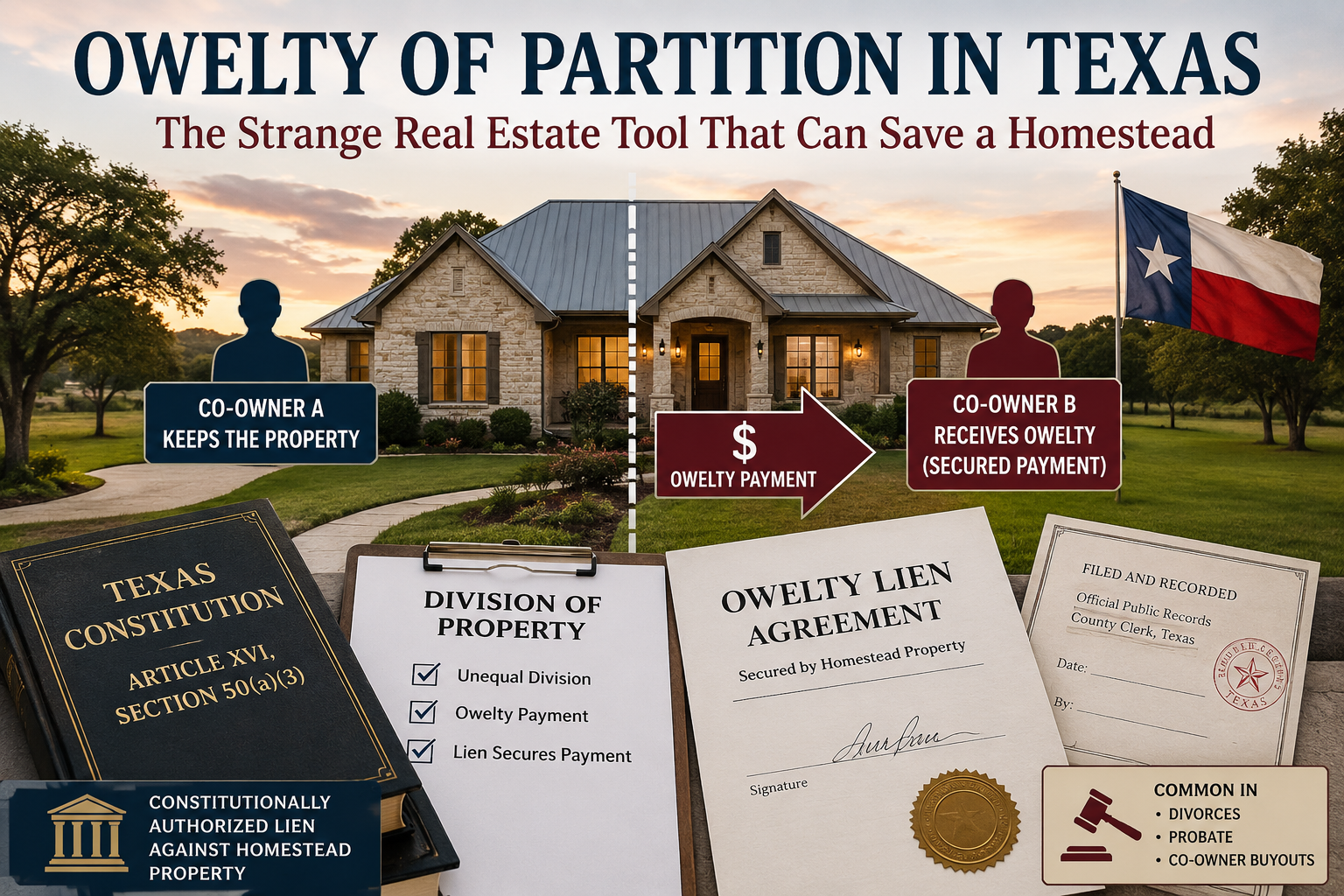
Most Texans have never heard the word owelty. In fact, many assume it is a typo.
Yet owelty of partition is one of the most unusual concepts in Texas real estate law. It allows a lien to be placed on homestead property in situations where Texas law would otherwise prohibit many liens altogether.
The doctrine frequently appears in divorces, inherited property disputes, and buyouts between co-owners. Understanding how it works can prevent expensive mistakes and help property owners structure transactions correctly.
What Is Owelty of Partition?
Owelty is money paid by one property owner to another to equalize an unequal division of property.
Imagine two siblings inherit a piece of real estate worth $400,000.
One sibling wants to keep the property. The other wants cash.
Rather than selling the property, the parties agree that:
- Sibling A receives the entire property.
- Sibling B receives $200,000.
The obligation to pay the other owner's share creates an owelty claim.
To secure payment, Texas law allows the creation of an owelty lien against the property.
The Texas Constitutional Exception
Texas homestead protections are among the strongest in the nation.
Article XVI, Section 50(a) of the Texas Constitution generally prohibits liens against a homestead except for specifically authorized categories.
One of those categories is:
"an owelty of partition imposed against the entirety of property by a court order or by a written agreement of the parties to the partition, including a debt of one spouse in favor of the other spouse resulting from a division or an award of a family homestead in a divorce proceeding."
This language is found in Texas Constitution Article XVI, Section 50(a)(3).
This provision is important because many Texans incorrectly believe that no lien can ever attach to a homestead. The reality is that Texas law recognizes several constitutional exceptions, and owelty is one of them.
Why Owelty Matters in Divorce Cases
Owelty liens frequently arise in Texas divorces.
Consider a common situation.
A married couple owns a homestead worth $500,000 with little or no mortgage debt.
The court awards the residence to Wife but determines Husband is entitled to $250,000 for his share of the equity.
Rather than forcing a sale, the divorce decree may award Wife the home and grant Husband an owelty lien securing payment of the amount owed.
This allows:
- One spouse to keep the residence;
- The children to remain in the home; and
- The other spouse to receive compensation for his or her equity interest.
Without the doctrine of owelty, many such divisions would require liquidation of the property.
Owelty and Inherited Property
The doctrine also appears in probate matters.
Suppose three heirs inherit a family ranch.
Two heirs want cash.
One heir wants to continue operating the property.
The heirs may agree to partition ownership by transferring full title to one heir while granting the others secured payment rights through an owelty arrangement.
This can preserve family property while still compensating the departing co-owners.
The Texas Property Code
Texas Property Code § 41.001 generally protects homestead property from seizure by creditors.
However, Section 41.001(b) expressly recognizes constitutional exceptions, including properly created owelty liens.
The result is that an owelty lien occupies a unique position under Texas law. Although many creditors cannot reach homestead property, a valid owelty claimant may have rights that ordinary creditors do not.
Financing and Owelty Liens
Owelty liens are commonly encountered during mortgage refinancing.
Lenders often require documentation establishing that a prior divorce or partition created a valid owelty lien.
Failure to structure the transaction correctly can create title issues, underwriting problems, and disputes regarding lien priority.
For that reason, attorneys handling divorces, probate matters, and real estate transactions frequently coordinate with title companies and lenders when an owelty lien is involved.
Common Misconceptions
Misconception #1: Owelty only exists in divorce.
False.
Although divorce cases frequently involve owelty liens, the doctrine also applies to partitions among heirs, co-owners, and other property holders.
Misconception #2: Homestead property can never be encumbered.
False.
The Texas Constitution expressly permits certain liens against homestead property, including valid owelty liens.
Misconception #3: Owelty creates ownership.
False.
Owelty does not create ownership rights in the property itself. Rather, it generally creates a secured claim arising from an unequal partition.
Practical Considerations
Before using an owelty arrangement, property owners should consider:
- Proper documentation;
- Constitutional requirements;
- Title company requirements;
- Lender underwriting standards;
- Recording requirements; and
- Enforcement procedures.
Mistakes in drafting can create significant title and collection problems years later.
Final Thoughts
Owelty of partition is one of the more unusual doctrines in Texas real estate law. Despite its unfamiliar name, it serves a practical purpose: allowing co-owners to divide property fairly without forcing a sale.
Whether arising in a divorce, probate matter, or ownership dispute, a properly structured owelty lien can preserve valuable property while ensuring that departing owners receive their equitable share.
Because Texas homestead law is highly technical and constitutional restrictions are strictly enforced, property owners should consult experienced legal counsel before creating or challenging an owelty lien.
At David C. Barsalou, Attorney at Law, PLLC, we help clients navigate business, family, tax, estate planning, and real estate matters ranging from document drafting to litigation with clarity and confidence. If you’d like guidance on your situation, schedule a consultation today. Call us at (713) 397-4678, email barsalou.law@gmail.com, or reach us through our Contact Page. We’re here to help you take the next step.