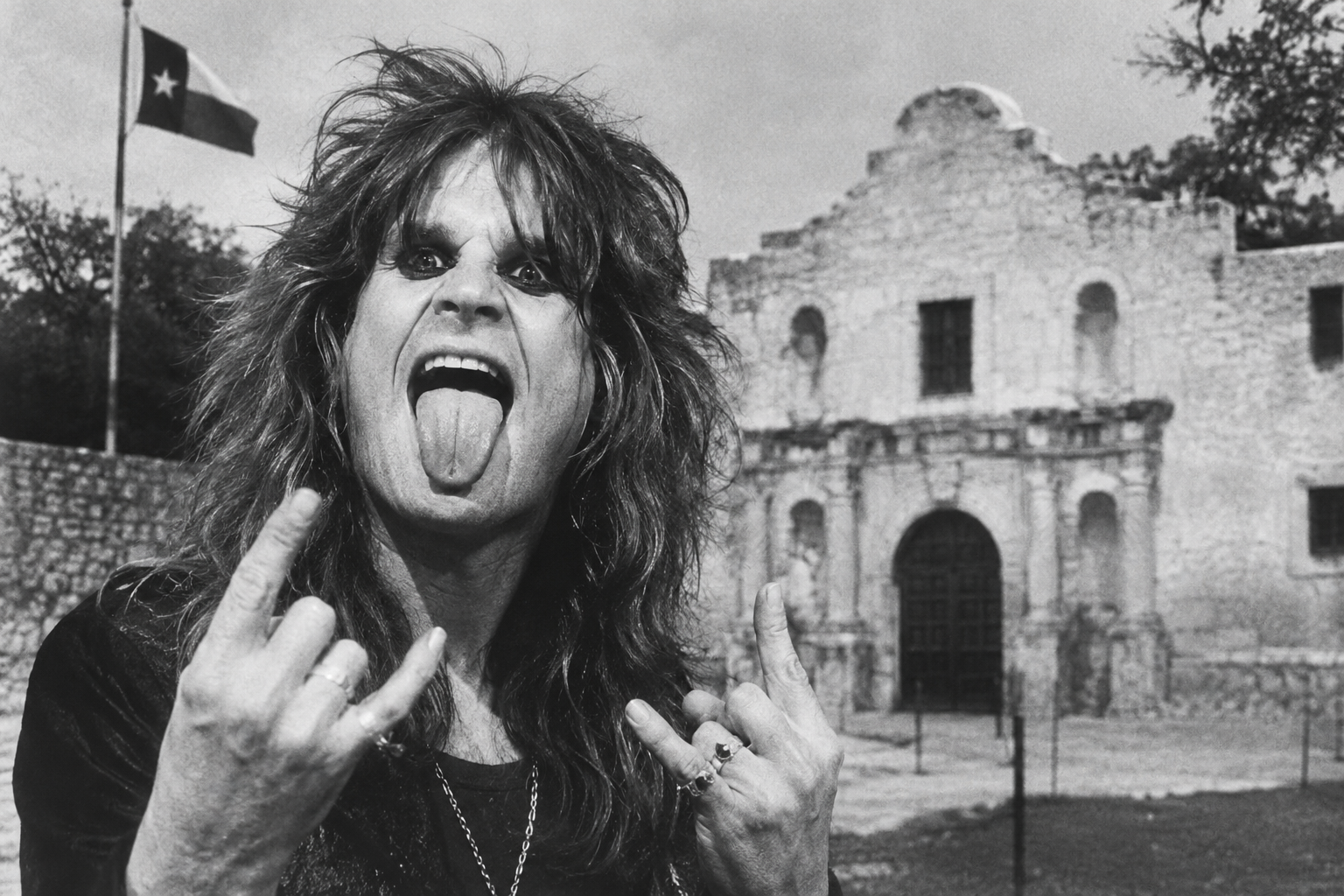
How one of rock music's most notorious incidents became an unlikely lesson in municipal authority, constitutional law, and the limits of government power in Texas.
On February 19, 1982, British heavy metal singer Ozzy Osbourne committed an act that would become one of the strangest episodes in Texas rock-and-roll history.
Intoxicated, wearing a woman's dress, and wandering through downtown San Antonio, the former Black Sabbath frontman urinated against a monument near the Alamo.
Unfortunately for Osbourne, the monument was not an ordinary wall.
It was the Alamo Cenotaph, a memorial honoring the defenders of the 1836 Battle of the Alamo.
The incident resulted in an arrest, public outrage, and an extraordinary response from San Antonio's municipal government: a prohibition against Osbourne performing in city-owned facilities.
A decade later, Osbourne returned to San Antonio, made a $10,000 charitable donation, and performed before enthusiastic audiences.
The story is frequently remembered as an example of outrageous celebrity behavior. But beneath the absurdity lies an interesting collection of legal questions.
Can a Texas city prohibit a particular entertainer from using municipal facilities? Does the First Amendment protect a musician against that kind of exclusion? And how did the distinction between city and county ownership allow Osbourne to return?
The answers reveal something important about the structure and limits of local government.
1. The 1982 Alamo Incident: A Rock Star Meets Texas History
By February 1982, Ozzy Osbourne had already established a reputation for unpredictable behavior.
His departure from Black Sabbath had not diminished his popularity, and his solo career was flourishing.
San Antonio was an important market for hard rock and heavy metal, and Osbourne was scheduled to perform at the city's HemisFair Arena.
According to contemporary newspaper accounts and subsequent historical reporting, Osbourne's manager and future wife, Sharon Arden, had attempted to prevent him from going out drinking by hiding his clothes.
Osbourne improvised.
He put on a green evening dress and ventured into downtown San Antonio.
During his excursion, he stopped near the Alamo and urinated against what he reportedly believed was an old wall.
In reality, he was at the Cenotaph, a memorial commemorating those who fought and died during the Texas Revolution.
Police arrested Osbourne for public intoxication.
He was subsequently released and performed at HemisFair Arena that evening.
The concert itself generated additional controversy. Fans unable to enter the sold-out performance damaged windows at the arena, and numerous arrests followed.
San Antonio officials were not amused.
The combination of Osbourne's conduct at the memorial and the disorder surrounding the concert helped produce a municipal response that would follow the singer for years.
2. San Antonio's Response: The City Bans Ozzy from Its Facilities
Following the incident, members of the San Antonio City Council proposed prohibiting Osbourne from performing in municipal venues.
A proposal for a 15-year ban did not initially succeed.
However, several months later, the City Council unanimously approved a prohibition against Osbourne performing in city-owned facilities.
This distinction is important.
Osbourne was not legally banished from the entire City of San Antonio.
The prohibition concerned the use of facilities owned by the municipal government, including the HemisFair Arena.
A citywide prohibition against a particular person entering San Antonio would have raised considerably different constitutional questions.
Instead, the City Council exercised what it understood to be its authority over municipal property and the activities conducted there.
That raises the first interesting legal issue: How much control does a city actually have over public facilities?
3. Can a Texas City Legally Ban Someone from Performing on City Property?
Texas municipalities possess substantial authority to manage property and facilities under their control.
For home-rule municipalities such as San Antonio, that authority derives from the Texas Constitution, applicable statutes, and the city's charter.
Article XI, Section 5 of the Texas Constitution authorizes qualifying cities to adopt home-rule charters, subject to constitutional and statutory limitations.
Texas Local Government Code § 51.072 further provides:
"The municipality has full power of local self-government."
That is a broad grant of municipal authority.
But it is not unlimited.
A city may establish reasonable rules governing the rental and operation of its facilities. It may impose safety requirements, establish rental conditions, regulate occupancy, and address legitimate concerns about public order.
However, a municipal government remains subject to constitutional protections, including the First Amendment.
A city cannot necessarily exclude an entertainer simply because elected officials dislike the entertainer's music, message, or reputation.
The constitutional analysis depends on the nature of the facility, the government's reasons for exclusion, and the manner in which the restriction operates.
Government ownership does not eliminate constitutional rights
The United States Supreme Court has repeatedly distinguished between different types of government property when evaluating restrictions on expression.
Traditional public forums, such as streets and parks, generally receive substantial First Amendment protection.
Other government properties may be subject to different rules depending on their purpose and the extent to which they have been opened for expressive activity.
A municipally operated concert arena presents a different situation from a public sidewalk.
The city may impose reasonable operating requirements and manage the facility for its intended use.
But when a government opens a venue for performances by private entertainers, excluding a particular performer because of disfavored expression may present constitutional problems.
The Supreme Court's decision in Southeastern Promotions, Ltd. v. Conrad, 420 U.S. 546 (1975), is particularly instructive.
In that case, municipal officials denied permission to present the musical Hair at a publicly controlled theater.
The Supreme Court held that the denial operated as an unconstitutional prior restraint under the circumstances presented.
The decision illustrates an important principle: Government control of a performance venue does not necessarily give public officials unlimited authority to determine which expressive performances may occur there.
Was Ozzy's prohibition unconstitutional?
Not necessarily.
The historical record establishes that San Antonio prohibited Osbourne from performing in city-owned facilities, but that fact alone does not establish whether the restriction would have survived a constitutional challenge.
The city could have argued that its decision was based on documented misconduct, public safety concerns, and the disorder associated with the 1982 concert.
Osbourne, in turn, might have argued that the restriction singled him out for disfavored treatment and burdened his ability to engage in protected expression.
The outcome would have depended on the legal grounds for the restriction, the evidence supporting it, the forum involved, and the applicable constitutional standards.
There is an important difference between regulating conduct and punishing expression.
A government may generally enforce valid laws against public intoxication, disorderly conduct, and property damage.
It cannot simply assume that disapproval of an entertainer's message is sufficient justification for suppressing a performance.
There is no need to invent a constitutional lawsuit here. The historical significance is that San Antonio's response raises precisely the kinds of questions that constitutional litigation frequently addresses.
4. The Legal Loophole: San Antonio Did Not Own Every Concert Venue
Here is where the story becomes especially interesting.
In 1992, approximately ten years after the Alamo incident, Osbourne announced his return to San Antonio.
There was one obvious complication.
The city had previously prohibited him from performing in city-owned facilities.
But San Antonio was not the only governmental entity operating major entertainment venues in the area.
Osbourne's comeback performances were scheduled at Freeman Coliseum.
Freeman Coliseum was a county-owned facility, not a city-owned facility.
That distinction made all the difference.
A prohibition adopted by the San Antonio City Council concerning city-owned facilities did not automatically extend to property controlled by Bexar County.
The city and county are separate governmental entities.
Each possesses its own legal powers, governing body, and responsibilities.
The City Council's authority over municipal property did not, simply by virtue of its earlier action, give it control over the county's entertainment facilities.
Thus, Osbourne could perform at Freeman Coliseum without necessarily violating the city's venue restriction.
He did not have to win a constitutional challenge.
He did not have to obtain a court order declaring the prohibition invalid.
He simply performed at a venue outside the prohibition's stated reach.
This was not a loophole in the sense of evading a criminal statute. It was a jurisdictional and property-ownership distinction.
And it is a useful reminder that governmental authority is limited by the legal jurisdiction and powers of the particular governmental body exercising it.
5. Why City and County Governments Are Legally Different
Texas residents sometimes speak of cities and counties as though they are interchangeable components of local government.
Legally, they are not.
A municipality and a county possess different sources of authority and different responsibilities.
Municipalities may exercise powers authorized by their charters, statutes, and the Texas Constitution.
Counties, by contrast, are political subdivisions of the state whose powers are generally limited to those expressly or impliedly authorized by law.
Texas Local Government Code § 81.032 addresses a commissioners court's authority concerning county property.
The statute provides that the commissioners court may:
"sell or lease any real property of the county"
subject to applicable legal requirements.
This is one example of the statutory framework governing county property.
The larger point is that ownership and control matter.
A city ordinance regulating municipal facilities does not automatically govern every facility physically located within city limits.
Likewise, a county's ownership of property does not make that property immune from all otherwise applicable municipal regulations.
The distinction depends on the particular governmental power being exercised.
In Osbourne's case, the relevant historical prohibition concerned his use of city-owned performance venues.
Freeman Coliseum fell outside that ownership category.
For a rock star attempting to return to San Antonio, that distinction was enormously useful.
6. The $10,000 Apology: Was Ozzy Legally Buying His Way Back?
Before his 1992 performances, Osbourne made a $10,000 donation to the Daughters of the Republic of Texas.
At the time, the organization was responsible for caring for the Alamo.
Osbourne also expressed regret over his earlier conduct.
The donation helped repair his relationship with the city and its residents.
But was the $10,000 payment legally necessary?
There is an important distinction between a legally enforceable condition and a voluntary act intended to restore goodwill.
The historical reporting does not establish that the donation was a statutory fine, a court-ordered penalty, or a legally required payment to lift the municipal prohibition.
Nor does the record establish that the donation itself formally repealed the earlier restriction.
Rather, the donation appears to have been part of a broader effort at reconciliation.
That makes the story more interesting.
Osbourne had found a venue where the city's earlier prohibition did not control, but he still had practical reasons to make peace with the community.
Legal permission and public acceptance are not always the same thing.
A performer may have the legal right to appear at a venue while still facing public opposition, reputational damage, or strained relationships with local officials.
The $10,000 donation addressed those practical concerns.
It was an act of public contrition, not an established legal mechanism for purchasing an exemption from the law.
7. Could San Antonio Have Permanently Banned Ozzy Osbourne?
This question is more complicated than it initially appears.
A municipality may impose reasonable restrictions concerning the use of its property, particularly when legitimate safety or operational concerns exist.
However, an indefinite, individualized exclusion from a government-controlled performance venue could invite constitutional scrutiny.
The legal analysis would likely consider whether the restriction was reasonable in light of the facility's purpose, whether it was based on protected expression, and whether the government applied its policies in a viewpoint-neutral manner.
The fact that someone engaged in misconduct does not necessarily authorize the government to impose every conceivable future restriction on that person's expressive activities.
Nor does the First Amendment automatically guarantee an entertainer the right to use a particular government-owned venue.
Both principles matter.
In Osbourne's case, the city's prohibition was directed at his ability to perform in municipal facilities rather than his general ability to enter San Antonio.
That narrower scope was significant.
Even so, the duration and individualized nature of the prohibition would have been relevant considerations in any serious constitutional challenge.
There is no need to assume that a court would necessarily have struck down the city's action.
The more useful observation is that municipal ownership creates regulatory authority, but constitutional law places limits on how that authority may be exercised.
8. The Prohibition's Curious Afterlife: Ozzy Eventually Played City-Owned Venues
The story did not end with the 1992 Freeman Coliseum performances.
In January 1996, Osbourne performed at the Alamodome, a city-owned venue.
He later returned for additional performances associated with Ozzfest and Black Sabbath.
That development is particularly interesting because the earlier prohibition had concerned city-owned facilities.
What happened?
The historical accounts establish that Osbourne eventually performed at city-owned venues, but they do not conclusively establish the precise legal mechanism by which the earlier restriction ceased to prevent those appearances.
The original prohibition may have been formally rescinded, superseded, or otherwise no longer enforced.
Without reviewing the relevant municipal records, it would be inappropriate to claim that a particular legal action occurred.
However, the practical result is clear.
The restriction that had once prevented Osbourne from performing in municipal facilities no longer kept him off San Antonio's city-owned stages.
His relationship with the city had changed substantially.
This illustrates another important distinction in public law: The continued existence of a governmental enactment, its enforceability, and its actual application are separate questions.
A historical prohibition does not necessarily tell us what legal restrictions remain operative decades later.
9. Can a City Punish Someone Twice for the Same Misconduct?
One tempting way to characterize the controversy is to suggest that Osbourne was punished twice: once through his arrest and again through the municipal performance prohibition.
But that description requires legal care.
The Double Jeopardy Clause of the Fifth Amendment generally protects against multiple criminal prosecutions or punishments for the same offense.
It does not automatically prohibit every adverse governmental consequence that follows criminal misconduct.
For example, a person convicted of an offense might also face professional licensing consequences, contractual termination, or restrictions on the use of particular facilities.
Those consequences are not necessarily additional criminal punishments.
A municipal venue restriction might be characterized as an administrative or proprietary decision rather than a criminal penalty.
Whether a particular measure is genuinely regulatory or punitive depends on its legal characteristics and purpose.
Thus, the more substantial constitutional questions surrounding Osbourne's exclusion would likely have concerned freedom of expression, governmental authority, and the permissible use of public facilities.
The mere existence of both an arrest and a venue restriction would not establish a double jeopardy violation.
10. What Does Ozzy Osbourne's Alamo Incident Teach Us About Texas Law?
At first glance, this episode seems to have little to do with serious legal analysis.
It involves an intoxicated musician, an evening dress, a historic monument, and a municipal government understandably irritated by the resulting publicity.
But several important legal principles emerge.
First, municipal authority is not unlimited. A Texas city possesses significant powers over its facilities, but those powers remain subject to constitutional and statutory restrictions.
Second, governmental ownership matters. The distinction between city-owned and county-owned property can determine whether a particular governmental restriction applies.
Third, freedom of expression complicates governmental decisions about public venues. A municipality may regulate legitimate safety concerns without necessarily possessing unrestricted authority to exclude disfavored performers.
Fourth, legal remedies and public reconciliation are different things. Osbourne's $10,000 donation helped restore goodwill, but the available historical record does not establish that it was a legally required payment to eliminate the prohibition.
Finally, the practical consequences of governmental action may change over time. A restriction that once prevented a performer from appearing at city-owned facilities may eventually cease to operate, whether through formal legal action, changed policy, or other developments.
These principles extend far beyond the entertainment industry.
They arise in disputes involving public facilities, municipal contracts, licensing, government property, and constitutional rights.
Conclusion: The Prince of Darkness Discovers the Limits of Municipal Government
Ozzy Osbourne's 1982 encounter with the Alamo Cenotaph was unquestionably an extraordinary moment in Texas entertainment history.
It resulted in an arrest, substantial controversy, and a prohibition against performing in San Antonio's city-owned venues.
Yet the prohibition contained a limitation that ultimately mattered more than its dramatic origins.
San Antonio did not own every concert venue in Bexar County.
When Osbourne returned in 1992, he performed at a county-owned facility, made a $10,000 donation to the organization then caring for the Alamo, and began repairing his relationship with the city.
Within a few more years, he was performing at city-owned venues as well.
The story demonstrates how the seemingly technical distinctions between governmental entities can have very real consequences.
It also demonstrates that legal restrictions and public forgiveness do not necessarily operate on the same timetable.
In the end, the Prince of Darkness did not need to defeat the City of San Antonio in court to make his comeback. He simply needed to find a venue the city did not own.
And for once, the most interesting thing about an Ozzy Osbourne story was not what the singer did.
It was what the law allowed him to do afterward.
Understanding Your Rights Under Texas Law
Legal disputes involving governmental authority, contracts, property rights, and constitutional limitations can present complicated questions.
David C. Barsalou, Attorney at Law, PLLC, represents clients in civil litigation, contractual disputes, real estate matters, and other legal controversies throughout the Houston area and Texas.
Whether a dispute involves private parties or governmental action, understanding the source and limits of legal authority is often an important first step.
Visit barsalou-law.com to learn more about the firm's services or request a consultation.
Disclaimer: This article is provided for general informational and educational purposes only. It does not constitute legal advice, and the discussion of historical events should not be understood as a legal determination concerning the validity of any particular municipal action.
Legal Authorities and Historical Sources
Legal authorities
- Texas Constitution, Article XI, § 5 — Home-Rule Municipalities.
- Texas Local Government Code § 51.072 — Home-Rule Municipal Authority.
- Texas Local Government Code § 81.032 — County Property.
- U.S. Constitution, First Amendment.
- U.S. Constitution, Fifth Amendment.
- Southeastern Promotions, Ltd. v. Conrad, 420 U.S. 546 (1975).
- Perry Education Ass'n v. Perry Local Educators' Ass'n, 460 U.S. 37 (1983).
Historical sources
- San Antonio Express-News archival reporting concerning the February 19, 1982 incident and the 1992 return.
- Texas State University, Center for Texas Music History, Journal of Texas Music History, Volume 22, discussion of Ozzy Osbourne and San Antonio's heavy metal history.
- San Antonio Express-News, retrospective reporting on Osbourne's 1992 and 1996 performances.
At David C. Barsalou, Attorney at Law, PLLC, we help clients navigate business, family, tax, estate planning, and real estate matters ranging from document drafting to litigation with clarity and confidence. If you’d like guidance on your situation, schedule a consultation today. Call us at (713) 397-4678, email barsalou.law@gmail.com, or reach us through our Contact Page. We’re here to help you take the next step.