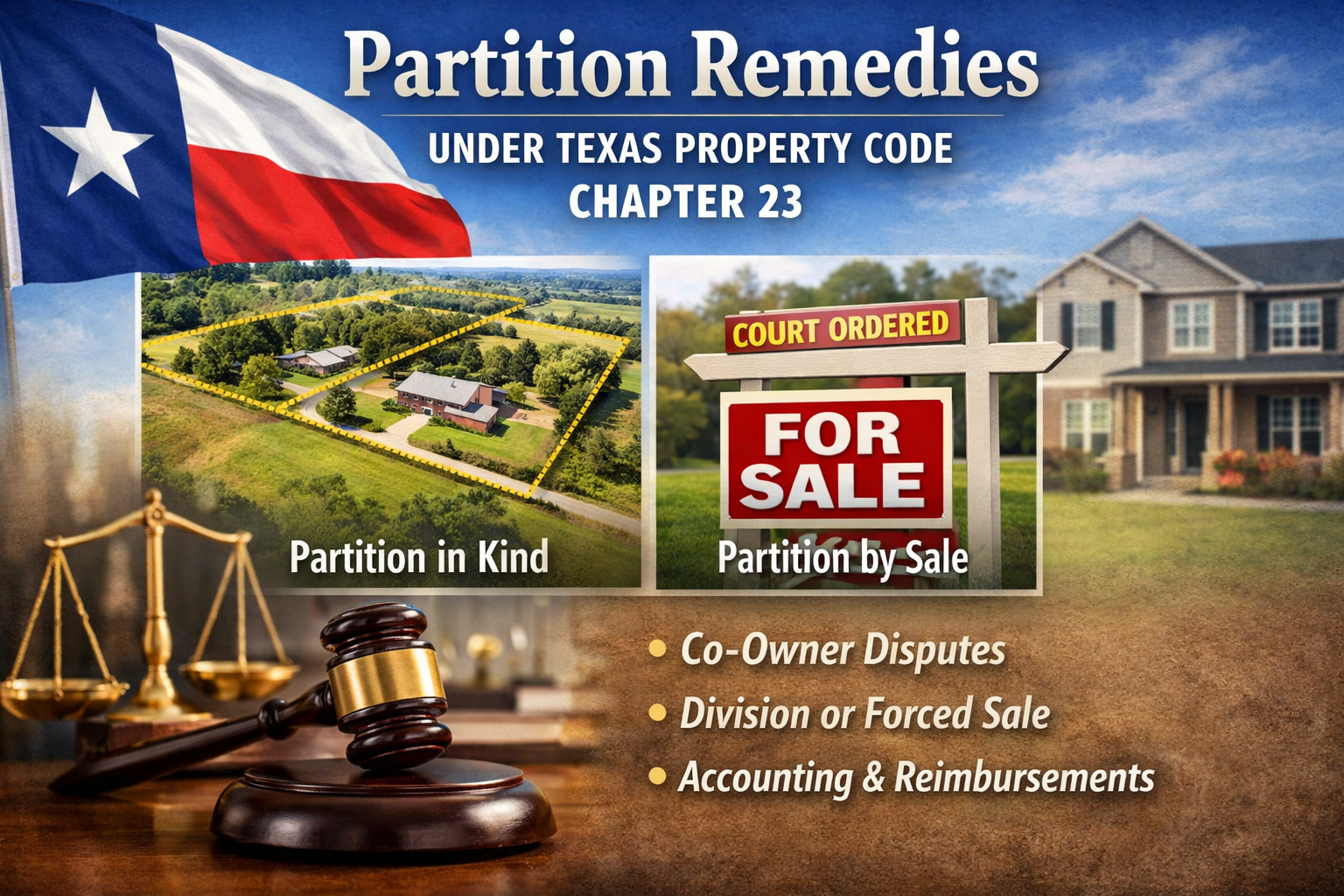
Partition Remedies Under Chapter 23 of the Texas Property Code
What Happens When Co-Owners Can’t Agree?
Texas real estate ownership often involves more than one person—family members inheriting property, business partners investing together, or former spouses who never fully separated their interests. When co-owners cannot agree on what to do with property, Texas law provides a solution: partition.
Chapter 23 of the Texas Property Code governs partition remedies, which allow a court to divide or sell jointly owned property when agreement is no longer possible. While partition actions can sound simple, they are often legally and emotionally complex—and the remedy imposed can permanently change ownership rights.
What Is a Partition Action?
A partition is a legal process that allows a co-owner of real property to force a division of the property or its value. In Texas, any co-owner with a present possessory interest generally has the right to seek partition, even if the other owners object.
Partition actions most commonly arise in:
- Inherited family property
- Joint investments or partnerships
- Divorce or post-divorce property disputes
- Co-owned land where one party wants to sell and another does not
Two Primary Types of Partition Under Texas Law
Chapter 23 recognizes two core partition remedies:
1. Partition in Kind (Physical Division)
A partition in kind divides the property itself into separate tracts, giving each owner a portion of the land.
This is the preferred remedy under Texas law, but only when it is:
- Fair
- Equitable
- Practical
For example, rural acreage may be divisible, while a single-family residence usually is not.
Courts will consider:
- Whether the land can be divided without materially impairing its value
- Whether each owner can receive a roughly equivalent share
- Whether division would unfairly prejudice any owner
If partition in kind is feasible, the court must generally order it.
2. Partition by Sale
If the court determines that a partition in kind is not fair or practicable, it may order a partition by sale.
In a partition by sale:
- The property is sold (often under court supervision)
- Sale proceeds are divided among the owners according to their ownership interests
This remedy is common when:
- The property is a single structure (like a house or commercial building)
- Division would substantially reduce the property’s value
- Co-owners’ interests are too entangled to separate fairly
Partition by sale is often the most contentious outcome, especially in family or inherited property disputes.
Accounting, Reimbursements, and Offsets
Partition cases are not just about dividing land—they often involve money.
Texas courts may conduct an accounting to address:
- Mortgage payments made by one co-owner
- Property taxes and insurance
- Necessary repairs and maintenance
- Rental income received by one owner
- Waste or damage to the property
The court can award reimbursements or offsets so that the final division reflects each party’s true financial contributions and benefits.
Attorney’s Fees and Costs
Under Chapter 23, courts have discretion to award:
- Attorney’s fees
- Appraisal costs
- Survey costs
- Receiver or sale expenses
These costs are often paid from the sale proceeds or apportioned among the owners, depending on fairness and the circumstances of the case.
Partition vs. Agreement: Why Litigation Is Often a Last Resort
While partition actions are a powerful remedy, they are rarely efficient or inexpensive. Litigation can:
- Destroy family relationships
- Force unwanted sales
- Reduce overall value due to legal and transaction costs
In many cases, negotiated buyouts, agreed sales, or restructuring ownership through agreements can achieve better outcomes than court-ordered partition.
Final Thoughts
Chapter 23 of the Texas Property Code provides essential tools when co-ownership becomes unworkable—but partition is not merely a mechanical process. The remedy chosen can permanently affect ownership, finances, and relationships.
If you are considering a partition action—or defending against one—it is critical to understand:
- Your ownership rights
- The likely remedy a court will impose
- The financial consequences of each option
Early legal guidance can often prevent a bad situation from becoming an irreversible one.
At David C. Barsalou, Attorney at Law, PLLC, we help clients navigate business, family, tax, estate planning, and real estate matters ranging from document drafting to litigation with clarity and confidence. If you’d like guidance on your situation, schedule a consultation today. Call us at (713) 397-4678, email barsalou.law@gmail.com, or reach us through our Contact Page. We’re here to help you take the next step.