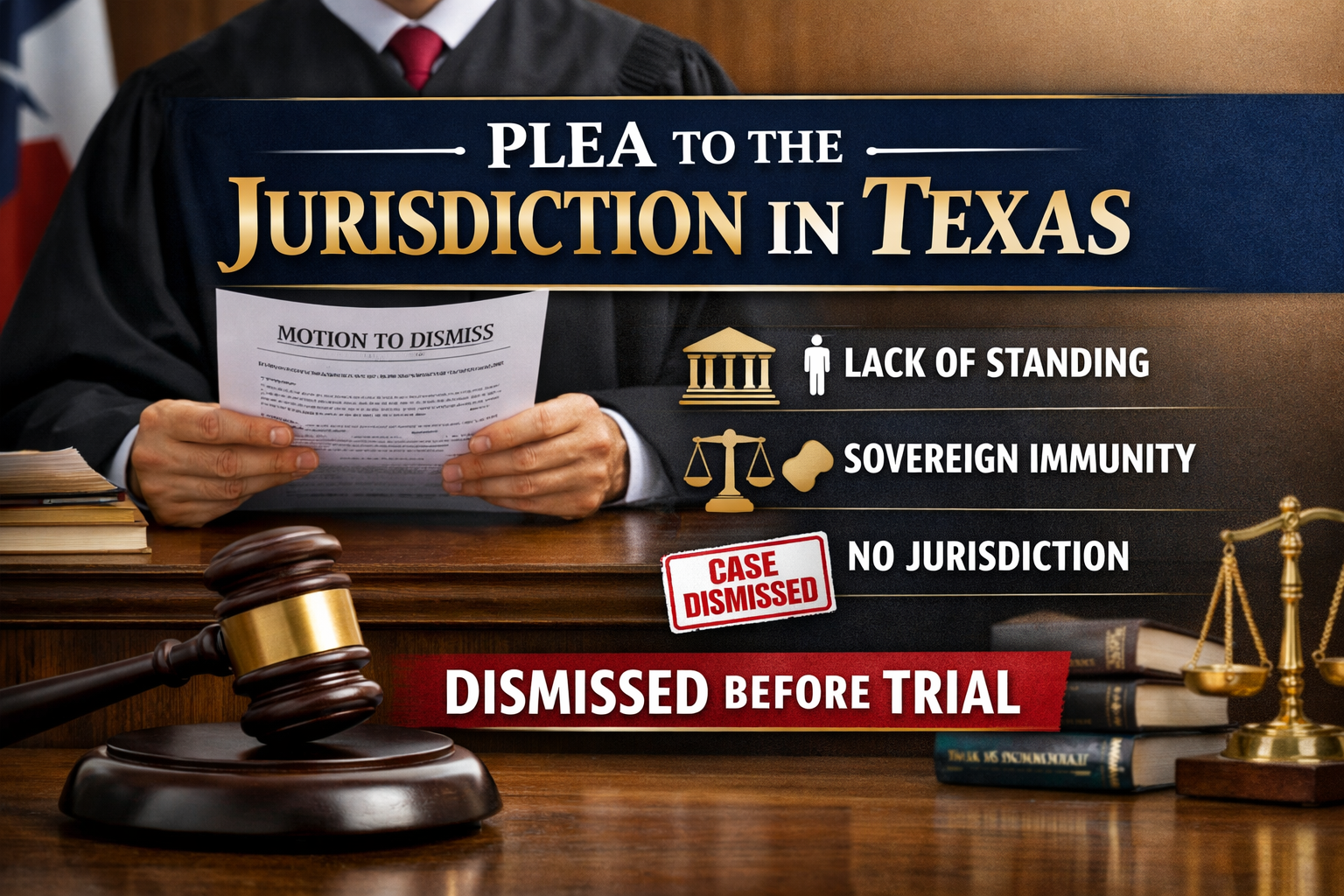
In Texas litigation, one of the most powerful—and often misunderstood—procedural tools is the plea to the jurisdiction. Unlike motions attacking the merits of a claim, a plea to the jurisdiction challenges whether the court has the authority to hear the case at all.
If successful, it ends the lawsuit before discovery, trial, or even meaningful litigation begins.
What Is a Plea to the Jurisdiction?
A plea to the jurisdiction is a procedural vehicle used to challenge a court’s subject-matter jurisdiction—that is, whether the court has the legal power to decide the dispute.
Texas courts are courts of limited jurisdiction, meaning:
“A court must have subject matter jurisdiction to decide a case.”
This principle is rooted in the structure of Texas courts under the Texas Constitution and statutory law.
Statutory Foundation: Sovereign Immunity and Jurisdiction
Many pleas to the jurisdiction arise in cases involving governmental entities. The key statutory anchor is:
Texas Government Code § 311.034
“Statutory prerequisites to a suit, including the provision of notice, are jurisdictional requirements in all suits against a governmental entity.”
This provision is critical. It means:
- If a plaintiff fails to comply with statutory requirements (like notice provisions),
- The court lacks jurisdiction, and
- The case must be dismissed.
Common Grounds for a Plea to the Jurisdiction
A plea to the jurisdiction is not a “catch-all.” It targets specific defects:
1. Sovereign or Governmental Immunity
If immunity has not been waived, the court has no jurisdiction.
Example:
- Claims against a city without complying with notice statutes (e.g., Tort Claims Act notice).
2. Lack of Standing
Standing requires a concrete injury.
Without it:
- The plaintiff has no right to bring the case,
- And the court lacks jurisdiction.
3. Ripeness
A dispute must be real and immediate—not hypothetical.
Courts will dismiss cases that:
- Depend on future events, or
- Are not yet fully developed.
4. Mootness
If the controversy no longer exists, the case must be dismissed.
5. Failure to Meet Statutory Prerequisites
Under Texas law, these are often jurisdictional.
For example:
- Notice requirements
- Administrative exhaustion
- Filing deadlines tied to statutory rights
Procedure: How a Plea to the Jurisdiction Works
A plea to the jurisdiction can challenge:
(A) The Pleadings
- The court looks only at the plaintiff’s petition.
- If the pleadings affirmatively negate jurisdiction → dismissal.
(B) The Evidence
- If jurisdictional facts are disputed, courts may consider evidence.
- This makes the plea function similarly to a summary judgment in practice.
Key Distinction: Jurisdiction vs. Merits
One of the most important distinctions:
- Jurisdiction = power to hear the case
- Merits = whether the plaintiff wins
A plea to the jurisdiction does not resolve liability—only whether the case belongs in court at all.
That said, in practice, the line can blur—especially when jurisdictional facts overlap with merits.
Burden of Proof
- The plaintiff bears the burden to affirmatively demonstrate jurisdiction.
- If challenged, the plaintiff must produce evidence supporting jurisdictional facts.
Why This Matters Strategically
From a litigation standpoint, a plea to the jurisdiction is:
- A cost-saving tool (ends cases early)
- A pressure mechanism (forces plaintiffs to prove foundational elements)
- A shield for governmental entities
For plaintiffs, it’s a reminder:
If jurisdiction is defective, no amount of merit will save the case.
Practical Example
Imagine a plaintiff sues a Texas city for negligence but:
- Fails to provide statutory notice, and
- Files suit anyway.
Under Texas Government Code § 311.034, the notice requirement is jurisdictional.
Result:
- The city files a plea to the jurisdiction,
- The court dismisses the case,
- The claim never reaches discovery.
Final Thoughts
The plea to the jurisdiction is one of the most efficient ways to dispose of a case in Texas litigation. It forces courts to answer a fundamental question:
Should this case even be here?
If the answer is no, the case ends—immediately.
At David C. Barsalou, Attorney at Law, PLLC, we help clients navigate business, family, tax, estate planning, and real estate matters ranging from document drafting to litigation with clarity and confidence. If you’d like guidance on your situation, schedule a consultation today. Call us at (713) 397-4678, email barsalou.law@gmail.com, or reach us through our Contact Page. We’re here to help you take the next step.