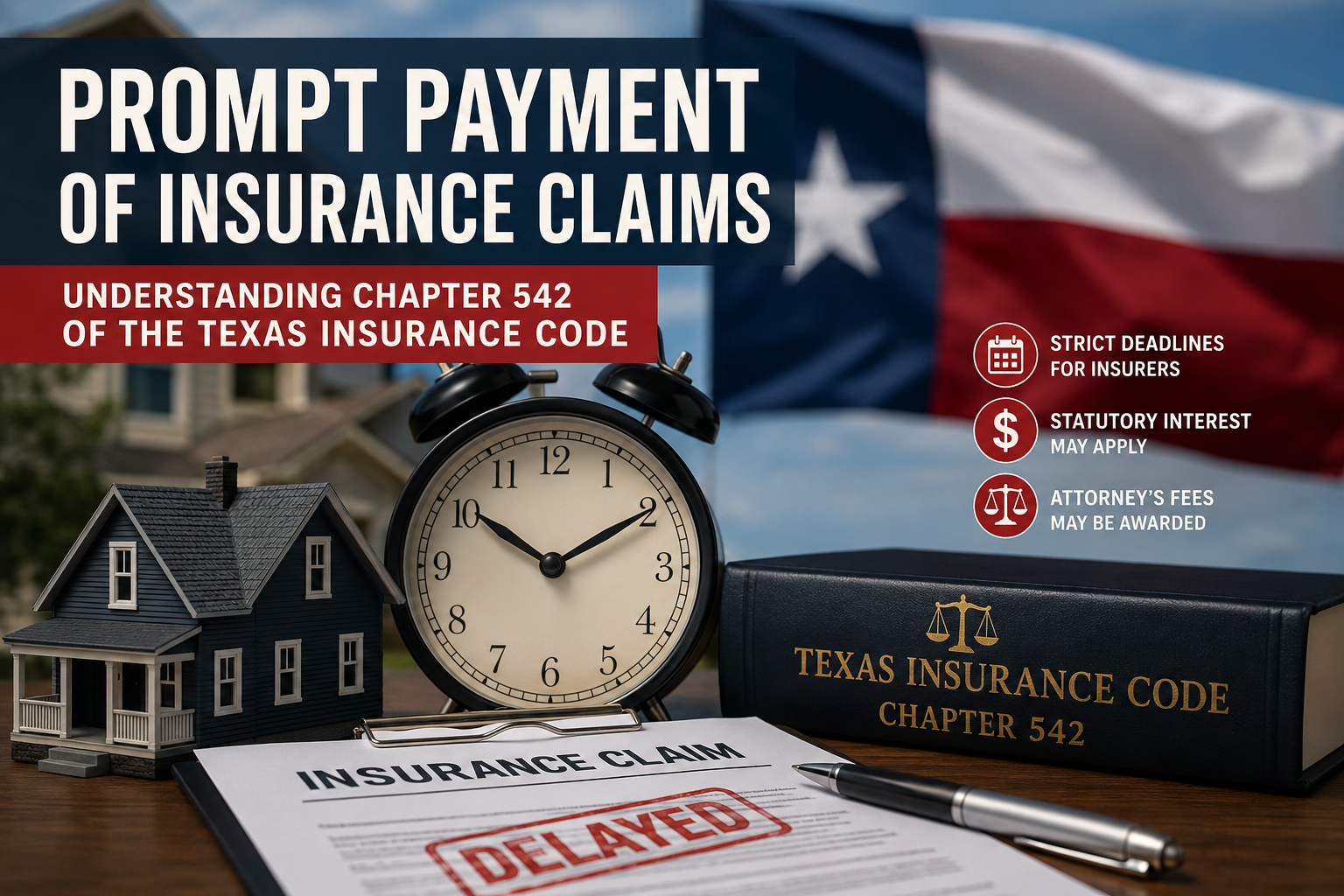
When an insurance company delays paying a legitimate claim, the dispute is often about much more than the amount of the loss. Texas has enacted one of the country's strongest prompt-payment statutes, imposing strict deadlines on insurers and significant financial consequences when those deadlines are violated.
For homeowners, businesses, commercial property owners, and anyone involved in an insurance dispute, understanding Chapter 542 of the Texas Insurance Code is essential.
What Is the Texas Prompt Payment of Claims Act?
The Texas Prompt Payment of Claims Act establishes mandatory deadlines for insurers when handling first-party insurance claims.
The purpose of the statute is straightforward:
- encourage prompt investigations;
- require insurers to communicate with policyholders;
- prevent unnecessary delay tactics; and
- compensate insureds when insurers improperly withhold payment.
Unlike a simple breach of contract claim, Chapter 542 creates statutory obligations that exist independently of the insurance policy itself.
The Insurer Must Acknowledge the Claim
One of the first statutory duties appears in Texas Insurance Code § 542.055, which provides:
"Not later than the 15th day... after receipt of notice of a claim, an insurer shall:
(1) acknowledge receipt of the claim;
(2) commence any investigation of the claim; and
(3) request from the claimant all items, statements, and forms that the insurer reasonably believes... will be required."
This provision prevents insurers from simply ignoring a claim while weeks or months pass.
The statute requires an affirmative response and investigation.
The Insurance Company Must Accept or Reject the Claim
After receiving the requested information, the insurer generally must decide whether to accept or reject the claim.
Section 542.056 states in part:
"Except as provided by Section 542.058, an insurer shall notify a claimant in writing of the acceptance or rejection of a claim not later than the 15th business day after the insurer receives all items, statements, and forms required by the insurer."
If additional time is genuinely necessary, the statute permits limited extensions under specific circumstances.
Payment Must Follow Promptly
Accepting a claim is only part of the process.
Under Texas Insurance Code § 542.057, payment generally must be made within a specified period after the insurer notifies the claimant that the claim will be paid.
In other words:
- investigate promptly;
- make a timely decision; and
- issue payment without unnecessary delay.
The statute regulates the entire claims-handling timeline—not merely the final payment.
What Happens if the Insurance Company Waits Too Long?
One of the most powerful provisions appears in Texas Insurance Code § 542.060.
If an insurer violates the Prompt Payment Act, it may become liable for:
- statutory interest on the amount of the claim; and
- reasonable attorney's fees.
These statutory damages can become substantial, particularly in large commercial property claims or disputes involving significant repair costs.
Importantly, these remedies may exist even when there is no evidence that the insurer acted maliciously or in bad faith. The focus is whether the statutory deadlines were violated.
This Is Different from Insurance Bad Faith
Many people confuse prompt-payment claims with bad-faith claims.
They are related but distinct.
A traditional insurance bad-faith claim generally involves allegations that an insurer acted unreasonably, failed to conduct a proper investigation, or denied coverage without a reasonable basis.
A Prompt Payment Act claim, by contrast, focuses primarily on statutory deadlines.
An insurer could ultimately owe the claim but still violate Chapter 542 by delaying payment beyond the deadlines established by the Legislature.
Which Insurance Claims Does Chapter 542 Affect?
The statute frequently arises in cases involving:
- residential property insurance
- commercial property losses
- storm damage claims
- fire losses
- water damage claims
- business interruption claims
- certain casualty insurance disputes
Whether Chapter 542 applies depends upon the type of insurance policy involved and the facts of the claim.
Common Litigation Issues
Prompt-payment lawsuits often involve questions such as:
- When did the insurer receive notice?
- What information was reasonably requested?
- When did the insurer receive all required documentation?
- Was the delay justified?
- Did the insurer issue partial payments?
- When did payment actually become overdue?
These issues frequently require careful review of emails, claim files, adjuster communications, inspection reports, and payment histories.
Why Documentation Matters
Policyholders should keep copies of:
- claim notices;
- photographs;
- repair estimates;
- correspondence;
- adjuster communications;
- invoices;
- proof of loss submissions; and
- every payment received.
Because Chapter 542 imposes statutory deadlines, the dates on which communications occur often become critical evidence.
Final Thoughts
Texas has chosen to regulate not only whether insurance companies pay valid claims, but also how quickly they do so. Chapter 542 of the Texas Insurance Code reflects the Legislature's determination that unnecessary delay can itself cause significant financial harm to insureds.
Whether you are a homeowner, landlord, commercial property owner, or business, understanding these statutory deadlines can make a significant difference if an insurance claim becomes disputed. If you believe an insurer has delayed investigating, deciding, or paying a claim, consulting an attorney familiar with Texas insurance litigation may help you evaluate whether the Prompt Payment of Claims Act provides additional remedies beyond a standard breach of contract claim.
At David C. Barsalou, Attorney at Law, PLLC, we help clients navigate business, family, tax, estate planning, and real estate matters ranging from document drafting to litigation with clarity and confidence. If you’d like guidance on your situation, schedule a consultation today. Call us at (713) 397-4678, email barsalou.law@gmail.com, or reach us through our Contact Page. We’re here to help you take the next step.