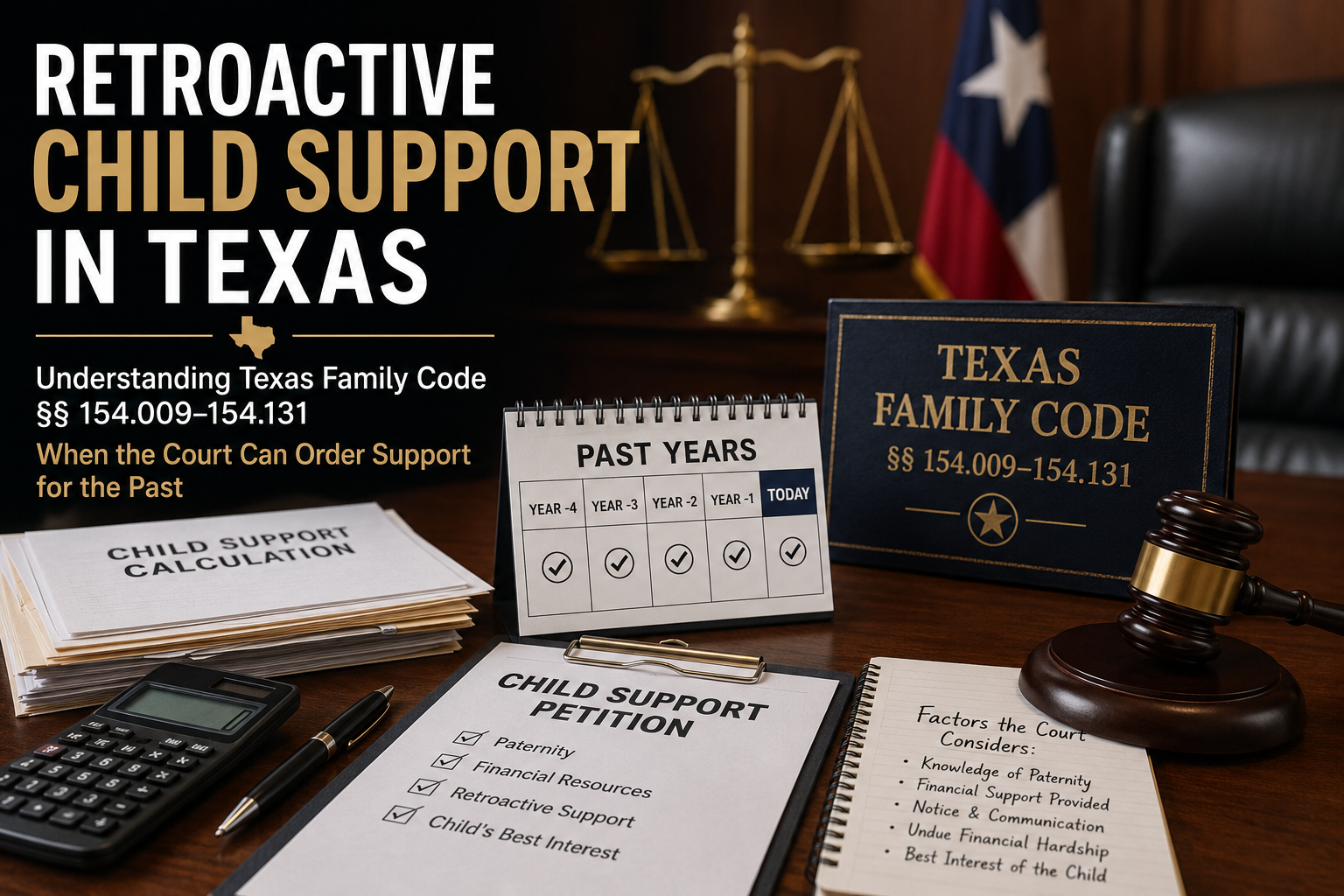
Most people think child support begins when a court signs an order. In many cases, that is true. However, Texas law also permits courts to order retroactive child support, requiring a parent to pay support for a period before the support order was entered.
Retroactive child support often arises in paternity suits, delayed divorce proceedings, or cases where one parent has been raising a child without financial assistance from the other parent. Although Texas courts have broad discretion, that discretion is guided by several important provisions of the Texas Family Code.
Understanding how these rules work can help parents realistically evaluate potential financial exposure before litigation begins.
What Is Retroactive Child Support?
Retroactive child support is support ordered for a time period before the court signs a current child support order.
Unlike ordinary child support, which pays for future expenses, retroactive support compensates for a parent's past failure to contribute to the child's financial needs.
Retroactive support is not automatic. Instead, the court evaluates the facts of each case under the Texas Family Code.
The Texas Family Code
Texas Family Code § 154.009 provides:
"The court may order a parent to pay retroactive child support if the parent was not previously ordered to pay support for the child."
The statute gives courts discretion rather than imposing a mandatory obligation.
The Four-Year Presumption
One of the most important provisions appears in Texas Family Code § 154.131.
The statute creates a rebuttable presumption that limiting retroactive child support to the preceding four years is reasonable and in the child's best interest.
The Family Code provides in relevant part:
"It is presumed that a court order limiting the amount of retroactive child support to the amount that would have been due for the four years preceding the date of the filing of the petition seeking support is reasonable and in the best interest of the child."
This does not mean retroactive support is always limited to four years.
Instead, the statute establishes a starting point that can be overcome with appropriate evidence.
When Can a Court Award More Than Four Years?
Texas Family Code § 154.131 further explains that the four-year presumption may be rebutted.
A court may award support for a longer period if the evidence shows, among other things, that:
- the obligor knew or should have known that they were the child's parent, and
- sought to avoid establishing a support obligation.
These cases frequently arise when a parent intentionally avoids legal proceedings, conceals their whereabouts, or otherwise delays the establishment of paternity or support.
Factors the Court Considers
Texas Family Code § 154.131 also directs courts to consider several equitable factors when determining retroactive support.
These include:
- whether the mother or another person attempted to notify the father of his possible paternity;
- whether the father knew or should have known of his possible paternity;
- whether the father voluntarily provided actual financial support before the lawsuit; and
- whether ordering retroactive support would impose an undue financial hardship.
These considerations recognize that every family situation is different.
For example, a parent who genuinely had no knowledge of the child's existence may be treated differently than one who knowingly avoided responsibility for years.
How Is Retroactive Child Support Calculated?
Texas courts generally begin by applying the same child support guidelines that would have been applicable during the relevant period.
Depending on the circumstances, the court may examine:
- historical earnings;
- employment records;
- tax returns;
- W-2s;
- 1099s;
- business records;
- unemployment periods;
- other evidence of earning capacity.
If reliable income records are unavailable, courts may rely upon other competent evidence to estimate historical resources.
Because retroactive support often covers multiple years, reconstructing income can become one of the most heavily litigated aspects of the case.
Can Voluntary Payments Count?
Yes.
Parents sometimes provide informal assistance before any court order exists.
Examples include:
- paying rent;
- purchasing clothing;
- buying groceries;
- paying medical expenses;
- paying daycare expenses; or
- making direct cash payments.
Evidence of these voluntary contributions may affect the amount of retroactive support ultimately ordered.
Good documentation can therefore become extremely important.
Interest and Collection
Once reduced to judgment, unpaid child support—including retroactive child support—may be subject to the various enforcement remedies available under the Texas Family Code.
Depending upon the circumstances, enforcement may include:
- income withholding;
- liens;
- contempt proceedings;
- license suspension; and
- other statutory collection remedies.
Because child support judgments receive significant protection under Texas law, delaying payment can substantially increase the overall financial consequences.
Practical Considerations
Parents should avoid assuming that waiting to file eliminates prior financial obligations.
Likewise, individuals who believe they may be a child's parent should understand that ignoring the issue rarely improves their legal position.
For parents seeking support, preserving financial records, communications, and evidence of past expenses may significantly strengthen a claim for retroactive support.
For parents defending such claims, maintaining employment records, tax returns, and documentation of voluntary payments may be equally important.
Conclusion
Retroactive child support reflects Texas's policy that parents share responsibility for supporting their children, even when a formal court order is entered years later. Although Texas law generally presumes that four years of retroactive support is reasonable, courts retain discretion to award more—or less—depending on the specific facts of each case.
If you are involved in a paternity case, divorce, or suit affecting the parent-child relationship involving retroactive child support, obtaining knowledgeable legal advice early can make a substantial difference in both the evidence presented and the ultimate financial outcome.
Disclaimer: This article is provided for general educational purposes only and does not constitute legal advice. Every case is different. If you have questions regarding retroactive child support under Texas law, consult a qualified Texas family law attorney.
At David C. Barsalou, Attorney at Law, PLLC, we help clients navigate business, family, tax, estate planning, and real estate matters ranging from document drafting to litigation with clarity and confidence. If you’d like guidance on your situation, schedule a consultation today. Call us at (713) 397-4678, email barsalou.law@gmail.com, or reach us through our Contact Page. We’re here to help you take the next step.