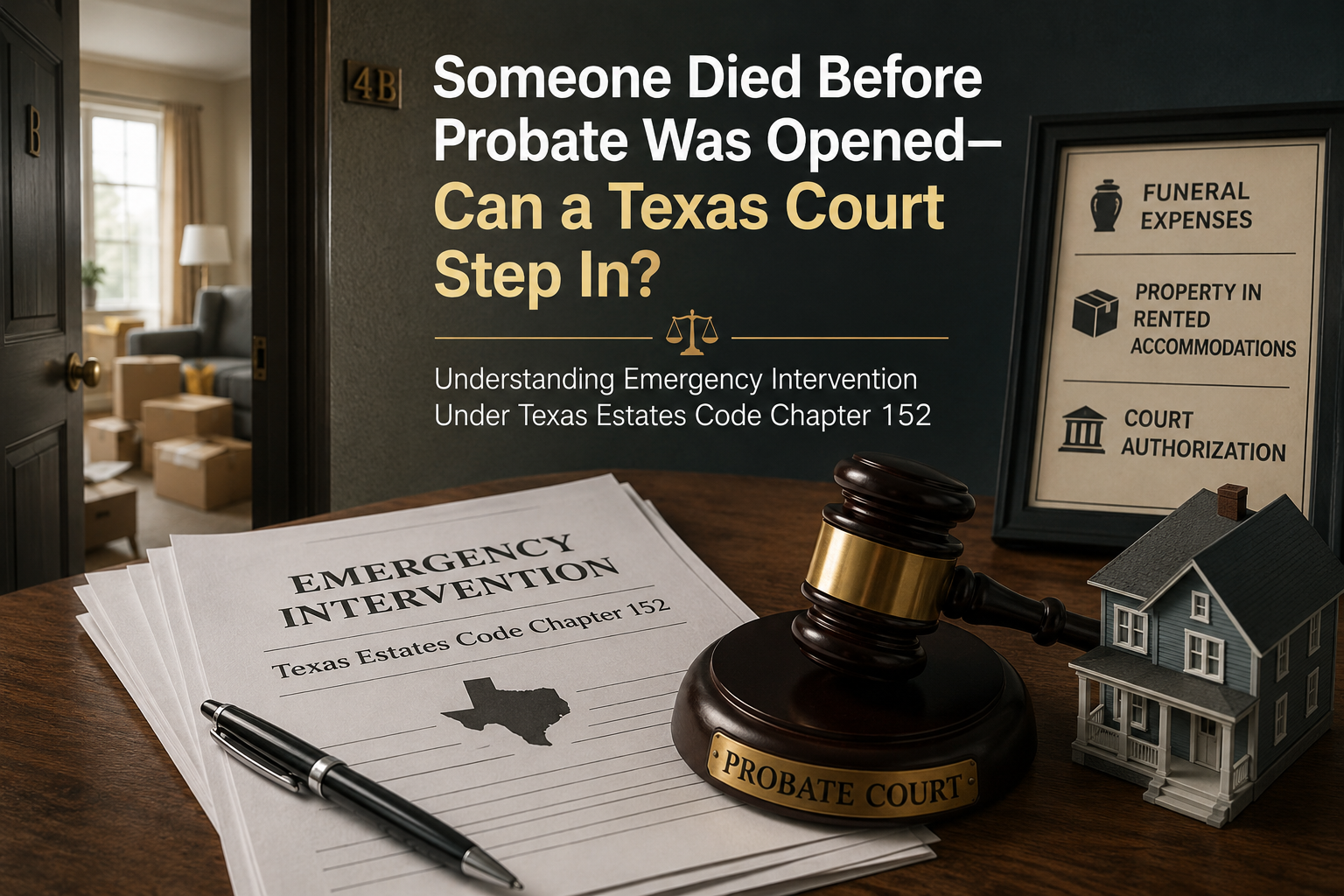
Death does not always occur on a convenient legal timetable.
A person may die with money sitting in a bank account but no one yet authorized to access it. Funeral expenses may need to be paid immediately. Personal belongings may remain inside a rented apartment while a landlord understandably refuses to give a relative unrestricted access. Meanwhile, opening a formal probate administration takes time.
Texas law provides an unusual solution for certain situations like these.
Texas Estates Code Chapter 152 allows a probate court to order an "emergency intervention" before an ordinary estate administration has been opened.
The procedure is narrow. It is not a substitute for probate and does not make the applicant a general-purpose executor. But when its requirements are satisfied, it can provide a surprisingly practical bridge between a person's death and the formal administration of the estate.
What Is an Emergency Intervention in Texas Probate?
Texas Estates Code § 152.001 authorizes certain persons who are qualified to serve as administrators to ask a court exercising probate jurisdiction for emergency intervention.
The statute identifies two specific purposes:
"(1) the payment or reimbursement of the decedent's funeral and burial expenses; or
(2) the protection and storage of personal property owned by the decedent" that was located in rented accommodations when the decedent died.
In other words, Chapter 152 addresses two problems that cannot necessarily wait for the normal probate process:
- Who is going to pay for the funeral?
- What happens to the deceased person's belongings sitting in a rented home, apartment, or other accommodation?
That second problem can be more serious than it initially sounds.
A family member may know that the decedent's apartment contains family photographs, jewelry, important documents, electronics, medications, financial records, or other valuable property. But the family member does not automatically become an executor merely because a relative died.
The landlord, meanwhile, has legal obligations of his or her own.
Chapter 152 creates a court-supervised mechanism for dealing with that gap.
Emergency Intervention Is Available Only in Limited Circumstances
A person cannot simply use Chapter 152 whenever emergency intervention seems easier than probate.
Under Texas Estates Code § 152.001(b), the procedure is available only if certain probate applications or affidavits have not already been filed and are not pending and the applicant needs either to obtain funds for funeral and burial expenses or to gain access to rented accommodations containing the decedent's property after access has been denied.
That makes emergency intervention fundamentally temporary.
The idea is not:
"Let's administer the estate without probate."
It is closer to:
"Something needs to happen now, but nobody has yet been formally appointed to handle the estate."
What Must the Application Say?
Texas Estates Code § 152.002 requires the emergency intervention application to be sworn.
Among other information, the application must state:
- the applicant's name, address, and interest;
- facts demonstrating an immediate need for an emergency intervention order;
- the decedent's date and place of death and residential address;
- information concerning the funeral home; and
- the names of known or ascertainable heirs and devisees.
Additional information is required depending upon the relief requested.
For funeral expenses, for example, the applicant generally must explain why known or ascertainable heirs and devisees cannot be contacted or have refused to assist with burial. The applicant must also provide information concerning the necessary funeral procedures and their costs, as well as information about funds belonging or owed to the decedent that may be available.
For property located in rented accommodations, the applicant must provide information concerning the property, the person possessing it, and the owner or manager of the accommodations.
The Cremation Provision Is Particularly Unusual
One of Chapter 152's quirkiest provisions appears in Texas Estates Code § 152.003.
When emergency intervention is sought to obtain money for funeral and burial expenses, the application must address any written instructions left by the decedent concerning the preferred type and manner of funeral or burial.
The statute then provides:
"If written instructions do not exist, the applicant may not permit or have permitted the decedent's remains to be cremated unless the applicant obtains or obtained the court's permission to cremate the remains."
That does not mean every Texas cremation requires a probate judge's permission.
The provision applies in the specific context of an applicant seeking emergency intervention under Chapter 152 for funeral and burial expenses.
But within that unusual proceeding, the Legislature expressly made the disposition of the decedent's remains part of the court's concern.
It is a good example of why probate law can become extremely practical extremely quickly. Questions about bank accounts, funeral arrangements, family authority, property rights, and the physical disposition of remains can all collide within days of a person's death.
Can the Court Order a Bank to Release Money for the Funeral?
Potentially, yes.
If the court determines that emergency intervention is necessary, Texas Estates Code § 152.051 authorizes the court to order funds belonging to the decedent and held by an individual, employer, or financial institution to be paid directly to the funeral home or, when applicable, the applicant.
But the statute tightly limits the permitted uses.
The money may be ordered for reasonable and necessary attorney's fees, court costs, and funeral and burial expenses.
Most notably, § 152.051 limits the funeral and burial component to:
"funeral and burial expenses not to exceed $5,000"
as ordered by the court to provide or reimburse a "reasonable, dignified, and appropriate funeral and burial."
The existence of money in the decedent's bank account therefore does not necessarily mean a relative can simply withdraw it after death. Chapter 152 instead gives the court a limited mechanism for directing appropriate funds toward immediate expenses.
What If the Problem Is Property Inside an Apartment?
This may be the most practically interesting part of the statute.
Suppose a person dies while renting an apartment. No executor has qualified. A relative asks the apartment manager for the deceased tenant's possessions, but the manager refuses access.
Texas Estates Code § 152.052 allows a probate court, when the statutory requirements are met, to order that the owner or agent of the rented accommodations grant the applicant access at a reasonable time and in the presence of the owner or agent.
The court can also require the applicant and the owner or agent to jointly prepare and file a general list of the property found there.
The statute further allows the court to authorize removal and storage of the property until it can be claimed by the decedent's heirs.
That structure protects both sides.
The family obtains a lawful method of preserving the deceased person's belongings, while the landlord receives a court order identifying what the applicant is actually authorized to do.
Does an Emergency Intervention Make You the Executor?
No.
That is one of the most important limitations of Chapter 152.
Texas Estates Code § 152.052 expressly contemplates that the applicant has only the powers specifically stated in the order that are necessary to protect the property involved.
The applicant does not suddenly acquire authority to sell the decedent's house, distribute the estate, settle every debt, rewrite beneficiary designations, or otherwise act as though letters testamentary or letters of administration had been issued.
Emergency intervention is targeted relief.
How Long Does an Emergency Intervention Order Last?
It is deliberately short-lived.
Texas Estates Code § 152.053 provides that the applicant's authority expires on the earlier of:
- the 90th day after the order is issued, or
- the date a personal representative of the estate qualifies.
That reinforces the central purpose of the law.
Chapter 152 fills a temporary vacuum. Once an executor or administrator has formally qualified, the ordinary probate system takes over.
There Is Also a Filing Window
Texas Estates Code § 152.004 imposes another unusual limitation.
An emergency intervention application must generally be filed in the appropriate county:
"not earlier than the third day after the date of the decedent's death and not later than nine months after the date of the decedent's death."
So even a legal procedure called an emergencyintervention cannot ordinarily be filed immediately on the day of death.
The Legislature has created a specific window for this particular form of relief.
Chapter 152 Contains an Even Stranger Family Dispute Provision
Chapter 152 does not stop with funeral expenses and apartment property.
Subchapter C permits an executor or a decedent's next of kin to seek an order limiting a surviving spouse's right to control burial or cremation when the surviving spouse is alleged to have been a principal or accomplice in a willful act that resulted in the decedent's death.
Under Texas Estates Code § 152.102, if the court finds good cause to believe the allegation, it may limit the surviving spouse's right of control and designate someone else to make burial or cremation arrangements.
That is an extreme situation, but it illustrates an important principle: marriage ordinarily carries substantial legal rights after death, yet Texas law does not treat every one of those rights as absolute regardless of circumstances.
Why Does Texas Have an Emergency Probate Procedure?
Because ordinary life does not wait for letters testamentary.
Rent continues to accrue. Apartments contain property. Funeral homes need instructions. Burial expenses must be paid. Banks generally cannot hand a deceased customer's money to whichever relative appears at the counter. Landlords cannot safely decide complicated inheritance questions themselves.
At the same time, granting someone unrestricted access to a dead person's money or possessions merely because the person claims to be family would create obvious opportunities for abuse.
Chapter 152 attempts to solve that problem through a narrow judicial order.
The applicant must establish the need for intervention. The court controls the relief. The applicant receives only limited authority. And that authority ends when formal estate administration begins or the statutory period expires.
Emergency Intervention Is Not the Same as Opening Probate
Families sometimes assume that every problem following a death requires a full probate administration.
Other families make the opposite mistake and assume that being the spouse, child, parent, or sibling automatically gives them authority to deal with everything the decedent owned.
Neither assumption is necessarily correct.
Texas law contains numerous procedures designed for particular circumstances, including small estate affidavits, muniment of title, affidavits of heirship, independent administration, dependent administration, temporary administration, and emergency intervention.
The appropriate procedure depends heavily on the assets involved, whether a valid will exists, the identity of the heirs or beneficiaries, outstanding debts, real estate ownership, and what actually needs to be accomplished.
The Bottom Line
Texas Estates Code Chapter 152 provides a little-known emergency procedure for the awkward period after someone dies but before an estate representative has authority to act.
In qualifying circumstances, a Texas probate court can authorize limited access to a deceased tenant's rented accommodations, protect and store personal property, and direct certain funds toward funeral and burial expenses.
The statute can even require court permission for cremation in the specific circumstances governed by the emergency-intervention procedure.
It is a remarkably specific piece of Texas probate law—but that specificity reflects a very real problem. Death can immediately create legal questions that cannot wait weeks or months for ordinary estate administration.
When that happens, Texas law sometimes provides something between "do nothing" and "open a full probate estate."
Chapter 152 is one of those unusual tools.
This article is for general informational purposes only and does not constitute legal advice. Probate rights and procedures depend on the particular facts of each estate.
At David C. Barsalou, Attorney at Law, PLLC, we help clients navigate business, family, tax, estate planning, and real estate matters ranging from document drafting to litigation with clarity and confidence. If you’d like guidance on your situation, schedule a consultation today. Call us at (713) 397-4678, email barsalou.law@gmail.com, or reach us through our Contact Page. We’re here to help you take the next step.