Most property owners assume that if an easement is not written in the deed, it does not exist. In many situations that is true—but Texas law recognizes several types of easements that arise without an express written agreement.
One of the least understood is the easement implied from prior use. Unlike an easement by necessity, this doctrine focuses on how property was actually used before it was divided. The result can surprise both buyers and sellers.
If you own Texas real estate—or are purchasing property with shared driveways, utility lines, or access roads—this doctrine deserves attention.
What Is an Easement Implied from Prior Use?
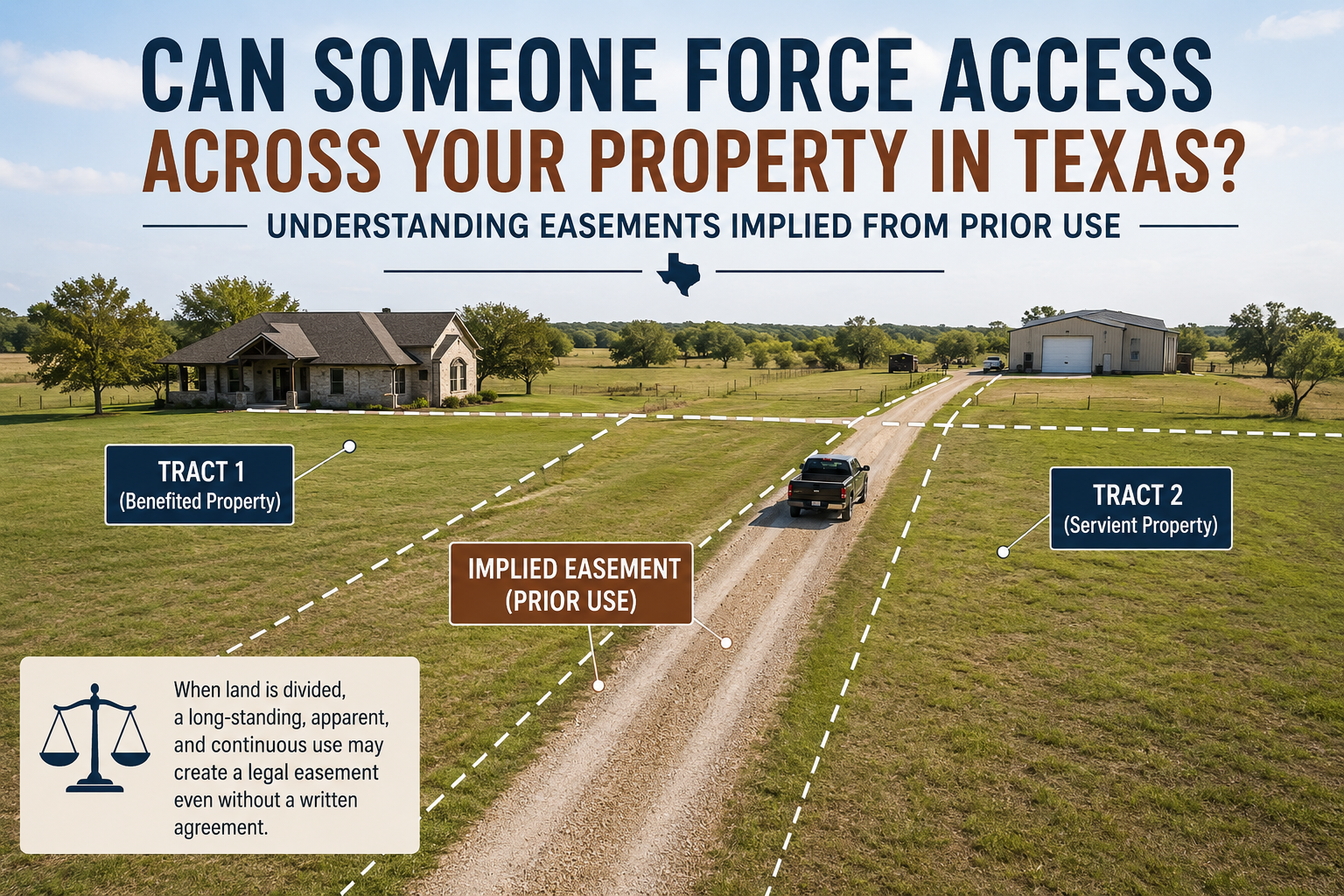
An easement implied from prior use arises when land was once owned by a single owner, who used one part of the property to benefit another part before dividing the land.
After the property is split into separate parcels, the law may continue recognizing that prior use as a legal easement even though no written easement appears in the deed.
Texas courts generally require proof that:
- The two parcels were once under common ownership.
- The use existed before the property was divided.
- The use was apparent or reasonably discoverable.
- The use was continuous.
- The easement is reasonably necessary for the enjoyment of the property.
This differs from an easement by necessity, which generally requires strict necessity rather than an established historical use.
Why Does This Matter?
Imagine a ranch owner builds one driveway serving two future tracts.
Years later, the ranch is divided and sold.
Neither deed mentions the driveway.
If both parties expected the driveway to continue serving both tracts—and the historical use satisfies Texas law—the owner of one tract may still possess legal rights to continue using it.
Likewise, buried utility lines, drainage systems, irrigation infrastructure, or private roads can all create disputes involving implied easements.
The Texas Property Code and Conveyances
Texas law generally requires conveyances of interests in land to satisfy the Statute of Frauds.
Texas Business and Commerce Code § 26.01(b)(4)provides that a promise or agreement involving:
"a contract for the sale of real estate"
must generally be in writing to be enforceable.
Likewise, Texas Property Code § 5.021 provides:
"A conveyance of an estate of inheritance, a freehold, or an estate for more than one year, in land and tenements, must be in writing and must be subscribed and delivered by the conveyor or by the conveyor's agent authorized in writing."
Despite these requirements, Texas courts recognize certain easements that arise by operation of law, including implied easements under appropriate circumstances.
Common Examples
Implied easements often involve:
- Shared driveways
- Water wells
- Septic system access
- Utility lines
- Irrigation systems
- Farm roads
- Drainage channels
- Boat ramps
- Private bridges
These situations commonly appear decades after property is subdivided, when new owners discover that neighboring property depends upon infrastructure crossing their land.
Can a Buyer Discover This Before Closing?
Sometimes.
A title commitment may identify recorded easements.
However, implied easements frequently are not recordedbecause they arise from historical facts rather than written documents.
Buyers should carefully inspect property for:
- Existing roads
- Visible utility facilities
- Shared fences
- Drainage improvements
- Well equipment
- Pipelines
- Long-standing patterns of use
These visible conditions may indicate that another property owner claims legal rights even if no easement appears in the deed.
Can Property Owners Prevent These Disputes?
Yes.
The best practice is to document access rights before property is subdivided.
Property owners should consider:
- Recording express easements
- Updating surveys
- Clarifying utility ownership
- Allocating maintenance responsibilities
- Defining termination rights
- Recording access agreements
Proper documentation is almost always less expensive than litigating implied property rights years later.
Litigation Can Be Fact Intensive
Unlike many property disputes, implied easement cases often depend less upon a single document and more upon historical evidence.
Courts may examine:
- Old aerial photographs
- Prior surveys
- Utility records
- Construction history
- Witness testimony
- Historical use patterns
- Deeds from earlier owners
Because every property has its own history, these cases frequently involve substantial factual investigation.
Final Thoughts
An easement implied from prior use demonstrates that Texas property rights do not always begin and end with the words contained in a deed. Historical use of land can sometimes create continuing legal rights that survive subdivision and subsequent sales.
Whether you are purchasing property, selling land, or involved in a dispute over access, utilities, or shared improvements, understanding implied easements may help prevent expensive surprises.
If you are facing a property dispute involving easements, boundary issues, or real estate litigation, consulting with an experienced Texas real estate attorney early can often help identify available legal options before the conflict escalates.
At David C. Barsalou, Attorney at Law, PLLC, we help clients navigate business, family, tax, estate planning, and real estate matters ranging from document drafting to litigation with clarity and confidence. If you’d like guidance on your situation, schedule a consultation today. Call us at (713) 397-4678, email barsalou.law@gmail.com, or reach us through our Contact Page. We’re here to help you take the next step.
