Introduction
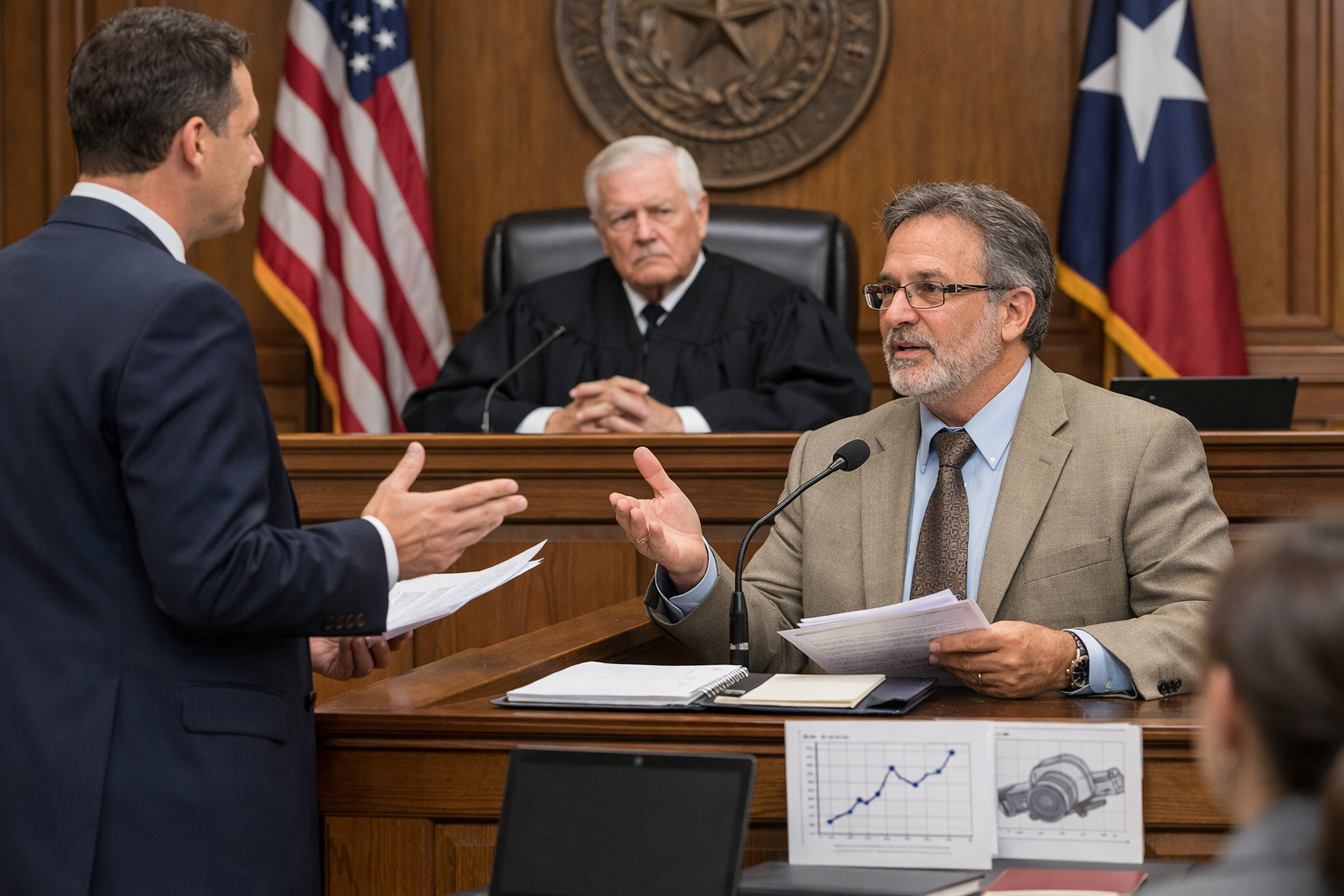
Expert witnesses can make or break a case. In Texas litigation—especially in construction disputes, business litigation, and family matters involving valuations—expert testimony often becomes the centerpiece of trial strategy.
But what happens when the opposing party’s expert is unreliable, undisclosed, or procedurally defective?
Texas law provides multiple avenues to strike or exclude expert testimony, and knowing how to use them can decisively shift a case before trial even begins.
1. The Legal Framework for Expert Testimony in Texas
Expert testimony in Texas is governed primarily by the Texas Rules of Evidence and Texas Rules of Civil Procedure.
Texas Rule of Evidence 702
“A witness who is qualified as an expert… may testify… if the expert’s scientific, technical, or other specialized knowledge will help the trier of fact….”
This rule establishes three core requirements:
- Qualification
- Reliability
- Relevance
Failure on any one of these grounds opens the door to exclusion.
2. Reliability: The Robinson Standard
Texas courts evaluate expert reliability under the landmark case E.I. du Pont de Nemours & Co. v. Robinson, 923 S.W.2d 549 (Tex. 1995).
The Texas Supreme Court adopted a non-exclusive list of factors, including:
- Whether the theory can be tested
- Whether it has been peer reviewed
- Known or potential error rate
- General acceptance in the relevant field
If an expert’s methodology is shaky, speculative, or results-driven, the court can exclude the testimony entirely.
3. Procedural Attacks: Disclosure Requirements Under TRCP 194
Even a qualified expert can be struck if disclosure rules are not followed.
Texas Rule of Civil Procedure 194.2(f)
A party must disclose:
- Expert name
- Subject matter
- General substance of opinions
- Documents reviewed
- Resume and qualifications
Failure to properly disclose triggers one of the most powerful procedural sanctions in Texas.
Texas Rule of Civil Procedure 193.6
“A party who fails to… respond… may not introduce in evidence the material or information… unless the court finds good cause or lack of unfair surprise or unfair prejudice.”
This is essentially an automatic exclusion ruleunless the offending party meets a narrow exception.
4. Motions to Strike vs. Motions to Exclude
There are two primary procedural vehicles:
Motion to Strike Expert
Used when:
- Expert was not properly disclosed
- Deadlines were missed
- Reports are incomplete
Motion to Exclude (Daubert/Robinson Challenge)
Used when:
- Methodology is unreliable
- Opinions are speculative
- Testimony will not assist the trier of fact
In practice, strong litigators often file both.
5. Timing Matters More Than You Think
Texas courts expect these challenges to be raised early enough to avoid trial disruption.
Failing to timely object can waive the issue.
Strategically, you should:
- File challenges before the discovery cutoff when possible
- Set hearings well before trial
- Tie objections to pretrial orders
Waiting until trial is risky—and often ineffective.
6. Practical Litigation Strategy
From a strategic standpoint, attacking an expert is often less about the law and more about leverage.
Why Striking an Expert Matters
- It can destroy a damages model
- It can eliminate liability theories
- It can force settlement
Common Weak Points to Target
- Boilerplate reports
- Overreaching opinions
- Lack of factual foundation
- Experts acting as advocates
In construction cases, for example, “experts” often rely on incomplete project data—making them prime targets for exclusion.
7. The Burden of Proof
The burden shifts depending on the challenge:
- Proponent of expert testimony must prove admissibility under Rule 702
- Opponent raises objections and identifies defects
Once challenged, the offering party must show:
- Reliable methodology
- Proper application
- Relevance to the facts
Conclusion
Expert testimony is not automatically admissible in Texas—it must survive both procedural scrutiny and substantive reliability analysis.
A well-timed and properly supported motion to strike or exclude can:
- Narrow the issues
- Undermine the opposing case
- Position your client for a favorable outcome
In many cases, winning the expert battle is winning the case.
At David C. Barsalou, Attorney at Law, PLLC, we help clients navigate business, family, tax, estate planning, and real estate matters ranging from document drafting to litigation with clarity and confidence. If you’d like guidance on your situation, schedule a consultation today. Call us at (713) 397-4678, email barsalou.law@gmail.com, or reach us through our Contact Page. We’re here to help you take the next step.