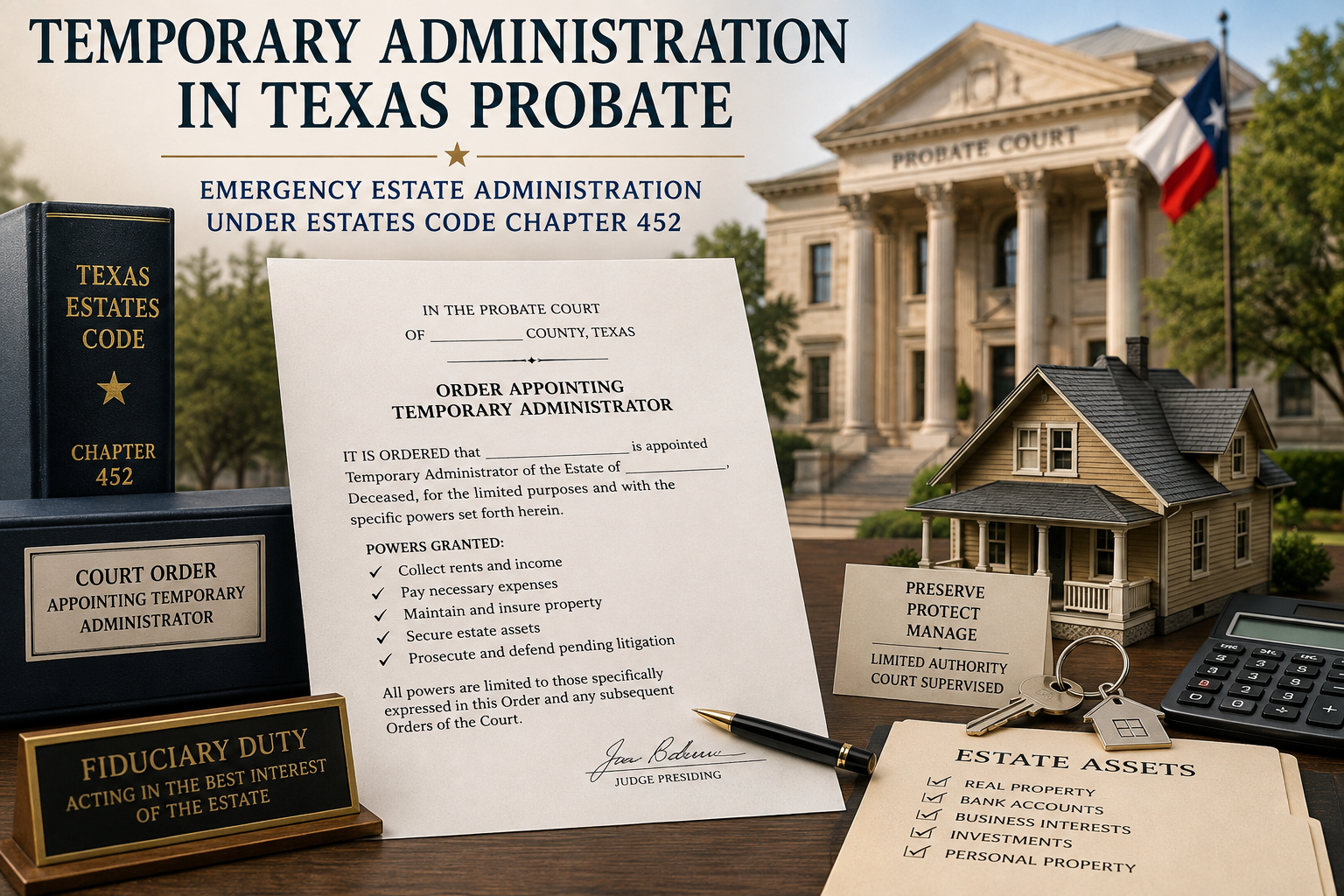
When someone dies, administering the estate can take time. A will may be contested. Family members may disagree about who should serve as executor. Property may need immediate protection. A business may still be operating. Bills may be accumulating while nobody has legal authority to act.
Texas probate law has a technical solution for situations in which the estate simply cannot wait: temporary administration.
Texas Estates Code Chapter 452 allows a probate court, under appropriate circumstances, to appoint a temporary administrator with specifically defined authority to protect an estate while the underlying probate proceeding continues. Unlike an ordinary independent executor, however, a temporary administrator does not automatically receive broad authority over everything belonging to the estate.
That distinction can be critical.
What Is a Temporary Administrator in Texas?
A temporary administrator is a court-appointed fiduciary authorized to perform particular tasks concerning a decedent's estate for a limited period.
Temporary administration is therefore different from ordinary permanent administration. Its central purpose is generally not to complete the entire administration of an estate. Instead, it gives the probate court a mechanism to deal with an immediate problem while the court determines what should happen next.
Texas Estates Code Chapter 452 governs temporary administrations. (Texas Statutes)
A classic situation might arise when a decedent owned property that needs immediate attention but a dispute prevents the prompt appointment of a permanent personal representative.
Imagine, for example, that a person dies owning several rental properties. The family disputes the validity of the purported will, but meanwhile:
- tenants are paying rent;
- insurance premiums are coming due;
- repairs are needed;
- bank accounts may need protection; and
- someone needs legal authority to preserve the properties.
Waiting months for the will contest to conclude could materially damage the estate.
Temporary administration can fill that gap.
The Most Important Rule: A Temporary Administrator Has Limited Powers
Perhaps the most important technical feature of temporary administration appears in Texas Estates Code § 452.101.
The statute provides that a temporary administrator may exercise only the rights and powers:
“specifically expressed in the court's order appointing the temporary administrator”
or expressed in subsequent court orders. (Texas Statutes)
That language matters enormously.
A temporary administrator should not be viewed as an ordinary executor who happens to have a shorter appointment. The administrator's authority is fundamentally tied to what the probate court has actually authorized.
If the appointment order authorizes the administrator to secure a house, maintain insurance, collect rent, and pay necessary expenses, those powers do not necessarily translate into unrestricted authority to sell the house, settle litigation, distribute property, or perform every other act that a permanent personal representative might perform.
The order itself becomes essential reading.
Why Would a Probate Court Appoint a Temporary Administrator?
Temporary administration is particularly useful when there is a gap between death and the appointment of someone who can permanently administer the estate.
The need may be especially pronounced where valuable property is exposed to immediate risk.
For example, temporary administration may be appropriate when an estate contains:
Operating businesses. Employees, vendors, customers, leases, and bank accounts may require immediate decisions.
Rental properties. Someone may need authority to collect rent, make repairs, maintain insurance, or prevent waste.
Perishable or vulnerable property. Certain assets may deteriorate or rapidly lose value if nobody can legally manage them.
Pending litigation. The estate may have claims requiring immediate attention.
Contested probate proceedings. A fight over the validity of a will or appointment of a permanent representative does not necessarily eliminate the need for someone to preserve estate property while that fight proceeds.
The Texas court system's probate guidance specifically notes that a temporary administrator can potentially be appointed and qualified on the same day the application is filed, provided the required oath and approved bond are filed. (Texas Courts)
That illustrates what makes temporary administration different: it is designed for circumstances in which ordinary probate timing may be inadequate.
Temporary Administration During a Will Contest
One particularly important use of temporary administration occurs when the validity of a will is being contested.
The existence of a will contest can create a practical dilemma. The court may not yet be prepared to determine who ultimately has the right to administer the estate, but the estate itself continues to exist and may require active management.
Texas Estates Code § 452.052 gives the court substantial flexibility in this setting.
When temporary administration has been granted pending a will contest or a contest concerning an application for letters of administration, the court may give the temporary administrator the powers of a permanent administrator regarding claims against the estate. (Texas Statutes)
Those powers may include matters such as:
- approving or disapproving claims;
- paying claims; and
- selling property to pay claims.
Importantly, the statute also provides additional bonding requirements when those broader powers are granted. (Texas Statutes)
So even during an intensely contested probate proceeding, the law does not necessarily require the estate's financial affairs to remain frozen.
Temporary Administration Is Highly Order-Specific
This produces an important practical lesson for lawyers, heirs, creditors, financial institutions, and anyone dealing with a temporary administrator:
Do not assume the temporary administrator has authority merely because permanent administrators normally possess that authority.
Instead, examine the order appointing the temporary administrator and any subsequent orders expanding or modifying that authority.
Consider a temporary administrator appointed to preserve a decedent's business.
The court might authorize the administrator to:
collect accounts receivable;
pay ordinary operating expenses;
maintain insurance;
access specified bank accounts; and
take reasonable steps to preserve business assets.
But whether the administrator can sell the entire business is a different question.
The answer may depend on the specific language of the court's orders and other applicable provisions of the Estates Code.
That makes temporary administration unusually technical even by probate standards.
Can a Temporary Administrator Sue on Behalf of the Estate?
Litigation can also become part of temporary administration.
Texas Estates Code § 351.053 addresses the authority of an administrator or temporary administrator while an appeal from the order appointing that person is pending. The statute provides that the appointee continues to act and may prosecute suits already pending in favor of the estate during the appeal. (Texas Statutes)
More generally, Texas Estates Code § 351.054 authorizes an executor or administrator appointed in Texas to commence suits involving recovery of personal property, debts or damages and actions involving title to or possession of land and related rights. (Texas Statutes)
For a temporary administrator, however, Chapter 452's limitation remains critical: the practitioner must determine whether the temporary administrator's appointment actually gives that representative the necessary authority.
Temporary Administration Is Not the Same as Independent Administration
Texas probate practitioners frequently prefer independent administration because it dramatically reduces ongoing court supervision.
Texas Estates Code § 402.002 provides:
“Unless this title specifically provides otherwise, any action that a personal representative subject to court supervision may take with or without a court order may be taken by an independent executor without a court order.”
That is almost the opposite conceptual model from temporary administration.
An independent executor generally possesses broad authority subject to statutory exceptions.
A temporary administrator generally possesses the particular authority granted by the court.
That difference can affect everything from banking transactions to real estate sales.
What Happens When the Temporary Administration Ends?
Temporary administration is, by definition, temporary.
When the appointment ends, Texas law requires an accounting of what happened while the temporary administrator controlled estate property.
Texas judicial guidance summarizes the statutory procedure by explaining that, when the temporary appointment expires, the administrator must file a sworn list of estate property received, a return of sales made, and a full account of the administrator's other acts. Remaining estate assets are then delivered to the persons legally entitled to possession, and the court can ultimately discharge the temporary administrator and release the sureties from future liability. (Texas Courts)
This reinforces an important point: temporary administration is not informal caretaking.
The temporary administrator is acting under judicial authority and must ultimately account for the exercise of that authority.
Temporary Administrator vs. Temporary Guardian
The terminology can also cause confusion.
A temporary administrator under Chapter 452 concerns the estate of a person who has died.
A temporary guardian, by contrast, may be appointed for a living person when the statutory requirements for emergency guardianship intervention are satisfied.
Texas Estates Code § 1251.001 provides for appointment of a temporary guardian when the court is presented with substantial evidence that a person may be incapacitated and has probable cause to believe that the person, the person's estate, or both require immediate appointment of a guardian. (Texas Statutes)
The two proceedings therefore address very different legal circumstances despite their similar terminology.
Why Temporary Administration Can Become Contentious
Temporary administration often arises precisely when the estate is already unstable.
Potential disputes can include:
whether temporary administration is actually necessary;
who should serve;
how large the administrator's bond should be;
which assets the administrator should control;
whether property should be sold;
whether claims should be paid;
whether litigation should be prosecuted or defended; and
whether the administrator has exceeded the authority granted by the court.
That last issue deserves particular attention.
Because § 452.101 limits the temporary administrator to powers specifically granted in the appointment or subsequent orders, an act that might be routine for an independent executor could present a serious authority question when performed by a temporary administrator. (Texas Statutes)
A Small Probate Problem Can Become an Emergency
Temporary administration illustrates an important feature of probate law: the most urgent problem is not always determining who eventually receives the property.
Sometimes the immediate question is simply:
Who has legal authority to protect the property today?
A decedent may leave behind houses, businesses, vehicles, financial accounts, litigation claims, livestock, intellectual property, or other assets that cannot simply remain unattended while interested parties litigate larger questions.
Texas Estates Code Chapter 452 gives probate courts a mechanism for dealing with that interim period.
But the flexibility comes with an equally important limitation: the temporary administrator's powers depend heavily on what the court has actually ordered.
For attorneys and interested parties, that means the appointment order should never be treated as boilerplate. It may effectively define the boundaries of the temporary administrator's legal world.
Conclusion
Temporary administration is one of the more technical tools available in Texas probate proceedings. It allows a probate court to protect an estate when immediate action is necessary but permanent administration cannot yet proceed normally.
The central principle is straightforward but easy to overlook: a Texas temporary administrator does not automatically have all the powers of an ordinary executor or administrator.
Under Texas Estates Code § 452.101, the temporary administrator generally exercises only those powers specifically granted by the court. (Texas Statutes)
For families, beneficiaries, creditors, and lawyers dealing with an estate in transition, understanding that distinction can prevent unauthorized transactions, preserve valuable property, and keep an already difficult probate dispute from becoming substantially worse.
This article is for general informational purposes only and does not constitute legal advice. Probate proceedings are highly fact-specific, and anyone dealing with an estate requiring immediate protection should consult a qualified Texas attorney.
At David C. Barsalou, Attorney at Law, PLLC, we help clients navigate business, family, tax, estate planning, and real estate matters ranging from document drafting to litigation with clarity and confidence. If you’d like guidance on your situation, schedule a consultation today. Call us at (713) 397-4678, email barsalou.law@gmail.com, or reach us through our Contact Page. We’re here to help you take the next step.
