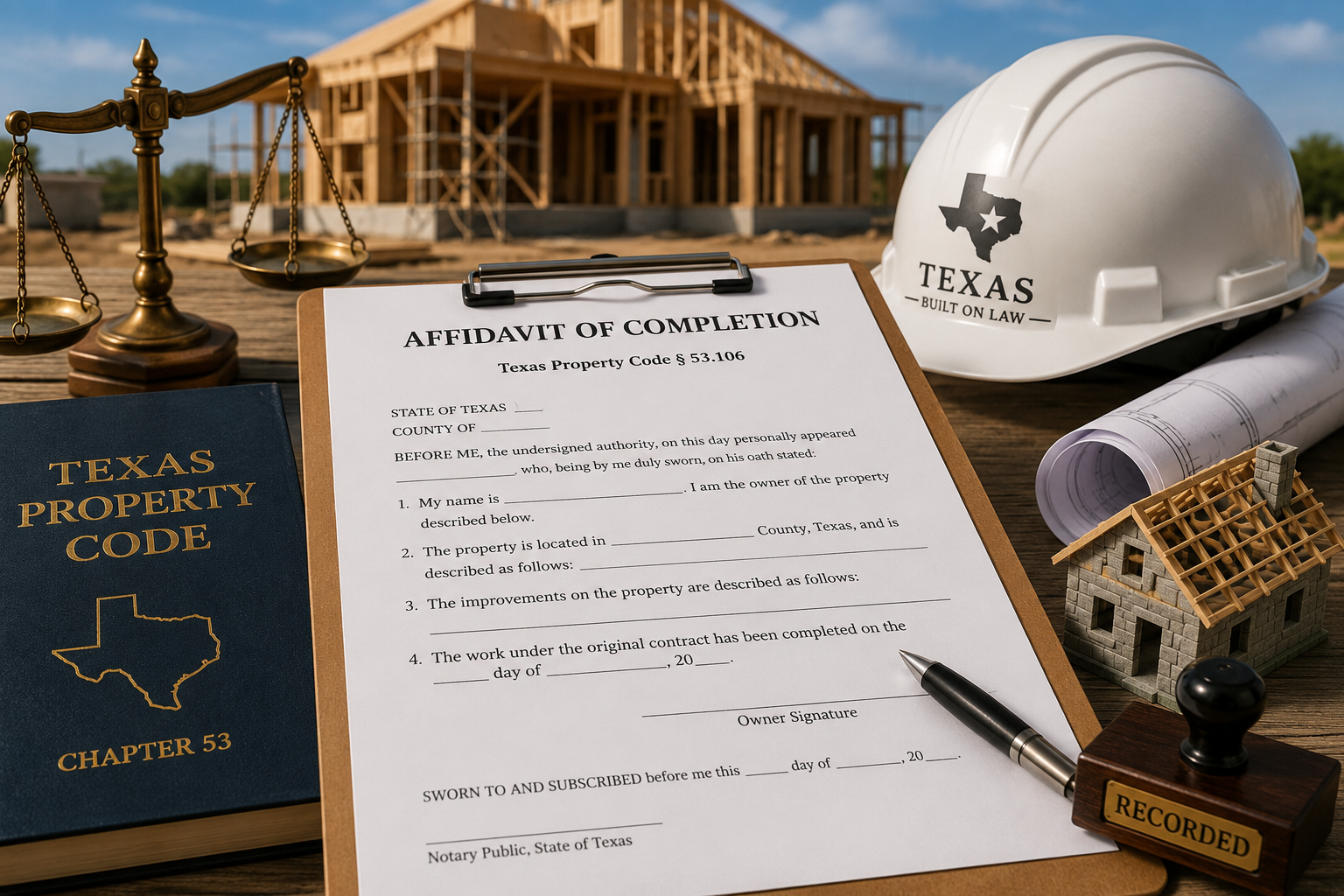
What Is an Affidavit of Completion in Texas?
Construction projects often end with a handshake, a final payment, and the assumption that everything is finished. Unfortunately, Texas construction law does not always work that way. Contractors, subcontractors, suppliers, and property owners can find themselves involved in lien disputes months after a project appears complete.
One of the most overlooked tools available under Texas law is the Affidavit of Completion. Properly filed, it can significantly affect lien deadlines and provide greater certainty regarding when a construction project officially ended.
For property owners, lenders, developers, and contractors, understanding this document can help avoid costly disputes and title problems.
The Statutory Basis
Texas Property Code § 53.106 authorizes the filing of an affidavit of completion.
The statute provides:
"An owner may file an affidavit of completion if the original contract has been completed." Tex. Prop. Code § 53.106(a).
The affidavit is filed in the real property records of the county where the project is located.
Why Does an Affidavit of Completion Matter?
Many rights under Texas mechanic's lien law are tied to specific deadlines. Determining exactly when a project was completed can therefore become extremely important.
Without a clear completion date, disputes often arise regarding:
- Whether a lien affidavit was timely filed;
- Whether notice deadlines were satisfied;
- Whether retainage claims remain viable;
- Whether a title company will insure a sale or refinance.
An affidavit of completion creates a publicly recorded document identifying the owner's position regarding when completion occurred.
What Must the Affidavit Contain?
Texas Property Code § 53.106 requires specific information, including:
- The name and address of the property owner;
- A description of the property;
- A description of the improvements;
- The date of completion;
- A statement that the work under the original contract has been completed.
Because the affidavit becomes part of the county's official real property records, accuracy is critical.
An incorrect affidavit may create litigation risk and potentially undermine the purpose of filing it in the first place.
Does Filing an Affidavit Automatically Defeat Liens?
No.
This is one of the biggest misconceptions surrounding affidavits of completion.
The filing of an affidavit does not automatically invalidate mechanic's liens or extinguish valid claims. Instead, it helps establish a completion date that may affect certain statutory deadlines.
Parties with lien rights may still assert claims if they comply with applicable notice and filing requirements.
In other words, an affidavit of completion is a procedural tool—not a magic shield.
Why Property Owners Should Care
Property owners frequently discover lien issues when attempting to:
- Sell property;
- Refinance;
- Obtain title insurance;
- Secure construction financing.
A recorded affidavit of completion can help create a clearer timeline and reduce uncertainty regarding potential lien exposure.
On larger projects, lenders and title companies often pay close attention to completion dates because mechanic's lien rights can affect priority disputes.
Why Contractors Should Pay Attention
Contractors sometimes ignore affidavits of completion because they assume the document only benefits owners.
That assumption can be costly.
A contractor who receives notice that an affidavit has been filed should immediately evaluate:
- Remaining payment issues;
- Potential retainage claims;
- Outstanding subcontractor disputes;
- Upcoming lien deadlines.
Construction law deadlines are notoriously unforgiving. Waiting too long can result in the permanent loss of otherwise valid rights.
Common Litigation Issues
Texas courts frequently see disputes involving:
- Whether the project was actually complete;
- Whether punch-list items prevented completion;
- Whether the affidavit contained inaccuracies;
- Whether lien deadlines were properly calculated.
In many cases, the fight is not about the construction work itself but rather about timing.
A single disputed completion date can determine whether a claim survives or fails.
Practical Tips
For Property Owners:
- Verify that the project is actually complete before filing.
- Ensure the legal description is accurate.
- Record the affidavit in the correct county.
- Maintain documentation supporting the completion date.
For Contractors:
- Monitor county records on significant projects.
- Review any affidavit of completion immediately.
- Recalculate lien deadlines upon learning of a filing.
- Consult counsel if payment disputes remain unresolved.
Final Thoughts
Texas mechanic's lien law is filled with technical deadlines and procedural traps. The Affidavit of Completion is one of the most underutilized tools available to property owners and one of the most overlooked documents by contractors.
While it does not eliminate valid lien rights, it can significantly influence how those rights are evaluated and enforced. Whether you are an owner seeking certainty or a contractor protecting payment rights, understanding the effect of an affidavit of completion can help you avoid expensive mistakes and preserve your legal position.
At David C. Barsalou, Attorney at Law, PLLC, we help clients navigate business, family, tax, estate planning, and real estate matters ranging from document drafting to litigation with clarity and confidence. If you’d like guidance on your situation, schedule a consultation today. Call us at (713) 397-4678, email barsalou.law@gmail.com, or reach us through our Contact Page. We’re here to help you take the next step.