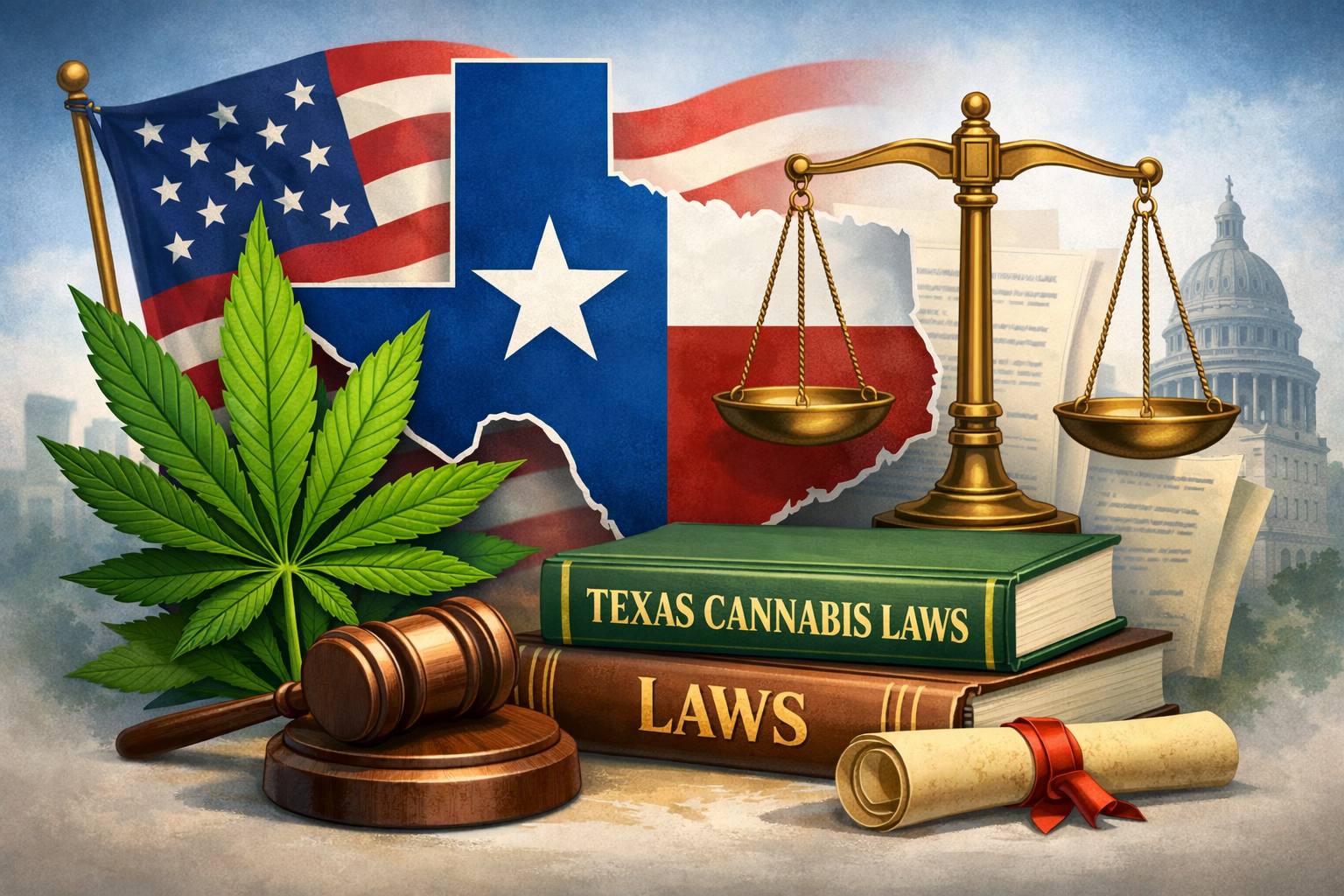
Texas cannabis law has always been complicated, but in the past few years it has become even more confusing. Retailers across Texas—including smoke shops, convenience stores, and CBD stores—have suddenly found that products they were legally selling one year may become illegal the next.
Recent enforcement actions against Texas retailers highlight an important reality: Texas cannabis laws are evolving quickly, and businesses that fail to keep up may face criminal charges or regulatory penalties.
This article explains the current legal landscape for cannabis, hemp, and THC products in Texas.
Marijuana Is Still Illegal in Texas
First, the baseline rule is simple: recreational marijuana remains illegal in Texas.
Under Texas Health and Safety Code § 481.121, possession of marijuana is a criminal offense. The statute provides:
“A person commits an offense if the person knowingly or intentionally possesses a usable quantity of marijuana.”
— Tex. Health & Safety Code § 481.121(a)
Penalties escalate depending on the amount possessed and may include fines and jail time.
Texas has not legalized recreational cannabis, unlike many other states.
Texas Has a Very Limited Medical Marijuana Program
Texas does allow a restricted form of medical cannabis through the Texas Compassionate Use Program (TCUP).
Under Texas Health and Safety Code § 487.201, the program allows physicians to prescribe low-THC cannabis products for certain medical conditions.
Low-THC cannabis is defined as cannabis containing no more than 1% THC by weight. (Martinez Law Firm)
Qualifying conditions include certain neurological disorders and other medical diagnoses approved by the state.
However, the program remains narrow compared with medical marijuana programs in most states.
The Hemp Loophole That Created a Retail THC Market
In 2019, Texas passed legislation implementing the 2018 federal Farm Bill, which legalized hemp products containing less than 0.3% Delta-9 THC by dry weight. (Kut)
This law allowed businesses to sell hemp-derived products such as:
- CBD products
- Delta-8 THC products
- hemp-derived edibles
- beverages containing THC
As a result, thousands of stores across Texas began selling intoxicating hemp products, often in gas stations and smoke shops.
But the legal framework was unstable from the beginning.
The State Has Begun Closing Cannabis “Loopholes”
Texas lawmakers and regulators have recently taken steps to restrict the rapidly growing hemp-derived THC market.
For example, Senate Bill 2024, effective September 1, 2025, makes it illegal to sell vape products containing cannabinoids such as THC, CBD, or Delta-8. Selling these products can be charged as a Class A misdemeanor, punishable by up to one year in jail and a $4,000 fine. (The Texas Tribune)
At the same time, regulators have imposed stricter rules on hemp products, including:
- stronger testing requirements
- labeling rules
- age-verification requirements
- licensing regulations for retailers. (covasoftware.com)
The Texas Alcoholic Beverage Commission (TABC) has also finalized new rules regulating the hemp industry and requiring retailers to verify customers are over age 21. (FOX 7 Austin)
Delta-8 and Other THC Variants Remain in Legal Limbo
One of the most confusing areas of Texas cannabis law involves Delta-8 THC and similar hemp-derived cannabinoids.
Delta-8 is chemically similar to marijuana’s psychoactive compound (Delta-9 THC) but is usually produced from hemp-derived CBD. (Texas State Law Library Guides)
Courts have repeatedly blocked attempts by state regulators to ban Delta-8 products outright, leaving the industry in an uncertain legal position. (Cheryl A. Wulf, Attorney at Law)
At the same time, lawmakers have proposed legislation to eliminate intoxicating hemp products entirely.
The result is constant legal uncertainty, which has created risk for both retailers and consumers.
Why Smoke Shops and Retailers Are Getting Arrested
Many retailers mistakenly assume that because a product was legal when they purchased it, they can continue selling it indefinitely.
That assumption can be dangerous.
Cannabis laws in Texas are frequently updated through:
- new legislation
- regulatory rule changes
- court rulings
- enforcement actions
A product that was legal one year may become illegal the next due to changes in regulatory definitions or enforcement priorities.
Retailers who continue selling newly prohibited products may face:
- criminal charges
- license revocation
- seizure of inventory
- civil penalties.
What Texas Businesses Should Do Now
Businesses that sell hemp or cannabis-related products should take several steps to protect themselves:
1. Monitor legislative changes.
Cannabis laws in Texas change almost every legislative session.
2. Review regulatory rules.
Agencies such as the Texas Department of State Health Services (DSHS)and the Texas Alcoholic Beverage Commission (TABC) frequently update compliance requirements.
3. Verify product testing and labeling.
Hemp products must comply with strict testing standards and THC limits.
4. Seek legal advice before expanding product lines.
Many products marketed nationally may still be illegal in Texas.
The Bottom Line
Texas cannabis law is one of the most complicated and rapidly evolving areas of state regulation.
While recreational marijuana remains illegal, the explosion of hemp-derived THC products has created a confusing patchwork of laws, court rulings, and regulatory rules.
For retailers and consumers alike, the safest assumption is simple:
If you are unsure whether a cannabis-related product is legal in Texas, do not assume it is.
The law may have changed.
At David C. Barsalou, Attorney at Law, PLLC, we help clients navigate business, family, tax, estate planning, and real estate matters ranging from document drafting to litigation with clarity and confidence. If you’d like guidance on your situation, schedule a consultation today. Call us at (713) 397-4678, email barsalou.law@gmail.com, or reach us through our Contact Page. We’re here to help you take the next step