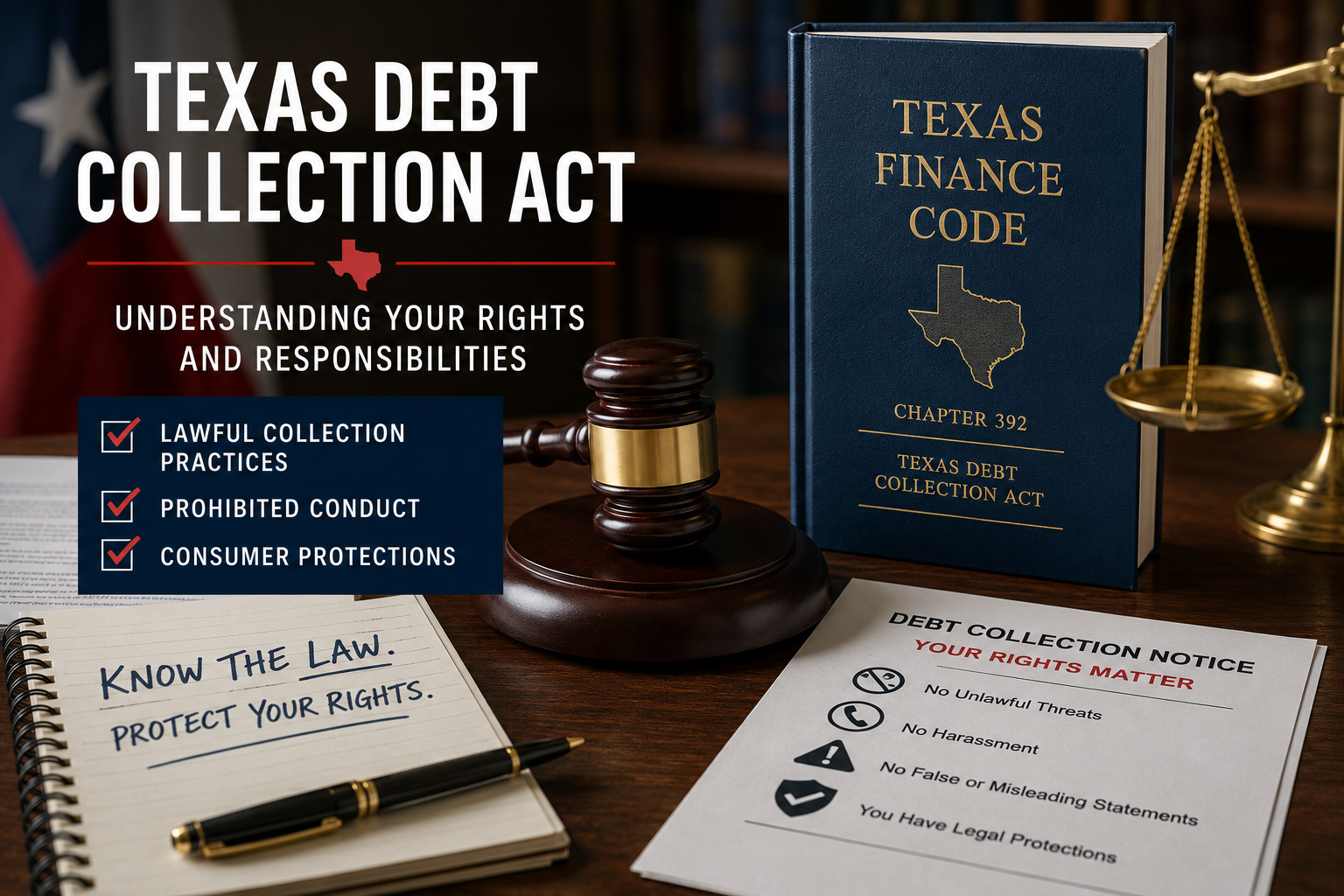
Businesses have the legal right to collect legitimate debts. Consumers have the right to be protected from abusive collection practices. Texas attempts to balance those interests through the Texas Debt Collection Act ("TDCA"), Chapter 392 of the Texas Finance Code.
The Act is broader than many people realize. It does not only apply to traditional collection agencies. Depending upon the circumstances, creditors collecting their own debts, attorneys, and businesses may also need to understand its requirements.
If you are involved in a collection dispute, understanding Chapter 392 can make the difference between successfully collecting a debt and creating an entirely new lawsuit.
What Is the Texas Debt Collection Act?
Chapter 392 of the Texas Finance Code regulates how debts may be collected within Texas. It prohibits certain deceptive, misleading, threatening, or abusive collection practices while still permitting lawful efforts to recover money that is actually owed.
Importantly, the Act does not prohibit debt collection. Rather, it regulates how collection occurs.
The Statute Defines a "Debt"
The Act defines a debt broadly. Texas Finance Code § 392.001 provides in part:
"Debt means a consumer debt, or an alleged consumer debt, that is due or alleged to be due from a consumer."
Whether an obligation falls within the statute can become an important issue in litigation because commercial obligations are often treated differently than purely consumer debts.
Threats That Cannot Legally Be Made
One of the most frequently litigated portions of Chapter 392 concerns threats.
Texas Finance Code § 392.301 generally prohibits debt collectors from using coercion or threats in order to collect debts.
Examples include threatening:
- unlawful criminal prosecution;
- arrest when no lawful basis exists;
- seizure of exempt property;
- actions the collector has no legal authority to take; or
- conduct intended merely to intimidate rather than pursue legitimate legal remedies.
There is an important distinction between threatening an illegal action and informing someone that a creditor intends to file a lawsuit when a legal basis actually exists. Filing suit to collect a valid debt is generally a lawful remedy. Threatening actions that cannot legally occur is another matter entirely.
Harassment Is Also Prohibited
Texas Finance Code § 392.302 prohibits various forms of harassment or abuse.
Examples may include:
- repeated telephone calls intended to harass;
- obscene or profane language;
- repeatedly causing a telephone to ring with intent to harass;
- abusive communications designed solely to intimidate.
Courts generally evaluate the overall conduct rather than focusing on one isolated communication.
False or Misleading Statements
Another significant section is Texas Finance Code § 392.304, which prohibits fraudulent, deceptive, or misleading representations.
Examples can include:
- misrepresenting the amount owed;
- falsely claiming to be an attorney or government official;
- falsely representing the legal status of a debt;
- using deceptive collection methods;
- providing misleading information regarding legal consequences.
Many lawsuits under the TDCA focus on whether a communication would likely mislead an ordinary consumer.
Can a Creditor Still File a Lawsuit?
Yes.
The Texas Debt Collection Act does not eliminate a creditor's right to sue.
If a debt is legally enforceable, filing suit, obtaining a judgment, conducting post-judgment discovery, or pursuing lawful collection remedies generally remain available.
The key issue is that collection efforts must comply with Chapter 392 throughout the process.
Why Businesses Should Care
Business owners sometimes assume these rules apply only to national collection agencies.
That assumption can be expensive.
A business collecting its own consumer accounts should understand what communications are permitted before sending demand letters, making telephone calls, or threatening litigation.
Likewise, companies should train employees who communicate with customers regarding unpaid accounts.
Why Consumers Should Care
Consumers frequently believe that every aggressive collection effort violates Texas law.
That is not necessarily true.
Collectors may:
- demand payment;
- negotiate settlements;
- send collection letters;
- file legitimate lawsuits;
- obtain lawful judgments; and
- pursue authorized collection procedures after judgment.
The question is not whether collection occurs—it is whether the collection methods comply with Chapter 392.
Litigation Often Involves Multiple Claims
Debt collection disputes frequently involve more than the Texas Debt Collection Act.
Depending upon the facts, litigation may also involve:
- breach of contract;
- sworn account claims;
- fraud allegations;
- limitations defenses;
- federal Fair Debt Collection Practices Act claims;
- declaratory judgment actions; or
- counterclaims arising from the underlying transaction.
Properly evaluating the entire case often requires analyzing both the debt itself and the manner in which collection efforts were conducted.
An Experienced Texas Litigation Attorney Can Help
Whether you are attempting to collect a legitimate debt or believe unlawful collection practices have occurred, early legal advice can often prevent unnecessary litigation.
At David C. Barsalou, Attorney at Law PLLC, we represent Texas businesses and individuals in civil litigation, contract disputes, creditor matters, and commercial litigation. Understanding both the underlying debt and the procedural rules governing collection is essential to protecting your legal rights.
Disclaimer: This article is provided for general educational purposes only and does not constitute legal advice. Every case is different, and reading this article does not create an attorney-client relationship.
At David C. Barsalou, Attorney at Law, PLLC, we help clients navigate business, family, tax, estate planning, and real estate matters ranging from document drafting to litigation with clarity and confidence. If you’d like guidance on your situation, schedule a consultation today. Call us at (713) 397-4678, email barsalou.law@gmail.com, or reach us through our Contact Page. We’re here to help you take the next step.