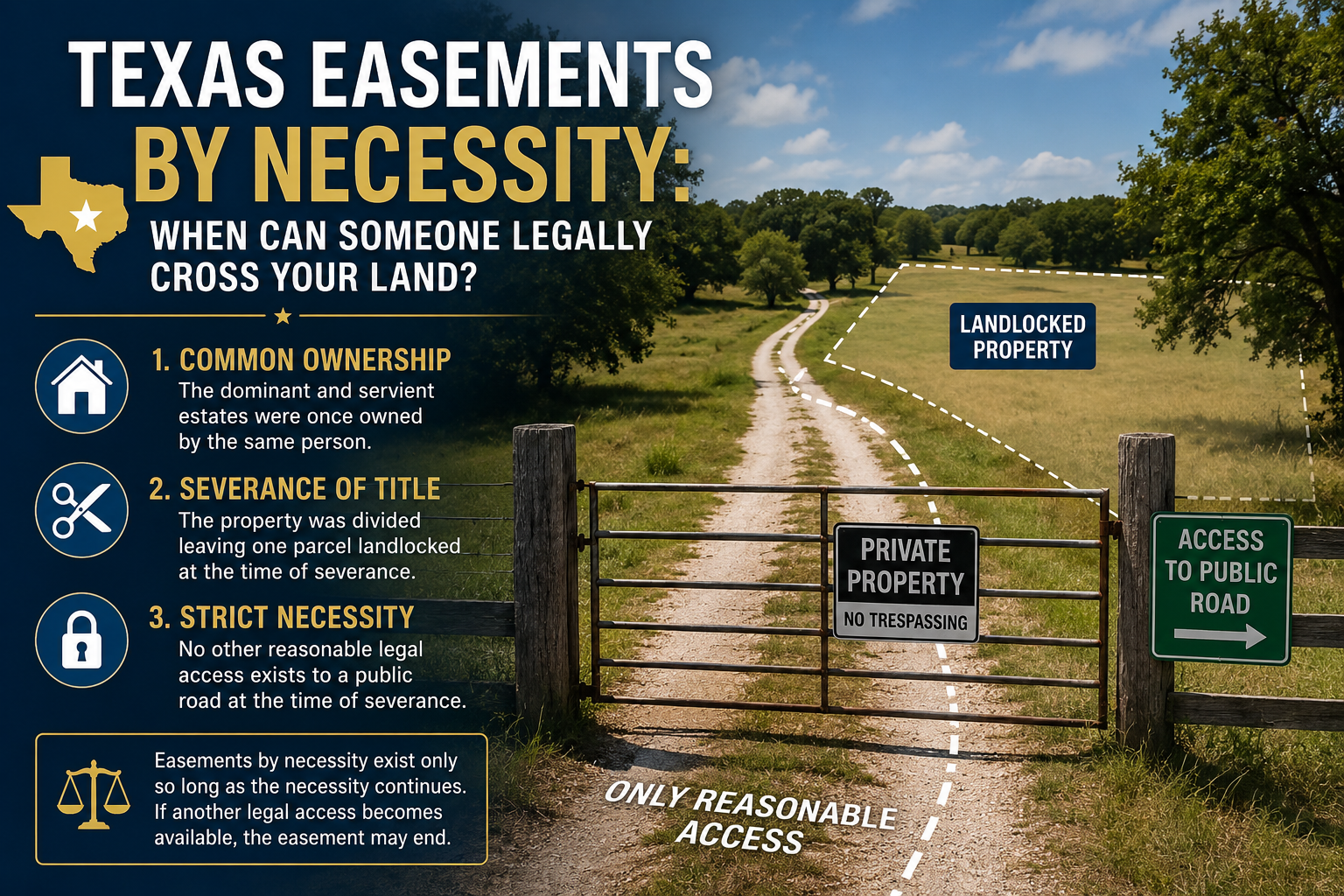
One of the more surprising issues in Texas real estate law is that, under limited circumstances, someone may acquire the legal right to cross another person's land—even when no written easement exists. These rights are known as easements by necessity, and they frequently arise when property is divided in a way that leaves one parcel without legal access to a public road.
Although many people assume that owning land means absolute control over who enters it, Texas law recognizes that landlocked property can become practically worthless if no legal access exists. An easement by necessity is designed to prevent that result.
What Is an Easement?
An easement is a nonpossessory right allowing one person to use another person's real property for a limited purpose. Easements are commonly created by written agreement, but Texas courts also recognize certain easements that arise by operation of law.
An easement by necessity is one of those judicially recognized exceptions.
The Texas Property Code Recognizes Easements
The Texas Property Code generally recognizes that easements are interests in real property that may be created, transferred, and recorded.
For example, Texas Property Code § 5.021 provides:
"A conveyance of an estate of inheritance, a freehold, or an estate for more than one year in land and tenements must be in writing and must be subscribed and delivered by the conveyor or by the conveyor's agent authorized in writing."
While easements are ordinarily created through written conveyances satisfying this statute, Texas courts have long recognized that an easement by necessity may arise even without an express written grant when equity requires it.
When Does an Easement by Necessity Exist?
Texas courts generally require three elements:
1. Common Ownership
Both parcels must originally have been owned by the same person.
For example, a landowner may own a single 100-acre tract before selling one portion.
2. Severance of Title
The common owner must divide the property into separate ownership.
Once the land is split, one parcel may become isolated from any public roadway.
3. Strict Necessity
The necessity must exist at the time of the severance.
Texas courts generally require strict necessity, not mere convenience.
If another legal means of access exists—even if it is longer, more expensive, or less desirable—the easement by necessity may not be recognized.
Mere Convenience Is Not Enough
Many property disputes arise because one route is shorter than another.
That is generally insufficient.
For example:
- A neighboring driveway is easier to use.
- Crossing another ranch saves several miles.
- Building a private road would be expensive.
Those facts alone usually do not create an easement by necessity.
Instead, the claimant typically must demonstrate that the property lacks any reasonable legal access to a public road.
Does the Easement Last Forever?
Not necessarily.
An easement by necessity generally lasts only so long as the necessity continues.
If another lawful route later becomes available—perhaps through the purchase of adjoining land or construction of a public roadway—the necessity may end, and with it the easement.
Common Situations
Easements by necessity often appear in situations involving:
- Family land divided among children
- Rural ranch subdivisions
- Estate administrations
- Partition lawsuits
- Boundary disputes
- Improperly drafted deeds
- Older properties with incomplete title records
Many of these disputes ultimately require careful examination of historical deeds, surveys, title records, and the property's chain of ownership.
Why These Cases Become Complicated
Property owners often believe the issue is simply whether someone has used a road for years.
In reality, several different legal doctrines may apply, including:
- Express easements
- Prescriptive easements
- Implied easements
- Easements by necessity
- Easements by estoppel
Each doctrine has different legal requirements, and proving one does not necessarily establish another.
Practical Advice for Texas Property Owners
If you are buying rural property, never assume existing roads are legally authorized.
Before closing, you should consider reviewing:
- The recorded deed
- Any recorded easements
- The survey
- Title commitments
- County property records
Likewise, if a neighboring landowner claims the right to cross your property, the issue should be carefully evaluated before granting permission or erecting barriers.
Conclusion
Easements by necessity illustrate an important principle of Texas property law: ownership rights are strong, but they are not always absolute. In limited situations, Texas courts may recognize an implied right of access to prevent property from becoming unusable.
Because these disputes frequently involve title issues, historical conveyances, and equitable principles, obtaining experienced legal advice early can often prevent costly litigation.
If you are involved in an easement dispute, landlocked property issue, or other Texas real estate controversy, consulting an experienced Texas real estate attorney can help protect your ownership rights while evaluating any legal claims that may exist.
At David C. Barsalou, Attorney at Law, PLLC, we help clients navigate business, family, tax, estate planning, and real estate matters ranging from document drafting to litigation with clarity and confidence. If you’d like guidance on your situation, schedule a consultation today. Call us at (713) 397-4678, email barsalou.law@gmail.com, or reach us through our Contact Page. We’re here to help you take the next step.