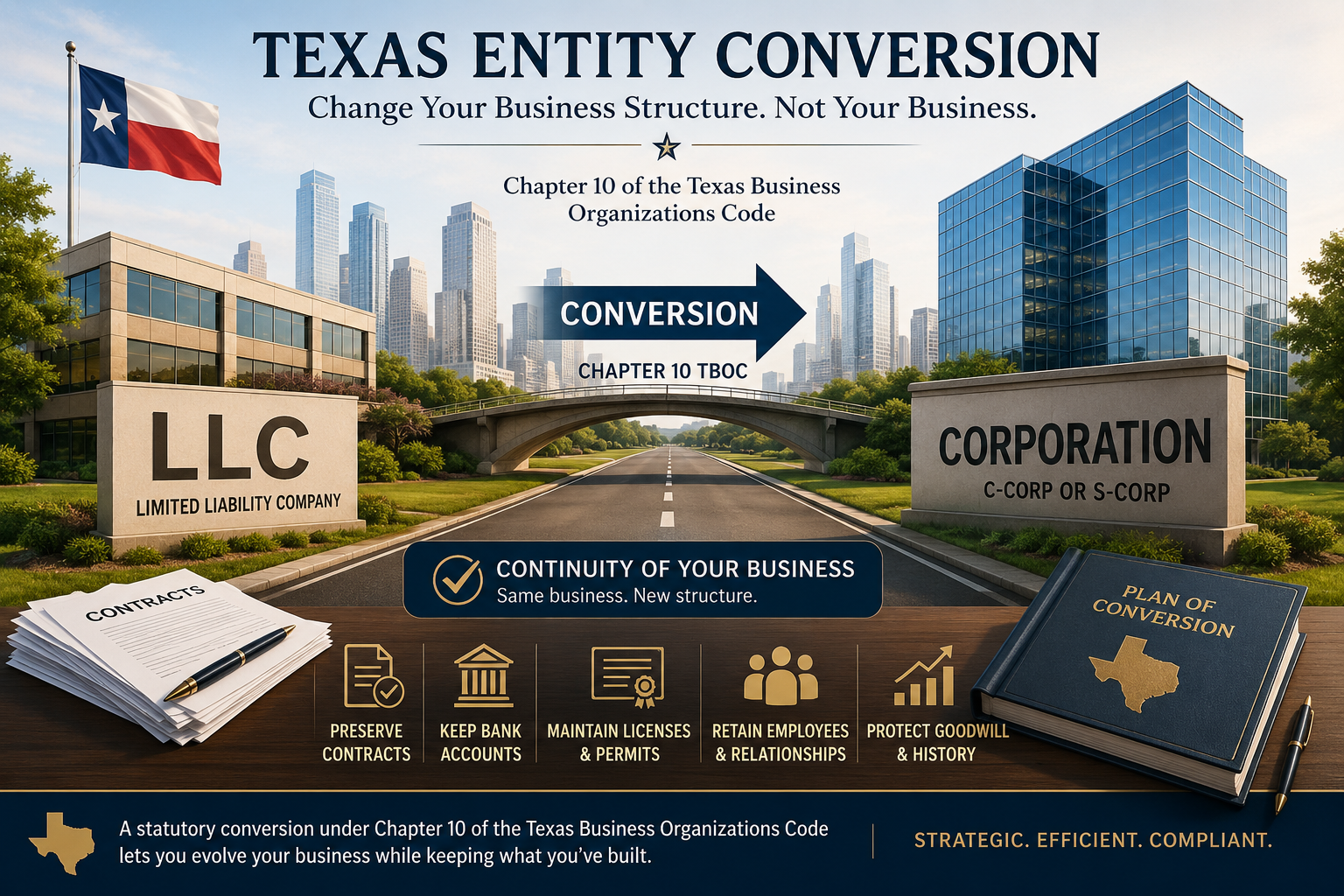
Business owners often assume that changing from one type of business entity to another requires shutting down the old company and starting a completely new one. In Texas, that is often unnecessary.
The Texas Business Organizations Code ("TBOC")allows many business entities to convert into different forms while preserving the continuity of the business. Rather than dissolving an LLC and creating a corporation—or vice versa—a properly completed statutory conversion can often accomplish the transition more efficiently.
Understanding how these conversions work can save business owners significant legal, tax, and administrative headaches.
What Is an Entity Conversion?
An entity conversion is a statutory process that allows one type of legal entity to become another type of legal entity.
Common examples include:
- An LLC converting into a corporation.
- A corporation converting into an LLC.
- A limited partnership converting into an LLC.
- A professional entity converting into another authorized entity.
Unlike dissolving one company and creating another, a conversion generally preserves the legal existence of the business while changing its organizational form.
Texas Law Governing Entity Conversions
Entity conversions are primarily governed by Chapter 10 of the Texas Business Organizations Code.
For example, Texas Business Organizations Code § 10.101provides:
"A domestic entity may convert into another domestic entity or a non-code organization if the conversion is authorized by this code."
The TBOC also authorizes many conversions involving foreign entities when statutory requirements are satisfied.
Why Would Someone Convert Their Business?
Business needs evolve over time.
A conversion may be appropriate when:
- Investors require a corporate structure.
- Owners want the flexibility of an LLC.
- Tax planning objectives change.
- The company prepares for a merger or acquisition.
- Ownership expands significantly.
- The business wants a different management structure.
Rather than abandoning contracts, licenses, goodwill, and operational history, a statutory conversion may allow the business to continue with substantially uninterrupted operations.
Does the Business Become a New Company?
Not necessarily.
One of the major advantages of a statutory conversion is continuity.
Although the governing structure changes, Texas law generally treats the converted organization as continuing the existence of the original entity, subject to the governing provisions of Chapter 10 and the filing requirements with the Texas Secretary of State.
This distinction can be extremely important for:
- Existing contracts
- Vendor relationships
- Bank accounts
- Permits
- Litigation
- Property ownership
Of course, individual contracts or governmental licenses may impose separate consent requirements that should always be reviewed before completing a conversion.
What Must Be Approved?
Before filing a conversion, the entity generally must adopt a plan of conversion.
Depending upon the type of entity involved, approval may require:
- Members of an LLC
- Shareholders of a corporation
- Partners
- Managers
- Directors
The governing documents of the entity—and applicable provisions of the Texas Business Organizations Code—determine the necessary approval process.
Filing Requirements
Once properly approved internally, the entity typically files:
- A Certificate of Conversion; and
- A Certificate of Formation for the converted entity if required.
The Secretary of State reviews these filings before the conversion becomes effective.
Merely deciding to convert is not enough; statutory filing requirements must also be satisfied.
Does a Conversion Affect Existing Debts?
Generally, no.
One purpose of the statutory conversion process is continuity.
While specific facts always matter, creditors generally do not lose their rights merely because an entity changes organizational form.
Likewise, a business cannot simply convert from one entity type to another to escape existing contractual obligations.
Conversion Is Not the Same as a Merger
Business owners frequently confuse conversions with mergers.
A conversion changes the legal form of the same business.
A merger combines two or more separate entities into one surviving entity.
Although both are governed by Chapter 10 of the Texas Business Organizations Code, they accomplish very different legal objectives.
Tax Considerations
A legal conversion does not automatically determine the federal tax consequences.
Federal tax treatment depends upon numerous factors, including:
- The original entity classification.
- The new entity classification.
- IRS elections.
- Asset basis.
- Built-in gains.
- Ownership structure.
Accordingly, business owners should coordinate with both legal counsel and a qualified tax professional before implementing a conversion.
When Should You Consider an Entity Conversion?
Conversions are commonly considered when:
- Raising outside investment.
- Preparing for a sale of the business.
- Changing ownership structure.
- Simplifying management.
- Responding to tax planning recommendations.
- Reorganizing affiliated companies.
Because conversions can affect liability protection, governance, financing, taxation, and contractual rights, careful planning before filing documents with the Secretary of State is essential.
Final Thoughts
Texas provides businesses with substantial flexibility to adapt as circumstances change. Chapter 10 of the Texas Business Organizations Code allows many companies to convert into a different legal entity without necessarily abandoning the business they have spent years building.
If your company is considering a restructuring, a statutory conversion may be a more efficient solution than dissolving one entity and forming another. However, because conversions involve corporate governance, contracts, taxation, and filing requirements, obtaining legal advice before proceeding can help avoid costly mistakes.
Disclaimer: This article is for informational purposes only and does not constitute legal advice. Every business conversion involves unique facts and should be evaluated individually before action is taken.
At David C. Barsalou, Attorney at Law, PLLC, we help clients navigate business, family, tax, estate planning, and real estate matters ranging from document drafting to litigation with clarity and confidence. If you’d like guidance on your situation, schedule a consultation today. Call us at (713) 397-4678, email barsalou.law@gmail.com, or reach us through our Contact Page. We’re here to help you take the next step.