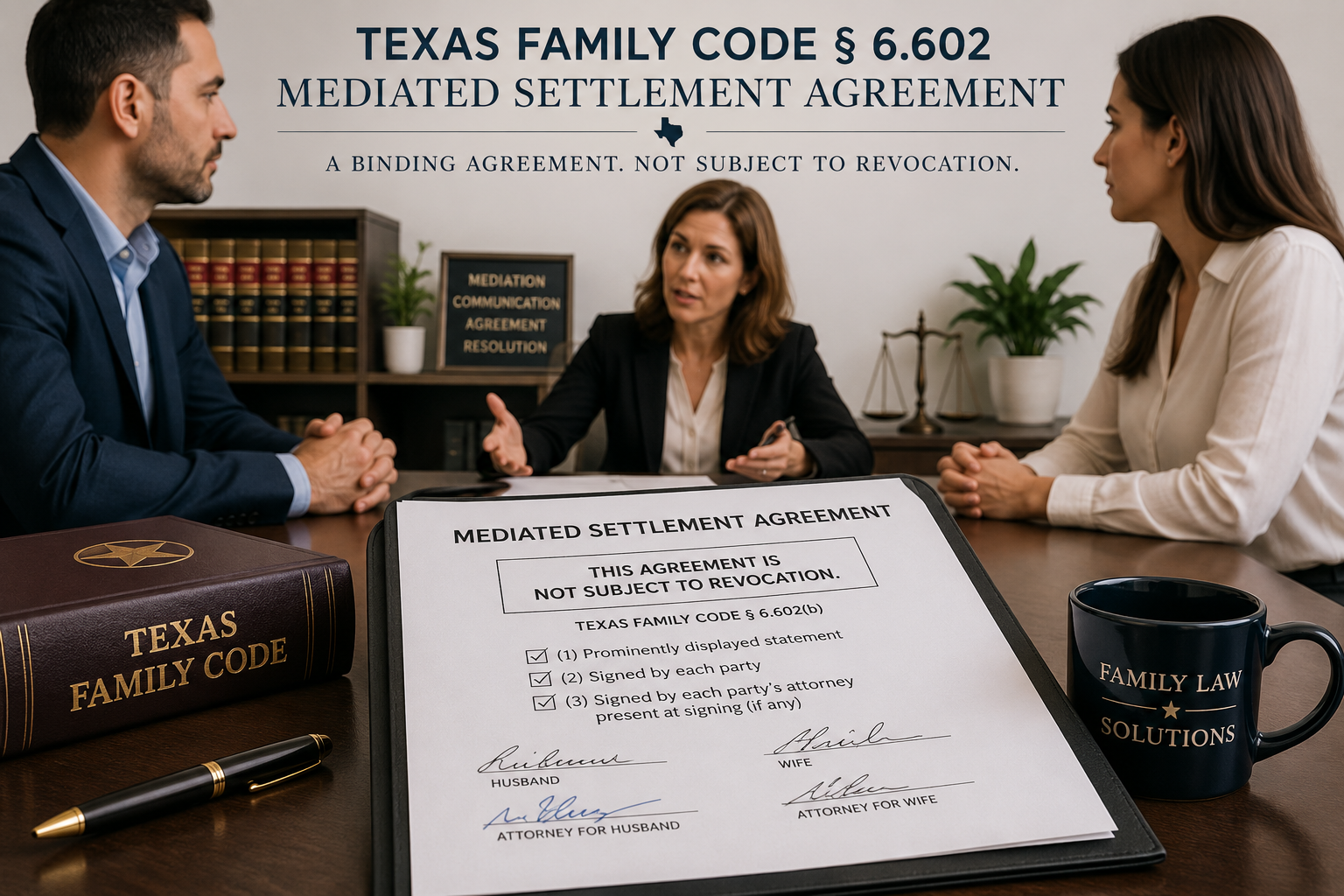
When Texas divorce cases settle, many parties assume they can change their minds before the final decree is signed. In many situations, that assumption is wrong.
One of the most powerful—and sometimes surprising—provisions in Texas family law is Texas Family Code § 6.602, which governs mediated settlement agreements ("MSAs") in divorce cases. Under the right circumstances, a properly executed MSA becomes binding on both parties and can severely limit a court's ability to alter the parties' agreement.
Understanding how these agreements work is critical before signing one.
What Is a Mediated Settlement Agreement?
A mediated settlement agreement is a written agreement reached during mediation, typically with the assistance of a neutral mediator. Rather than allowing a judge to decide disputed issues, the parties negotiate their own resolution regarding property division, spousal maintenance, debt allocation, and other matters.
Texas strongly favors settlement of family law disputes. As a result, the Legislature created special protections for mediated settlement agreements.
The Statute
Texas Family Code § 6.602(b) provides:
"A mediated settlement agreement is binding on the parties if the agreement:
(1) provides, in a prominently displayed statement that is in boldfaced type or capital letters or underlined, that the agreement is not subject to revocation;
(2) is signed by each party to the agreement; and
(3) is signed by the party's attorney, if any, who is present at the time the agreement is signed."
When these statutory requirements are met, the agreement becomes extraordinarily difficult to escape.
Why MSAs Are Different from Ordinary Settlement Agreements
In most civil litigation, parties may encounter disputes about whether a settlement agreement should be enforced. Courts often analyze contract defenses such as fraud, duress, mistake, or unconscionability.
Family law mediated settlement agreements operate differently.
Texas courts have repeatedly recognized that a qualifying MSA receives special statutory protection. The Legislature intended to provide certainty and finality to settlements reached during mediation.
As a result, a party who later regrets the agreement often discovers that regret alone is not enough.
Can a Party Revoke an MSA?
Generally, no.
The entire purpose of § 6.602 is to create an agreement that is "not subject to revocation." Once properly executed, a party ordinarily cannot simply change his or her mind before entry of the final divorce decree.
This surprises many litigants who assume that no agreement becomes final until a judge signs the decree.
In reality, the MSA itself often becomes the controlling document.
Must the Court Follow the Agreement?
Texas Family Code § 6.602(c) states:
"If a mediated settlement agreement meets the requirements of this section, a party is entitled to judgment on the mediated settlement agreement notwithstanding Rule 11, Texas Rules of Civil Procedure, or another rule of law."
That language is powerful.
When the statutory requirements are satisfied, a party may generally insist that the trial court render judgment consistent with the MSA.
In other words, the court's discretion may be significantly limited.
Common Areas Covered by MSAs
A mediated settlement agreement may resolve:
- Division of community property;
- Allocation of marital debts;
- Spousal maintenance;
- Responsibility for tax liabilities;
- Disposition of retirement accounts;
- Reimbursement claims;
- Business ownership disputes;
- Real estate issues; and
- Other divorce-related property matters.
Many complex divorce cases are ultimately resolved through mediation because the parties can craft solutions a court might not otherwise impose after trial.
Are There Any Exceptions?
While MSAs are extremely powerful, litigation occasionally arises regarding:
- Fraud allegations;
- Forgery claims;
- Lack of statutory compliance;
- Public policy concerns;
- Family violence issues in certain circumstances;
- Interpretation of ambiguous settlement language.
These disputes can become highly technical and fact-specific.
However, courts generally begin with a strong presumption favoring enforcement of properly executed mediated settlement agreements.
Practical Advice Before Signing an MSA
Because a mediated settlement agreement can become binding immediately, parties should carefully review every provision before signing.
Questions to consider include:
- Have all assets been disclosed?
- Are retirement accounts addressed?
- Does the agreement specify how debts will be paid?
- Are tax consequences understood?
- Is the language clear and enforceable?
- Have future contingencies been considered?
The pressure of mediation can make settlement attractive, but a rushed decision may create long-term consequences.
Final Thoughts
Texas Family Code § 6.602 gives mediated settlement agreements extraordinary legal force. Once the statutory requirements are met, a party's ability to walk away from the deal may be extremely limited.
For many divorcing spouses, mediation provides a faster, less expensive, and more predictable resolution than trial. However, the same features that make mediated settlement agreements effective also make them powerful legal documents that should never be signed without careful consideration.
If you are facing divorce litigation, understanding the legal effect of a mediated settlement agreement before signing can help you avoid costly surprises later.
At David C. Barsalou, Attorney at Law, PLLC, we help clients navigate business, family, tax, estate planning, and real estate matters ranging from document drafting to litigation with clarity and confidence. If you’d like guidance on your situation, schedule a consultation today. Call us at (713) 397-4678, email barsalou.law@gmail.com, or reach us through our Contact Page. We’re here to help you take the next step.