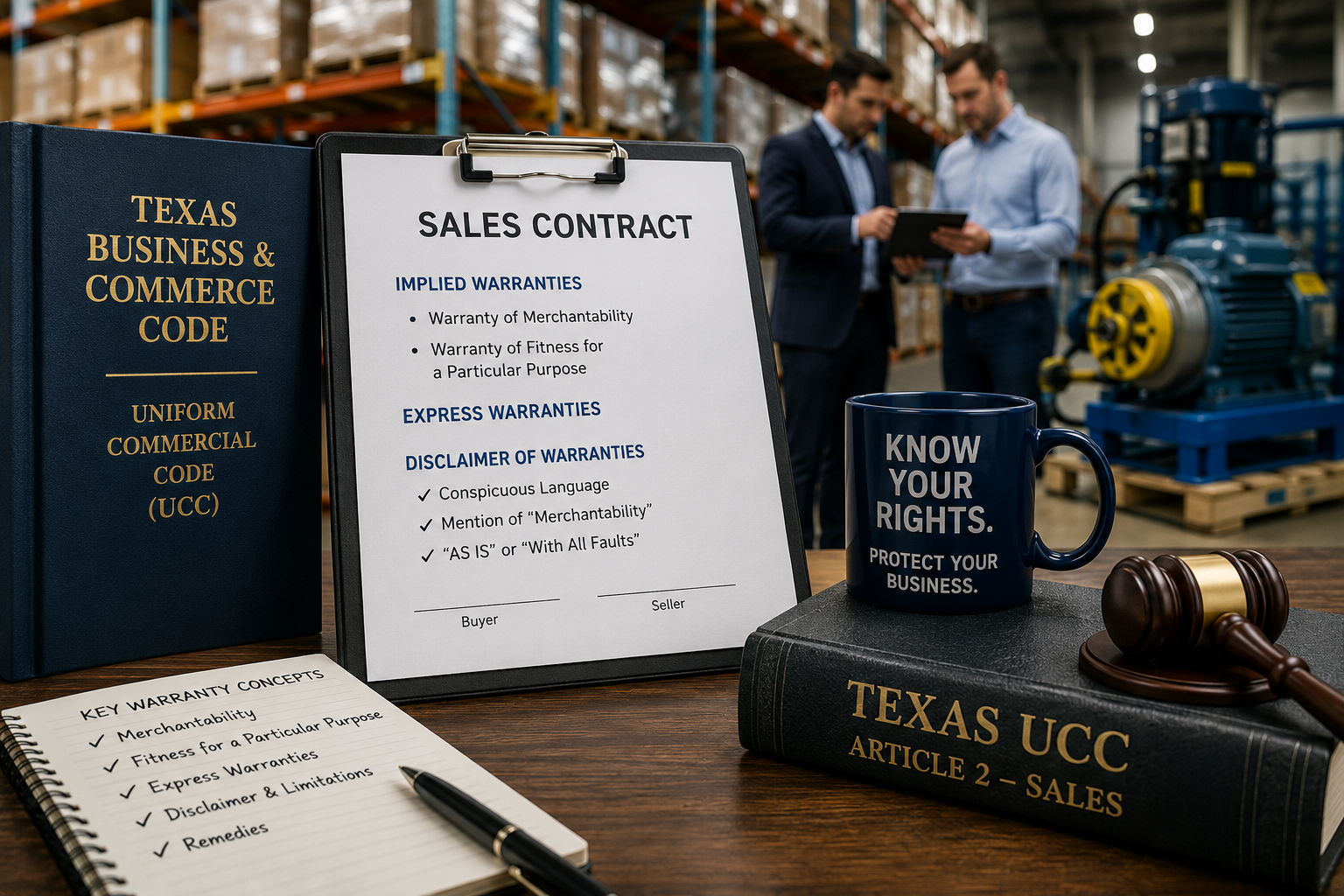
Texas Implied Warranties Can Create Liability Even When a Contract Says Very Little
Many Texas businesses assume that if a contract does not promise anything about a product, there are no warranties. In many transactions, that assumption is incorrect.
Under the Texas Business & Commerce Code, certain warranties arise automatically unless they are properly excluded or modified. These warranties can become the basis for breach of warranty lawsuits involving defective products, commercial equipment, inventory, machinery, or consumer goods.
Understanding these rules can help both buyers and sellers reduce unnecessary disputes.
What Is an Implied Warranty?
An implied warranty is a legal promise created by law rather than by the parties' express agreement.
Unlike an express warranty—which arises from statements, descriptions, samples, or promises made by the seller—an implied warranty exists because the law recognizes certain minimum expectations in commercial transactions.
The Implied Warranty of Merchantability
One of the most important provisions appears in Texas Business & Commerce Code § 2.314, which provides:
"Unless excluded or modified... a warranty that the goods shall be merchantable is implied in a contract for their sale if the seller is a merchant with respect to goods of that kind."
In practical terms, merchantable goods generally should:
- Pass without objection in the trade.
- Be fit for their ordinary purpose.
- Be adequately packaged and labeled.
- Conform to promises made on the label, if any.
For example:
- A commercial refrigerator should cool food.
- Office computers should operate normally.
- Industrial equipment should perform its ordinary function.
The warranty does not guarantee perfection. Rather, it requires that the goods meet ordinary commercial expectations.
The Implied Warranty of Fitness for a Particular Purpose
Texas Business & Commerce Code § 2.315 creates a different warranty.
This warranty applies when:
- the seller knows the buyer has a particular purpose for the goods, and
- the buyer relies on the seller's expertise in selecting suitable goods.
For example:
A landscaping company tells a supplier it needs pumps capable of operating continuously in saltwater conditions.
If the supplier recommends a particular model knowing that purpose, an implied warranty of fitness may arise.
Express Warranties Are Different
Express warranties arise when the seller makes factual representations about the product.
Examples include:
- "This generator produces 10,000 watts."
- "This roof will last 30 years."
- "These parts are OEM."
Statements of opinion or sales talk ("This is the best truck on the market.") usually do not create express warranties.
Can Implied Warranties Be Disclaimed?
Yes—but only if the disclaimer complies with the Texas Business & Commerce Code.
For example:
- disclaimers often must be conspicuous,
- the term "merchantability" generally must be specifically mentioned to disclaim that warranty,
- language such as "AS IS" or "WITH ALL FAULTS" may also eliminate certain implied warranties when used properly.
Poorly drafted disclaimer language frequently becomes a source of litigation.
Common Commercial Disputes
Warranty issues frequently arise in disputes involving:
- commercial equipment
- construction materials
- manufacturing machinery
- wholesale inventory
- vehicle sales
- agricultural equipment
- business-to-business sales contracts
Many lawsuits involve both breach of contract and breach of warranty claims.
Why Warranty Language Matters
Businesses often reuse contract forms for years without reviewing their warranty provisions.
A few sentences can dramatically change:
- who bears the risk of defective goods,
- whether repair or replacement is the exclusive remedy,
- whether consequential damages are available,
- whether attorneys' fees may become part of the dispute under other applicable law.
Well-drafted contracts help reduce uncertainty before problems arise.
Need Help with a Texas Commercial Contract?
Whether you are purchasing equipment, selling products, negotiating supply agreements, or litigating a commercial dispute, understanding warranty provisions is essential. Proper contract drafting at the outset is often far less expensive than resolving a warranty lawsuit after a dispute develops.
If you have questions regarding Texas commercial contracts or business litigation, consulting with an experienced Texas attorney can help protect your legal rights.
At David C. Barsalou, Attorney at Law, PLLC, we help clients navigate business, family, tax, estate planning, and real estate matters ranging from document drafting to litigation with clarity and confidence. If you’d like guidance on your situation, schedule a consultation today. Call us at (713) 397-4678, email barsalou.law@gmail.com, or reach us through our Contact Page. We’re here to help you take the next step.
