Insurance disputes are not always about whether coverage exists. Frequently, the dispute centers on how the insurance company handled the claim. Texas law imposes numerous duties on insurers to investigate, evaluate, and resolve claims fairly. Those duties are primarily found in Chapter 541 of the Texas Insurance Code, one of the most important statutes governing insurance litigation in Texas.
Although Chapter 541 often appears alongside common-law bad faith claims, it provides its own independent statutory causes of action and remedies.
What Is Chapter 541?
Chapter 541 prohibits insurers and certain insurance professionals from engaging in deceptive or unfair methods of competition or unfair or deceptive acts or practices in the business of insurance.
One of the statute's central provisions states:
"A person may not engage in this state in an unfair method of competition or an unfair or deceptive act or practice in the business of insurance."
Tex. Ins. Code § 541.003.
Rather than requiring consumers to rely solely upon common-law bad faith claims, Chapter 541 creates specific statutory standards governing insurer conduct.
Common Unfair Settlement Practices
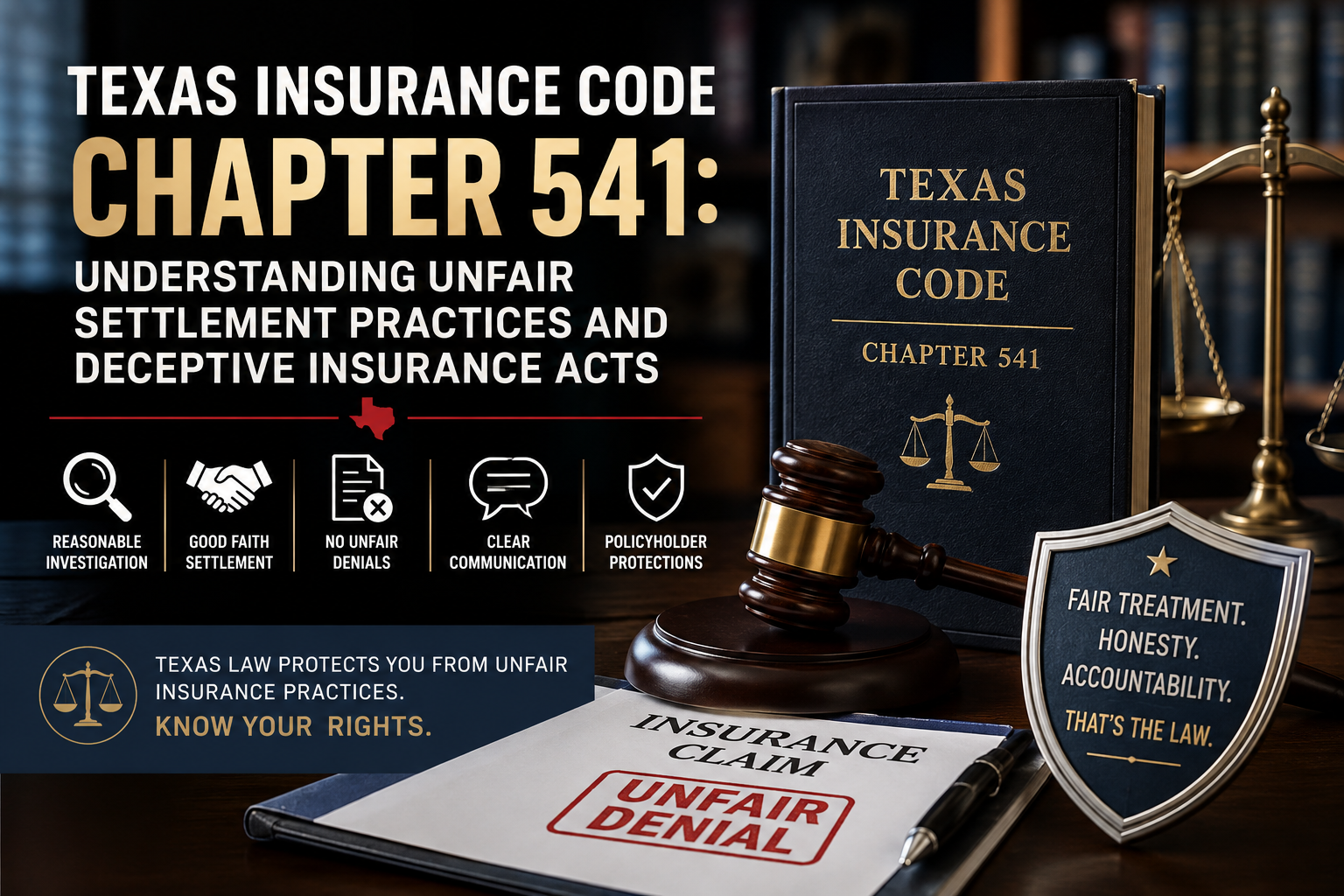
Perhaps the most frequently litigated provision is Texas Insurance Code § 541.060, which identifies numerous unfair settlement practices.
Among other things, an insurer may violate the statute by:
- Misrepresenting an important fact or policy provision.
- Failing to attempt in good faith to effectuate a prompt, fair, and equitable settlement once liability becomes reasonably clear.
- Failing to promptly provide a reasonable explanation for denying a claim.
- Refusing to pay claims without conducting a reasonable investigation.
- Delaying payment by requesting unnecessary information.
Unlike simple disagreements over value, these provisions focus upon the insurer's conduct during the claims process.
Does Every Denied Claim Violate Chapter 541?
No.
The mere denial of a claim does not establish liability.
Insurance companies remain free to:
- dispute coverage,
- interpret policy language,
- contest damages,
- investigate suspicious claims, and
- litigate legitimate disagreements.
Chapter 541 instead focuses upon whether the insurer acted unfairly, deceptively, or unreasonably while handling the claim.
Who Can Be Liable?
Depending upon the circumstances, liability may extend beyond the insurance company itself.
Potential defendants can include:
- insurance companies,
- adjusters,
- insurance agents,
- brokers, and
- other persons engaged in the business of insurance who violate Chapter 541.
The identity of the proper defendant often depends upon the specific conduct alleged.
Relationship to Common-Law Bad Faith
Texas recognizes common-law duties requiring insurers to deal fairly and in good faith with insureds.
Chapter 541 does not replace those claims.
Instead, statutory claims under Chapter 541 often accompany:
- breach of contract,
- common-law bad faith,
- Prompt Payment of Claims Act claims (Chapter 542), and
- declaratory judgment actions involving insurance coverage.
Each claim has different legal elements and may provide different remedies.
Available Remedies
If a Chapter 541 violation is proven, available remedies may include:
- actual damages,
- court costs,
- attorney's fees,
- injunctive relief in appropriate circumstances, and
- additional damages if the conduct was committed knowingly.
The availability of enhanced damages frequently makes Chapter 541 an important component of insurance litigation.
Why Documentation Matters
Because Chapter 541 focuses on how claims are handled, documentation is often critical.
Helpful evidence may include:
- denial letters,
- adjuster communications,
- estimates,
- engineering reports,
- photographs,
- repair invoices,
- emails,
- recorded statements,
- claim notes obtained during litigation, and
- the insurance policy itself.
The timeline of communications often becomes just as important as the ultimate coverage decision.
Practical Takeaway
Not every denied insurance claim is unlawful. However, Texas law requires insurers to investigate claims fairly, communicate honestly, and attempt prompt, equitable settlements when liability becomes reasonably clear.
If an insurer misrepresents coverage, fails to conduct a reasonable investigation, or otherwise violates Chapter 541, Texas law may provide remedies beyond simple breach of contract. Because these cases often involve overlapping statutory and common-law claims, careful legal analysis is essential before filing suit.
If you are involved in an insurance coverage dispute or believe an insurer improperly handled your claim, consulting with an attorney experienced in Texas civil litigation can help determine what remedies may be available.
At David C. Barsalou, Attorney at Law, PLLC, we help clients navigate business, family, tax, estate planning, and real estate matters ranging from document drafting to litigation with clarity and confidence. If you’d like guidance on your situation, schedule a consultation today. Call us at (713) 397-4678, email barsalou.law@gmail.com, or reach us through our Contact Page. We’re here to help you take the next step.