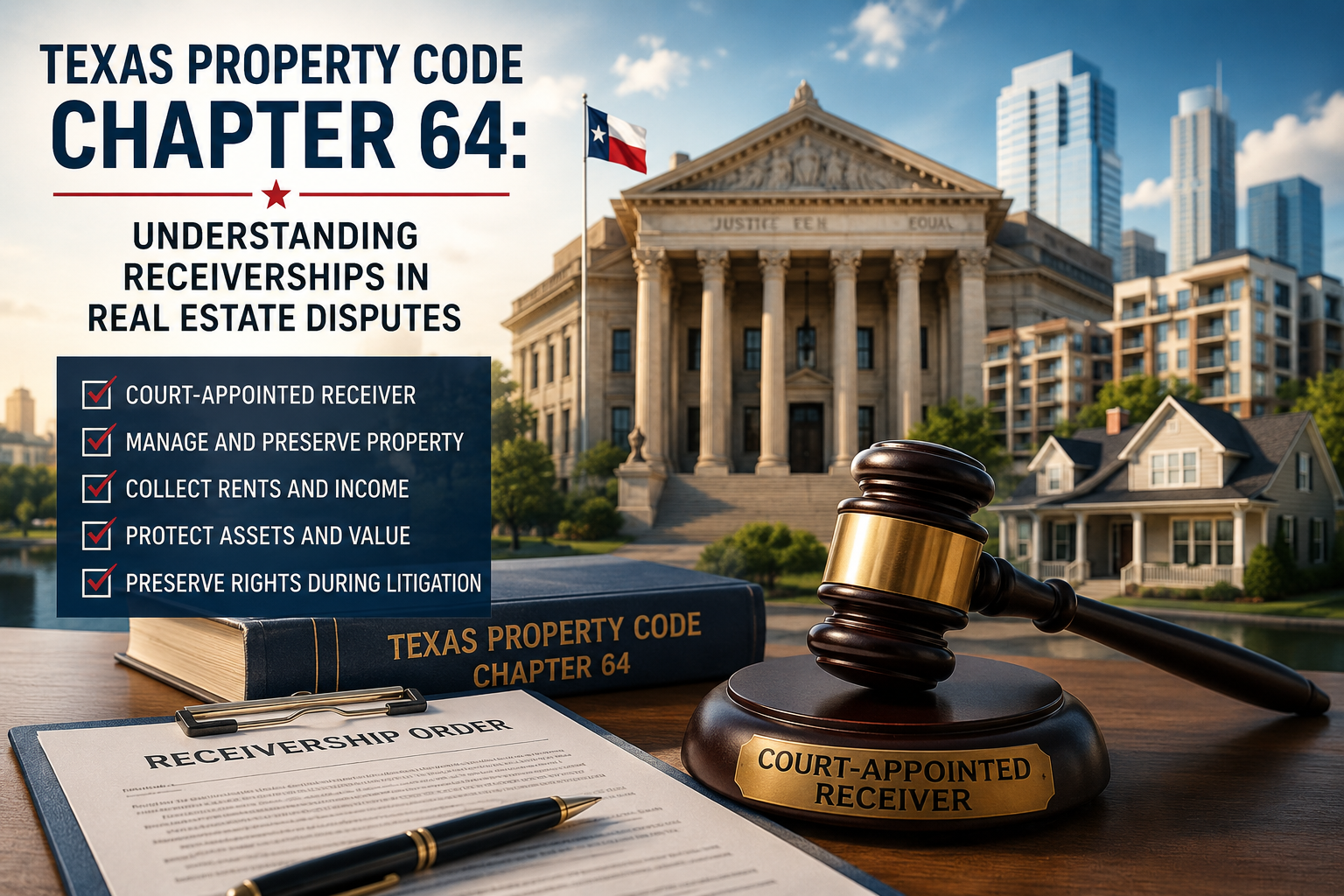
When most people think about a lawsuit involving real estate, they imagine a judge deciding who owns the property or whether money is owed. Few realize that Texas courts sometimes have the authority to place property under the control of a neutral third party known as a receiver.
Receiverships are among the most powerful—and least understood—remedies available under Texas law. In the right circumstances, a receiver can collect rents, manage property, preserve assets, and even facilitate the sale of real estate while litigation is ongoing.
What Is a Receiver?
A receiver is a person appointed by a court to take custody and control of property that is the subject of a dispute. The receiver acts as an officer of the court rather than as an agent of either party.
Texas Property Code Chapter 64 authorizes courts to appoint receivers in various real property disputes where intervention is necessary to preserve property rights or prevent waste.
Texas Property Code § 64.001(a) provides:
"A court of competent jurisdiction may appoint a receiver for real property located in this state."
While that sentence appears simple, the consequences can be significant.
Why Would a Court Appoint a Receiver?
Receivership is considered an extraordinary remedy. Courts generally do not appoint receivers merely because the parties disagree.
Instead, receiverships are often used when:
- Property is being neglected or wasted;
- Co-owners cannot agree on management;
- Rental income is being improperly withheld;
- A property is in danger of foreclosure;
- Fraud or misconduct threatens the property's value;
- The property must be preserved while ownership disputes are resolved.
The goal is usually to preserve the status quo and protect the property until the court can determine the parties' rights.
The Receiver's Powers Can Be Surprisingly Broad
Many property owners are surprised to learn how much authority a receiver may possess.
Under Texas Property Code § 64.031, a receiver may be authorized by court order to:
- Take possession of property;
- Collect rents and income;
- Lease property;
- Make repairs;
- Pay taxes and insurance;
- Preserve and maintain assets;
- Take legal action related to the property.
In some cases, the receiver effectively becomes the property's temporary manager.
Receiverships in Partition Disputes
One common scenario involves co-owned property.
Imagine siblings inherit a rental property. One wants to sell. Another wants to keep it. A third refuses to participate in management at all.
When disputes become severe enough that the property itself is endangered, a court may appoint a receiver to manage the asset while the case proceeds.
This can be especially useful when rent is being collected but not accounted for or when necessary repairs are being ignored.
Receiverships and Commercial Property
Receivers are frequently used in commercial real estate disputes.
For example:
- Shopping centers with ownership disputes;
- Apartment complexes suffering from management breakdowns;
- Office buildings involved in lender litigation;
- Multi-family properties where investors accuse one another of misconduct.
In these situations, a receiver can stabilize operations and protect the property's value pending final resolution.
Can a Receiver Sell Property?
Sometimes.
Texas law allows courts to authorize sales under certain circumstances. Whether a sale is appropriate depends heavily on the facts, the court's order, and the nature of the dispute.
The possibility of a court-authorized sale is one reason receivership proceedings are often taken very seriously by property owners.
Who Pays the Receiver?
Typically, the receiver is compensated from property income or assets under the receiver's control.
The court determines the receiver's compensation, and those costs can become substantial in complex cases.
For that reason alone, parties often have a strong incentive to resolve disputes before a receivership becomes necessary.
Why Property Owners Should Take Receivership Requests Seriously
A motion seeking appointment of a receiver is not just another procedural filing.
If granted, the property owner may temporarily lose significant control over the property. Decisions regarding management, maintenance, leasing, and finances may shift to a court-appointed third party.
For that reason, parties facing a receivership request should carefully evaluate both the legal basis for the request and the practical consequences if the court grants it.
Final Thoughts
Texas Property Code Chapter 64 provides courts with one of the most powerful tools available in real estate litigation: the ability to place property under the control of a neutral receiver.
Although receiverships are considered extraordinary remedies, they can be highly effective when property is being wasted, mismanaged, or threatened during a dispute. Whether you are seeking appointment of a receiver or opposing one, understanding the scope of a receiver's authority can be critical to protecting valuable real estate interests.
Because receiverships can dramatically affect ownership rights, property management, and financial outcomes, property owners should seek legal guidance before the court places their property under someone else's control.
At David C. Barsalou, Attorney at Law, PLLC, we help clients navigate business, family, tax, estate planning, and real estate matters ranging from document drafting to litigation with clarity and confidence. If you’d like guidance on your situation, schedule a consultation today. Call us at (713) 397-4678, email barsalou.law@gmail.com, or reach us through our Contact Page. We’re here to help you take the next step.