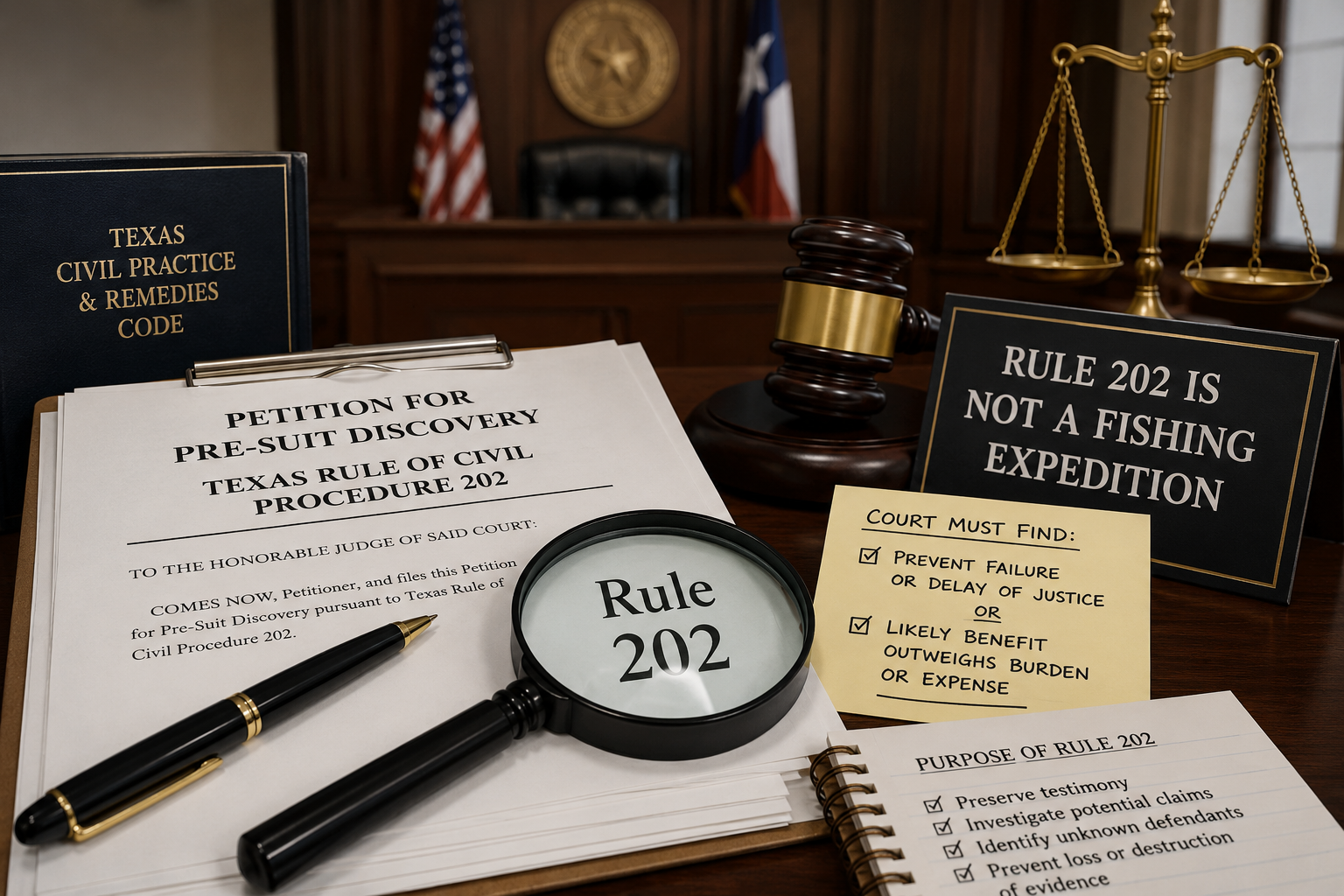
Texas has one of the most unusual procedural tools in the country: pre-suit discovery. Under Texas Rule of Civil Procedure 202, a person can sometimes obtain testimony or documents before filing a lawsuit. This powerful mechanism allows potential litigants to investigate claims, preserve testimony, and identify proper defendants before formal litigation begins.
But Rule 202 is not a blank check. Texas courts have repeatedly emphasized that pre-suit discovery cannot be used as a fishing expedition. In fact, Rule 202 contains significant limitations designed to protect privacy, prevent harassment, and ensure that courts are not used merely to search for possible claims.
Understanding these limitations is critical for both individuals seeking pre-suit discovery and those who find themselves responding to a Rule 202 petition.
What Is Rule 202?
Texas Rule of Civil Procedure 202 permits a court to authorize depositions before a lawsuit is filed in two circumstances:
"A person may petition the court for an order authorizing the taking of a deposition on oral examination or written questions either:
(a) to perpetuate or obtain the person's own testimony or that of any other person for use in an anticipated suit; or
(b) to investigate a potential claim or suit."
Tex. R. Civ. P. 202.1
The second category is what makes Texas unusual. In many jurisdictions, discovery cannot begin until after a lawsuit has been filed. Texas allows limited investigation before filing under appropriate circumstances.
The Required Findings
Before authorizing a deposition, a court must make specific findings.
Rule 202.4(a) provides:
"The court must order a deposition to be taken if, but only if, it finds that:
(1) allowing the petitioner to take the requested deposition may prevent a failure or delay of justice in an anticipated suit; or
(2) the likely benefit of allowing the petitioner to take the requested deposition to investigate a potential claim outweighs the burden or expense of the procedure."
Tex. R. Civ. P. 202.4(a).
The phrase "if, but only if" is important. The rule creates a mandatory limitation on judicial discretion. If the required findings cannot be made, the petition should be denied.
Why Courts Are Skeptical of Fishing Expeditions
Many people mistakenly assume Rule 202 allows them to search for evidence to determine whether someone has done something wrong.
Texas appellate courts have repeatedly rejected that interpretation.
Rule 202 was designed to investigate specific potential claims, not to permit broad-ranging discovery in hopes of finding one.
For example, courts routinely deny petitions that:
- Seek extensive categories of documents;
- Fail to identify a specific potential claim;
- Request discovery from numerous third parties;
- Appear designed to harass an opponent;
- Seek information obtainable through less intrusive means.
The petitioner must generally demonstrate a concrete reason why the requested discovery is necessary.
Privacy Concerns and Third-Party Rights
Rule 202 proceedings often involve requests directed at third parties such as:
- Banks;
- Internet service providers;
- Employers;
- Medical providers;
- Social media companies.
Because no lawsuit has yet been filed, courts frequently scrutinize these requests carefully.
The Texas Supreme Court has recognized that Rule 202 proceedings can create significant privacy concerns. A person may be forced to disclose sensitive information before any formal claim has even been asserted.
As a result, courts often require narrowly tailored requests and may impose protective limitations.
Responding to a Rule 202 Petition
Receiving a Rule 202 petition does not mean discovery will automatically occur.
Potential objections may include:
- Lack of jurisdiction;
- Failure to identify a viable potential claim;
- Excessive scope;
- Undue burden;
- Privacy concerns;
- Availability of information through other means;
- Failure to satisfy Rule 202.4's balancing test.
In many cases, a well-supported objection can substantially narrow or entirely defeat a Rule 202 request.
Can Rule 202 Be Used Against Anonymous Internet Users?
One increasingly common use of Rule 202 is identifying anonymous online speakers.
Businesses, defamation plaintiffs, and other litigants sometimes seek pre-suit discovery from internet platforms or service providers to identify the individuals behind anonymous posts.
Courts must balance competing interests:
- The right to investigate potentially actionable conduct;
- Constitutional free speech protections;
- Privacy interests of anonymous speakers.
As a result, these cases often receive heightened scrutiny.
The Hidden Cost of Abuse
Parties occasionally view Rule 202 as a shortcut around ordinary discovery rules.
That approach can backfire.
Texas courts possess authority to impose sanctions for abusive litigation conduct and may deny relief where a petition appears designed primarily to burden or intimidate another party rather than investigate a legitimate claim.
Additionally, unsuccessful Rule 202 proceedings can generate substantial attorney's fees and litigation expenses before any actual lawsuit is filed.
Practical Takeaway
Rule 202 is one of the most powerful—and most misunderstood—procedural tools in Texas law. It can preserve critical testimony, identify unknown defendants, and allow legitimate investigation before filing suit. At the same time, Texas courts carefully police its use to prevent fishing expeditions and protect privacy rights.
Anyone considering a Rule 202 petition should ensure that the request is narrowly tailored, supported by a legitimate need, and capable of satisfying the balancing test found in Rule 202.4. Likewise, recipients of Rule 202 petitions should understand that they have significant rights and defenses available before any discovery is ordered.
As with many procedural tools, success often depends less on the existence of the rule and more on understanding its limits.
At David C. Barsalou, Attorney at Law, PLLC, we help clients navigate business, family, tax, estate planning, and real estate matters ranging from document drafting to litigation with clarity and confidence. If you’d like guidance on your situation, schedule a consultation today. Call us at (713) 397-4678, email barsalou.law@gmail.com, or reach us through our Contact Page. We’re here to help you take the next step.