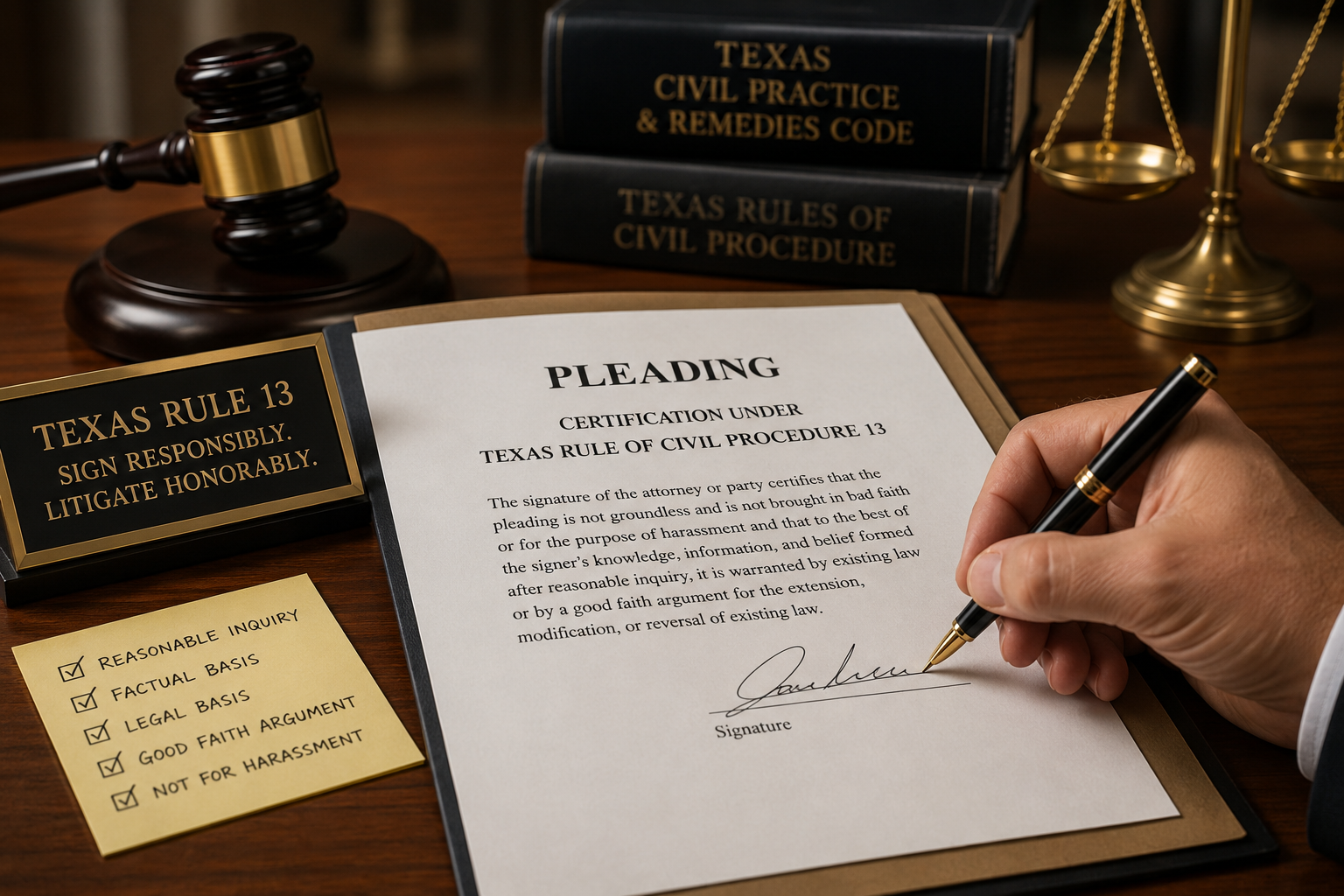
Most Texas litigants understand that filing a frivolous lawsuit can result in sanctions. Far fewer realize that merely signing a pleading, motion, or other paper submitted to the court carries legal consequences. Under Texas law, an attorney's or party's signature is not merely a formality—it is a certification that certain standards have been met.
Texas Rule of Civil Procedure 13 and Chapter 10 of the Texas Civil Practice and Remedies Code often receive most of the attention in sanctions discussions. However, Texas Rule of Civil Procedure 11 contains its own powerful certification requirement regarding representations made to the court. Understanding this rule can help litigants avoid sanctions and better appreciate the responsibilities that come with filing documents in a lawsuit.
The Purpose Behind Rule 11
Texas courts rely heavily upon attorneys and parties to make truthful and well-founded representations. The judicial system cannot function efficiently if pleadings are filed without investigation, for improper purposes, or without factual support.
Rule 11 addresses this concern by treating a signature as more than a procedural requirement. The act of signing itself carries legal significance.
The rule provides:
"The signatures of attorneys or parties constitute a certificate by them that they have read the pleading, motion, or other paper; that to the best of their knowledge, information, and belief formed after reasonable inquiry the instrument is not groundless and brought in bad faith or groundless and brought for the purpose of harassment." Tex. R. Civ. P. 13.
Although Rule 13 is often cited in sanctions proceedings, many lawyers refer to this certification requirement as the Texas version of a Rule 11 obligation because it closely resembles the federal sanctions framework.
What Does "Groundless" Mean?
Rule 13 specifically defines the term:
"Groundless" means having no basis in law or fact and not warranted by good faith argument for the extension, modification, or reversal of existing law.
This definition is critical because many lawsuits fail without being sanctionable. Losing a case is not enough. Being wrong is not enough.
A pleading generally becomes sanctionable only when there is no reasonable legal or factual basis for it and no good-faith argument supporting a change in the law.
Texas courts recognize that litigation frequently involves disputed facts, uncertain legal theories, and evolving precedent. The sanctions process is not intended to punish attorneys simply because they lose.
The Importance of "Reasonable Inquiry"
One of the most overlooked aspects of Rule 13 is the requirement that the signer's belief be formed "after reasonable inquiry."
This means lawyers cannot blindly accept every statement a client provides. Likewise, parties representing themselves cannot file allegations based solely on speculation.
Reasonable inquiry often includes:
- Reviewing relevant documents;
- Interviewing witnesses;
- Examining publicly available records;
- Researching applicable law;
- Confirming factual allegations where possible.
The required level of investigation depends upon the circumstances. Complex commercial litigation generally requires more investigation than an emergency application filed under severe time constraints.
Bad Faith Versus Harassment
Rule 13 authorizes sanctions where a pleading is:
- Groundless and brought in bad faith; or
- Groundless and brought for purposes of harassment.
Bad faith generally refers to a dishonest or improper motive.
Harassment involves using litigation as a weapon rather than a legitimate means of resolving a legal dispute. Examples may include:
- Filing meritless claims solely to increase litigation costs;
- Repeatedly asserting allegations known to be false;
- Using the lawsuit process to pressure someone for unrelated reasons;
- Filing duplicative proceedings without justification.
The existence of an improper motive is often difficult to prove, which is one reason sanctions are not imposed lightly.
The Presumption Against Sanctions
Texas law creates an important safeguard for litigants.
Rule 13 expressly provides:
"Courts shall presume that pleadings, motions, and other papers are filed in good faith."
This presumption places the burden on the party seeking sanctions.
In practice, this means courts generally require evidence—not merely accusations—before imposing sanctions. A party cannot obtain sanctions simply because they believe the opposing side's arguments are weak.
Procedural Requirements Matter
Texas appellate courts frequently reverse sanctions orders when trial courts fail to follow proper procedures.
Before sanctions may be imposed, courts generally must provide:
- Notice of the alleged sanctionable conduct;
- An opportunity to be heard;
- Particularized findings supporting the sanctions imposed.
Because sanctions can affect professional reputations and substantially increase litigation costs, Texas courts require careful adherence to due-process protections.
What Sanctions Can Be Imposed?
Rule 13 authorizes courts to impose an "appropriate sanction" available under Rule 215.
Potential sanctions may include:
- Monetary penalties;
- Payment of attorneys' fees;
- Striking pleadings;
- Excluding evidence;
- Dismissal of claims in extreme circumstances.
The sanction imposed must bear a direct relationship to the misconduct and should not be excessive.
Texas courts generally prefer lesser sanctions before imposing case-dispositive penalties.
Practical Lessons for Litigants
For attorneys, the lesson is straightforward: investigate before filing.
For clients, the lesson is equally important: provide complete and accurate information to your lawyer. Omitting key facts can undermine the attorney's ability to conduct the reasonable inquiry required by Rule 13.
Litigation is adversarial, and strong advocacy is expected. However, Texas courts draw a clear distinction between aggressive representation and groundless litigation.
Final Thoughts
The signature appearing at the bottom of a pleading may seem routine, but under Texas law it carries significant legal weight. By signing a pleading, motion, or other paper, a party or attorney certifies that reasonable inquiry has been conducted and that the filing is not groundless, brought in bad faith, or intended merely to harass.
Understanding these obligations helps protect litigants, preserves the integrity of the judicial process, and reminds everyone involved that access to the courts comes with corresponding responsibilities.
If you are involved in a Texas lawsuit and have questions about sanctions, pleadings, or litigation strategy, consulting with experienced counsel can help you avoid costly procedural mistakes.
At David C. Barsalou, Attorney at Law, PLLC, we help clients navigate business, family, tax, estate planning, and real estate matters ranging from document drafting to litigation with clarity and confidence. If you’d like guidance on your situation, schedule a consultation today. Call us at (713) 397-4678, email barsalou.law@gmail.com, or reach us through our Contact Page. We’re here to help you take the next step.
