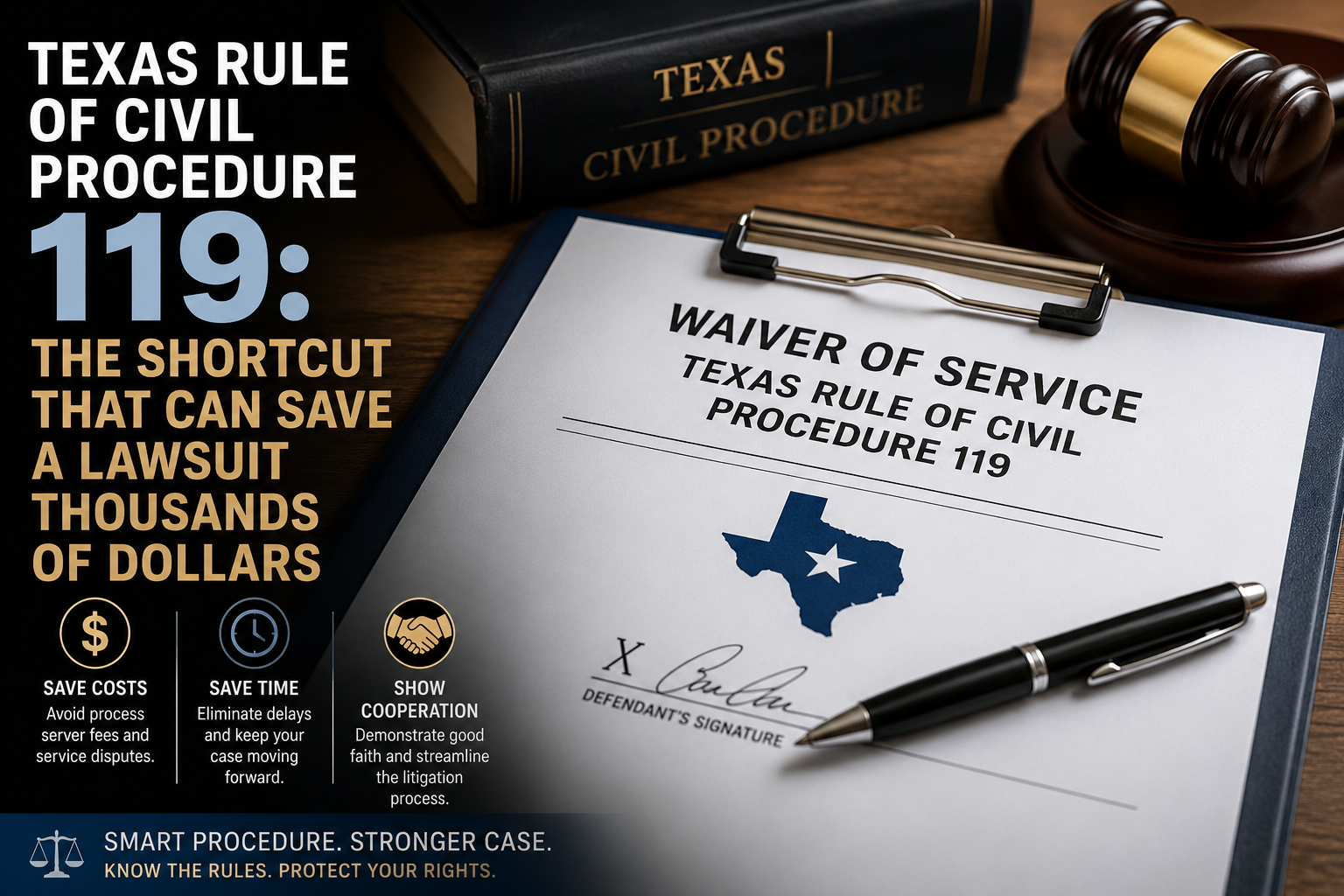
Many Texas lawsuits begin with a chase. Process servers knock on doors, defendants avoid service, motions for substituted service are filed, and deadlines stretch out for weeks. But Texas law contains a little-known procedural shortcut that can eliminate much of this drama: Texas Rule of Civil Procedure 119, the Acceptance or Waiver of Service. While simple in appearance, this rule can dramatically reduce litigation costs and accelerate a case—if used correctly.
What Is Rule 119?
Texas Rule of Civil Procedure 119 allows a defendant to formally accept or waive service of process rather than requiring formal service by a constable, sheriff, or private process server.
The rule provides:
"The defendant may accept service of process, or waive the issuance or service thereof by a written memorandum signed by him, or by his duly authorized agent or attorney, after suit is brought, sworn to before a proper officer other than an attorney in the case, and filed among the papers of the cause..." Tex. R. Civ. P. 119.
In other words, once a lawsuit has been filed, a defendant can voluntarily acknowledge receipt of the lawsuit and eliminate the need for formal service.
Why This Rule Exists
The purpose of service is constitutional. Before a court can exercise jurisdiction over a defendant, the defendant must receive notice and an opportunity to be heard.
However, there is little reason to spend money locating and serving a defendant who already knows about the lawsuit and is willing to acknowledge receipt.
Rule 119 allows parties to bypass the mechanics of service while still preserving due process.
The Hidden Requirements
Many lawyers know that waivers of service exist. Fewer appreciate that Rule 119 contains technical requirements.
The waiver must generally:
- Be signed after the lawsuit is filed;
- Be sworn before a proper officer;
- Be filed with the court; and
- Identify the lawsuit being accepted or waived.
The requirement that the waiver be executed after the suit is filed is particularly important. A pre-suit agreement to waive future service generally does not satisfy Rule 119.
Acceptance of Service vs. Waiver of Service
The rule actually contemplates two related concepts.
Acceptance of Service
A defendant may acknowledge receipt of the petition and citation.
In effect, the defendant is saying:
"I received the lawsuit and do not require a process server to hand it to me."
Waiver of Service
A defendant may go further and waive formal issuance or service entirely.
This can be particularly useful in:
- Agreed divorces;
- Probate proceedings;
- Business disputes between cooperating parties;
- Declaratory judgment actions;
- Family settlements.
Why Family Lawyers Use It Constantly
Rule 119 appears throughout Texas family law practice.
For example:
- Agreed divorces frequently involve waivers of service;
- Modifications may proceed using waivers;
- Certain uncontested SAPCR proceedings use waivers;
- Probate matters often utilize waivers and consents.
When parties are cooperating, spending money on formal service often serves little purpose.
The Cost Savings Can Be Significant
A routine service attempt may involve:
- Filing fees;
- Citation fees;
- Process server fees;
- Skip tracing costs;
- Multiple service attempts;
- Motions for substituted service.
In some cases, service issues alone can add hundreds or even thousands of dollars to litigation expenses.
A properly executed Rule 119 waiver can eliminate nearly all of those costs.
The Trap: Waiving Service Does Not Mean Waiving Rights
One common misconception is that signing a waiver means surrendering defenses.
Not necessarily.
A defendant who accepts or waives service generally still retains the ability to:
- File an answer;
- Assert affirmative defenses;
- Conduct discovery;
- Contest liability;
- Seek affirmative relief.
The waiver typically addresses only the method of service—not the merits of the lawsuit.
That distinction is critical.
The Bigger Trap: Default Judgments
The greater danger often falls on the defendant.
Once service has been accepted or waived, answer deadlines begin running.
Many people mistakenly believe:
"I signed a waiver, so I'll deal with the lawsuit later."
That can be a costly mistake.
Failure to timely answer after a valid waiver may expose the defendant to a default judgment just as if formal service had occurred.
The Rule 120 Connection
Texas lawyers often discuss Rules 119 and 120 together.
Rule 120 provides:
"The defendant may, in person, or by attorney, or by his duly authorized agent, enter an appearance in open court." Tex. R. Civ. P. 120.
Both rules operate on the same underlying principle: a party can voluntarily submit to the court's authority without requiring formal service procedures.
The difference is that Rule 119 focuses on accepting or waiving service, while Rule 120 concerns appearances generally.
Strategic Uses in Litigation
Experienced litigators sometimes use Rule 119 strategically.
Examples include:
- Preventing unnecessary service expenses;
- Demonstrating cooperation to the court;
- Accelerating scheduling orders;
- Beginning discovery sooner;
- Facilitating settlements;
- Avoiding disputes over defective service.
In some cases, obtaining a waiver can save more time than filing an early motion.
Conclusion
Texas Rule of Civil Procedure 119 is one of those procedural rules that rarely attracts attention but frequently changes the economics of a lawsuit. By allowing defendants to accept or waive service after suit is filed, the rule can eliminate unnecessary expense, reduce delay, and help cases move more efficiently through the court system.
For plaintiffs, it can save substantial service costs. For defendants, it can demonstrate cooperation while preserving substantive defenses. But both sides should remember the same lesson: once service is accepted or waived, litigation deadlines begin running, and the lawsuit becomes very real very quickly.
For that reason, Rule 119 remains one of the most practical—and most overlooked—procedural shortcuts in Texas civil practice.
This article is provided for educational purposes only and does not constitute legal advice. If you have questions regarding service of process, waivers, default judgments, or Texas civil procedure, consult a qualified Texas attorney.
At David C. Barsalou, Attorney at Law, PLLC, we help clients navigate business, family, tax, estate planning, and real estate matters ranging from document drafting to litigation with clarity and confidence. If you’d like guidance on your situation, schedule a consultation today. Call us at (713) 397-4678, email barsalou.law@gmail.com, or reach us through our Contact Page. We’re here to help you take the next step.