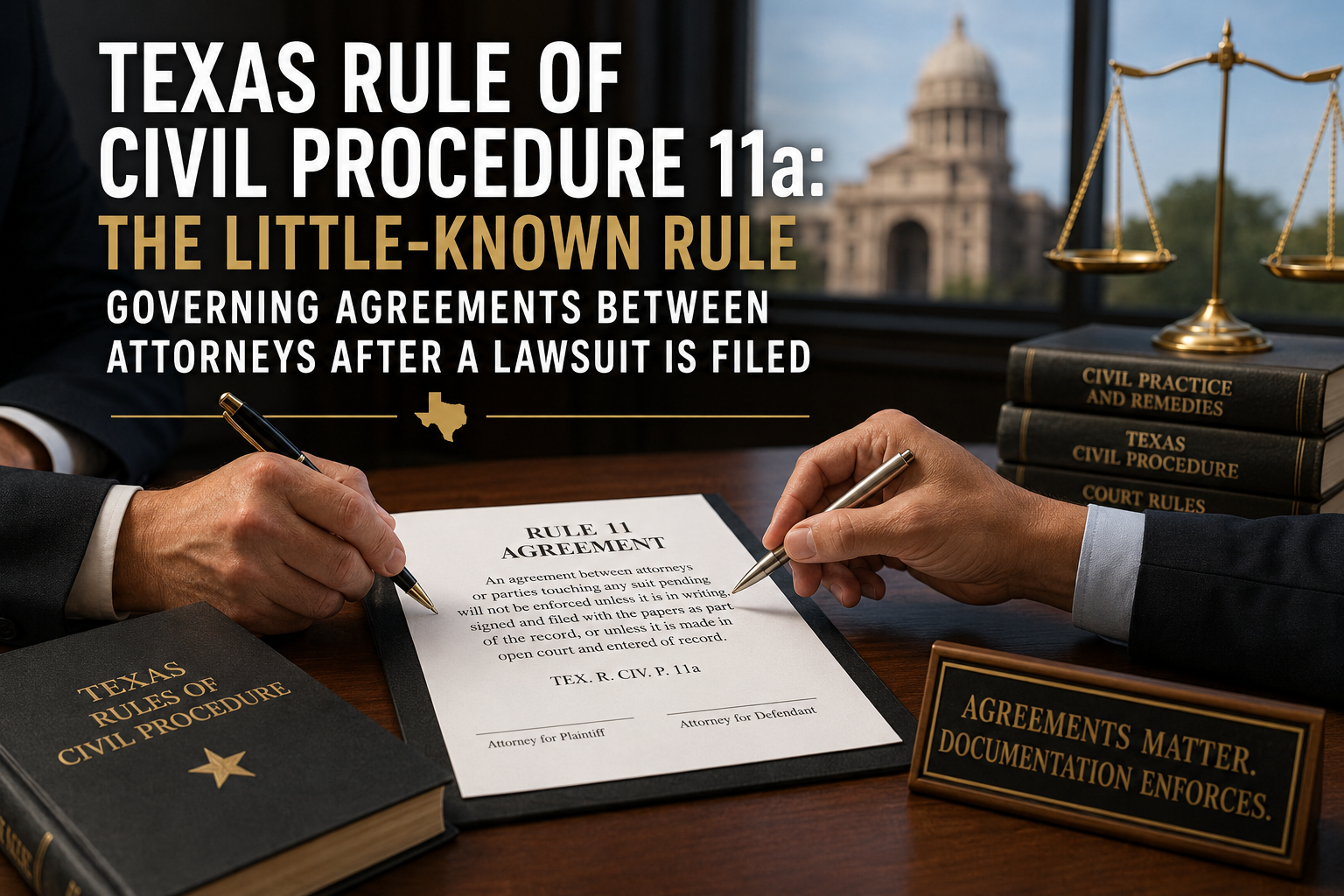
Texas litigation is full of deadlines, scheduling disputes, and strategic decisions. Attorneys routinely agree to extend discovery deadlines, continue hearings, postpone depositions, or modify litigation schedules. Most lawyers know about Texas Rule of Civil Procedure 11, which governs agreements between parties or attorneys concerning pending lawsuits.
Far fewer lawyers regularly think about Texas Rule of Civil Procedure 11a, despite the fact that it addresses an important practical issue involving attorney agreements.
Understanding how Rules 11 and 11a work together can help litigants avoid unnecessary disputes and prevent otherwise valid agreements from becoming unenforceable.
What Does Rule 11a Say?
Texas Rule of Civil Procedure 11a provides:
"An agreement between attorneys or parties touching any suit pending will not be enforced unless it is in writing, signed and filed with the papers as part of the record, or unless it is made in open court and entered of record."
Although practitioners often simply refer to "Rule 11 agreements," Rule 11a reinforces one of the most important procedural principles in Texas litigation:
Private agreements are generally not enforceable unless they comply with the rule's formal requirements.
Why Does This Rule Exist?
Imagine two attorneys have the following conversation:
"We'll postpone tomorrow's hearing."
Neither lawyer files anything.
The next morning, one attorney appears.
The other does not.
The absent attorney later argues:
"We had an agreement."
The court now faces a credibility contest.
Rule 11a largely eliminates this problem by requiring objective proof of litigation agreements.
The Formal Requirements
Generally, an enforceable litigation agreement must be either:
- reduced to writing,
- signed,
- filed with the court,
or
- made in open court,
- and entered into the record.
Without satisfying one of these methods, the agreement may not be enforceable.
Common Rule 11a Agreements
Texas attorneys frequently use Rule 11 agreements regarding:
- continuances;
- discovery extensions;
- scheduling depositions;
- mediation deadlines;
- temporary agreements during litigation;
- agreed protective orders;
- agreed amendments to scheduling orders;
- extensions for responses to written discovery;
- postponement of hearings.
Many cases operate smoothly because counsel cooperate through these agreements.
Email Agreements
One question that frequently arises is whether email exchanges satisfy Rule 11.
Modern Texas practice often recognizes electronic signatures and electronically filed agreements, but the safest practice remains to:
- clearly memorialize the agreement,
- ensure both sides assent,
- sign when appropriate,
- and file the agreement with the court if enforcement may later become necessary.
Merely assuming everyone remembers the conversation can create unnecessary risk.
Oral Agreements Can Be Dangerous
Many attorneys develop cordial professional relationships.
Unfortunately, memories differ.
A conversation like:
"I think we're good."
may later become:
"That's not what I agreed to."
Without a compliant Rule 11 agreement, courts frequently refuse to enforce informal understandings.
Relationship to Rule 11
Texas Rule of Civil Procedure 11 supplies the procedural mechanism for enforceable litigation agreements.
Rule 11a complements that principle by emphasizing that agreements affecting pending litigation require proper documentation before the court will enforce them.
The practical lesson is simple:
If an agreement matters, write it down.
Practical Examples
Example One
Plaintiff agrees to extend Defendant's deadline to answer discovery by thirty days.
Counsel exchange a signed Rule 11 agreement and file it.
The deadline is successfully extended.
Example Two
Defense counsel verbally agrees to continue a hearing.
Nothing is filed.
Plaintiff appears.
Defense counsel does not.
The court proceeds because there is no enforceable Rule 11 agreement in the record.
Example Three
The parties agree during a hearing, and the judge states the agreement on the record.
The court reporter records the agreement.
The agreement generally satisfies Rule 11 because it was made in open court and entered of record.
Why This Matters
Litigation often moves quickly.
Attorneys negotiate constantly.
Without enforceable documentation, disputes over what was supposedly agreed can waste time, increase litigation costs, and damage credibility before the court.
Rule 11a promotes certainty by ensuring that litigation agreements are supported by an objective record rather than competing recollections.
Final Thoughts
Professional cooperation is an important part of Texas litigation. Lawyers routinely grant reasonable extensions and resolve scheduling disputes without court intervention. However, good professional relationships should always be supported by good documentation.
Texas Rule of Civil Procedure 11a serves as a reminder that agreements affecting pending litigation should be reduced to writing and properly preserved. A simple signed filing today can prevent an expensive procedural fight tomorrow.
If you have questions regarding Texas civil litigation, procedural rules, or enforcement of litigation agreements, consulting an experienced Texas attorney can help protect your rights and avoid unnecessary procedural pitfalls.
Disclaimer: This article is provided for informational purposes only and does not constitute legal advice. Every case presents unique facts, and you should consult an attorney regarding your specific circumstances.
At David C. Barsalou, Attorney at Law, PLLC, we help clients navigate business, family, tax, estate planning, and real estate matters ranging from document drafting to litigation with clarity and confidence. If you’d like guidance on your situation, schedule a consultation today. Call us at (713) 397-4678, email barsalou.law@gmail.com, or reach us through our Contact Page. We’re here to help you take the next step.
