Understanding Attorney Withdrawal Under Texas Law
One of the most misunderstood procedural issues in Texas litigation is attorney withdrawal. Many clients assume that their lawyer can simply stop representing them whenever the relationship deteriorates. Likewise, some attorneys assume that filing a motion to withdraw automatically ends the representation.
Neither assumption is correct.
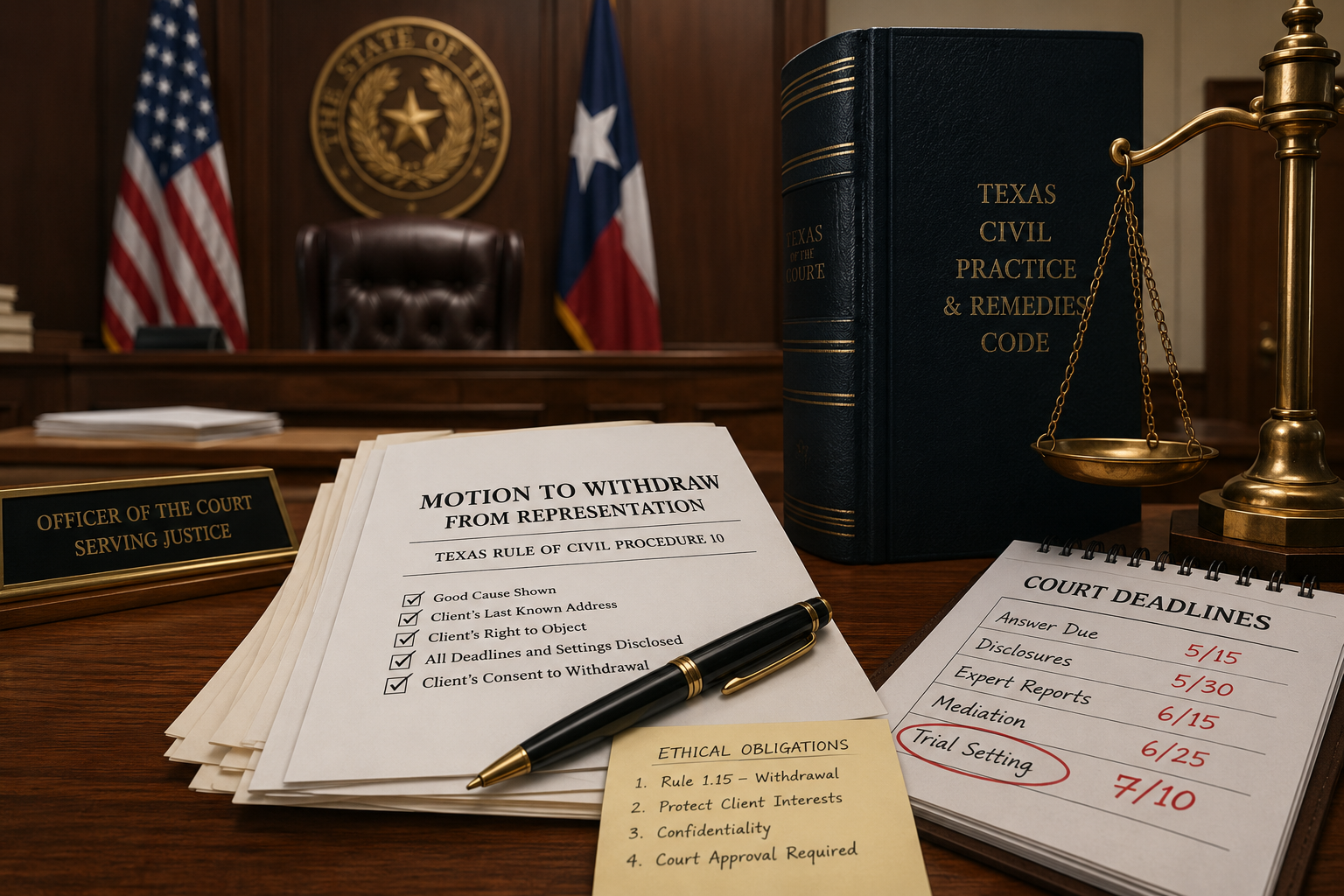
In Texas litigation, attorney withdrawal is governed primarily by Texas Rule of Civil Procedure 10, together with professional obligations imposed by the Texas Disciplinary Rules of Professional Conduct. Courts maintain significant control over when an attorney may withdraw from a pending case, particularly when trial settings or important deadlines are approaching.
Understanding these rules can help litigants avoid costly mistakes and ensure that cases continue to move through the judicial system fairly.
The Governing Rule
Texas Rule of Civil Procedure 10 provides:
"An attorney may withdraw from representing a party only upon written motion for good cause shown."
The rule further requires notice to the client and identifies specific information that must be included in the motion.
This means that an attorney's representation does not end merely because the attorney wishes to stop working on the matter. Instead, the court must approve the withdrawal.
Why Courts Control Withdrawals
Texas courts have a strong interest in maintaining the orderly administration of justice.
Imagine a complex divorce case set for trial in two weeks. If counsel could simply withdraw without court approval, the opposing party, witnesses, and the court itself could be severely prejudiced.
As a result, courts balance several competing interests:
- The attorney's legitimate reasons for withdrawing;
- The client's right to representation;
- The opposing party's interest in an efficient resolution;
- The court's interest in managing its docket.
The closer a case gets to trial, the more carefully courts tend to scrutinize withdrawal requests.
What Must Be Included in a Motion to Withdraw?
Rule 10 requires the motion to identify:
- The client's last known address;
- The client's right to object;
- Whether all deadlines and settings have been disclosed to the client;
- Whether the client consents to the withdrawal.
The motion must generally be delivered to the client.
Courts frequently deny motions that fail to satisfy these technical requirements.
What Constitutes "Good Cause"?
The rule itself does not define "good cause," but common examples include:
Failure to Pay Fees
A client who repeatedly refuses to pay agreed legal fees may provide grounds for withdrawal.
However, even nonpayment does not guarantee withdrawal if doing so would substantially prejudice the client or disrupt the court's schedule.
Breakdown in Communication
An attorney cannot effectively represent a client who refuses to communicate.
When a client stops responding to calls, emails, letters, or requests for information, courts often find good cause for withdrawal.
Ethical Conflicts
Sometimes circumstances arise that make continued representation ethically impossible.
For example, a lawyer may discover a conflict of interest or learn facts that require withdrawal under the Texas Disciplinary Rules of Professional Conduct.
Client Misconduct
Withdrawal may also be appropriate when a client demands conduct that violates the law or ethical rules.
Attorneys cannot assist clients in presenting false evidence or pursuing fraudulent objectives.
The Texas Disciplinary Rules
Rule 1.15 of the Texas Disciplinary Rules of Professional Conduct addresses both mandatory and permissive withdrawal.
Certain circumstances require withdrawal, while others merely permit it.
Examples of mandatory withdrawal may include situations where representation would result in a violation of the disciplinary rules or other law.
Examples of permissive withdrawal may include:
- Failure to fulfill obligations to the lawyer;
- Unreasonable difficulty caused by the client;
- Fundamental disagreements regarding representation.
Even when withdrawal is ethically permitted, court approval is still required in pending litigation.
Can a Client Prevent Withdrawal?
Sometimes.
A client may object to the motion and explain why withdrawal would cause substantial hardship.
Courts may deny withdrawal when:
- Trial is imminent;
- Discovery deadlines are approaching;
- The client would be severely prejudiced;
- Withdrawal appears intended primarily to delay proceedings.
This is particularly common in family law litigation and other highly contested matters.
What Happens After Withdrawal?
Once withdrawal is granted, the client generally becomes responsible for the case unless and until new counsel appears.
This creates significant risks.
The client remains responsible for:
- Court deadlines;
- Discovery responses;
- Hearings;
- Trial settings;
- Compliance with court orders.
Texas courts typically expect self-represented litigants to follow the same procedural rules that apply to attorneys.
Practical Considerations for Clients
If your attorney seeks withdrawal, do not ignore the motion.
Instead:
- Review the motion carefully;
- Determine upcoming deadlines;
- Consider retaining substitute counsel immediately;
- File any appropriate objections before the hearing.
Waiting until after withdrawal is granted can significantly reduce available options.
Practical Considerations for Attorneys
Attorneys should avoid treating withdrawal as a routine administrative filing.
A proper motion should:
- Comply strictly with Rule 10;
- Provide adequate notice;
- Protect client confidentiality;
- Avoid disclosure of privileged information;
- Ensure the client understands upcoming deadlines.
Failure to do so may result in denial of the motion or additional court scrutiny.
Conclusion
Attorney withdrawal in Texas is governed by procedural and ethical requirements designed to protect clients, opposing parties, and the judicial system. While lawyers may have legitimate reasons to end a representation, they generally cannot simply walk away from a pending lawsuit. Texas Rule of Civil Procedure 10 requires court approval, proper notice, and good cause before withdrawal becomes effective.
Whether you are a client facing attorney withdrawal or a lawyer seeking to withdraw from representation, understanding these procedural requirements can help avoid unnecessary delays, sanctions, and prejudice to the underlying case.
At David C. Barsalou, Attorney at Law, PLLC, we help clients navigate business, family, tax, estate planning, and real estate matters ranging from document drafting to litigation with clarity and confidence. If you’d like guidance on your situation, schedule a consultation today. Call us at (713) 397-4678, email barsalou.law@gmail.com, or reach us through our Contact Page. We’re here to help you take the next step.
