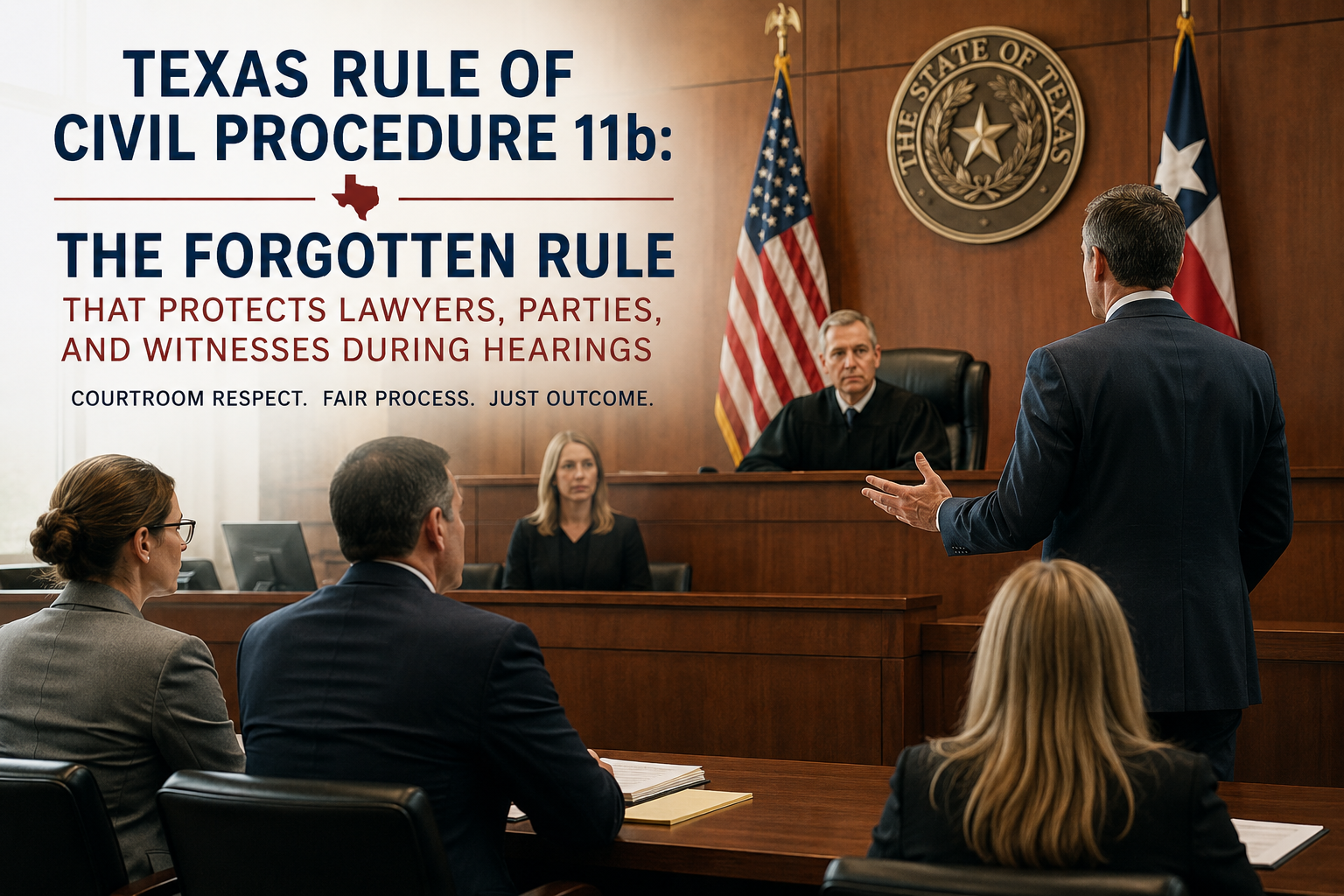
Understanding the Rule Against Disruptive Conduct in Texas Court Proceedings
Most Texas litigants understand that courts have broad authority to maintain order in the courtroom. What many people do not realize is that the Texas Rules of Civil Procedure contain a specific rule addressing disruptive conduct by attorneys, parties, witnesses, and spectators during court proceedings.
Texas Rule of Civil Procedure 11b is rarely discussed outside legal circles, yet it plays an important role in ensuring that hearings and trials proceed fairly and efficiently. In an era where emotions often run high during family law disputes, business litigation, probate contests, and property disputes, Rule 11b serves as an important reminder that the courtroom is a place for evidence and legal argument—not intimidation or disruption.
What Does Rule 11b Say?
Texas Rule of Civil Procedure 11b provides:
"No attorney shall engage in abusive or obstreperous conduct, nor shall any attorney encourage any person under the attorney's control to engage in such conduct. A court must not require any attorney to violate these rules."
The rule further authorizes trial courts to maintain decorum and impose appropriate sanctions when courtroom conduct interferes with the administration of justice.
Although short, the rule reflects a fundamental principle of the judicial system: disputes must be resolved through lawful procedures rather than intimidation, harassment, or disorderly behavior.
Why Rule 11b Matters
Many people assume courtroom decorum is governed solely by a judge's inherent authority. While judges certainly possess inherent powers, Rule 11b codifies expectations regarding professional behavior during litigation.
The rule protects:
- Attorneys attempting to represent clients effectively;
- Witnesses providing testimony;
- Parties seeking a fair hearing;
- Court staff performing official duties; and
- The integrity of the judicial process itself.
Without such protections, hearings could devolve into confrontational spectacles rather than reasoned legal proceedings.
What Conduct Can Create Problems?
Rule 11b does not provide an exhaustive list of prohibited conduct. However, courts generally disapprove of behavior such as:
- Repeated interruptions of the court;
- Personal attacks against opposing counsel;
- Intimidation of witnesses;
- Threatening behavior;
- Refusal to obey courtroom instructions;
- Encouraging clients or spectators to disrupt proceedings; and
- Conduct designed to delay or obstruct the administration of justice.
Importantly, vigorous advocacy is not the same thing as abusive conduct. Lawyers are expected to advocate zealously for their clients. Rule 11b addresses conduct that crosses the line from advocacy into disruption.
The Court's Authority to Respond
Texas courts possess broad authority to address disruptive conduct.
For example, Texas Government Code § 21.001(a) provides:
"A court has all powers necessary for the exercise of its jurisdiction and the enforcement of its lawful orders, including authority to issue writs and other process necessary to enforce its jurisdiction."
This statutory authority works alongside Rule 11b to allow courts to maintain order and protect the integrity of proceedings.
Depending on the circumstances, a court may:
- Admonish counsel or parties;
- Exclude disruptive spectators;
- Impose sanctions;
- Hold individuals in contempt; or
- Take other actions necessary to restore order.
The specific remedy will depend upon the severity of the misconduct.
Family Law Cases and High-Conflict Litigation
Rule 11b often becomes particularly relevant in emotionally charged litigation.
Divorce cases, child custody disputes, probate contests, and business breakups frequently involve parties who have deep personal disagreements. Those emotions can spill into court proceedings.
Judges expect parties to communicate through counsel, present evidence properly, and follow courtroom procedures. Attempts to argue directly with witnesses, confront opposing parties, or disrupt testimony can quickly create problems under Rule 11b and the court's inherent authority.
Does Rule 11b Apply Outside the Courtroom?
While Rule 11b is most commonly associated with courtroom conduct, courts increasingly expect professionalism throughout the litigation process.
Abusive conduct during depositions, hearings conducted by videoconference, or other formal proceedings may result in sanctions under various procedural rules and the court's inherent authority.
The modern courtroom may include Zoom hearings and electronic proceedings, but the expectation of professionalism remains unchanged.
Practical Advice for Litigants
If you are involved in a lawsuit, remember several basic principles:
- Let your attorney speak for you.
- Avoid arguing with witnesses or opposing parties.
- Follow the judge's instructions immediately.
- Remain respectful even when you strongly disagree.
- Focus on evidence rather than emotion.
A litigant who appears calm, respectful, and credible generally helps their case far more than one who becomes confrontational.
Conclusion
Texas Rule of Civil Procedure 11b is one of the shortest rules in the Texas procedural framework, but its purpose is significant. The rule reinforces a simple principle: courts exist to resolve disputes through law and evidence, not through intimidation or disorder.
Whether the case involves a divorce, probate dispute, real estate conflict, or commercial lawsuit, Rule 11b helps ensure that all participants receive a fair opportunity to be heard in an orderly judicial proceeding. By promoting professionalism and respect, the rule ultimately protects both litigants and the integrity of the Texas justice system.
At David C. Barsalou, Attorney at Law, PLLC, we help clients navigate business, family, tax, estate planning, and real estate matters ranging from document drafting to litigation with clarity and confidence. If you’d like guidance on your situation, schedule a consultation today. Call us at (713) 397-4678, email barsalou.law@gmail.com, or reach us through our Contact Page. We’re here to help you take the next step.