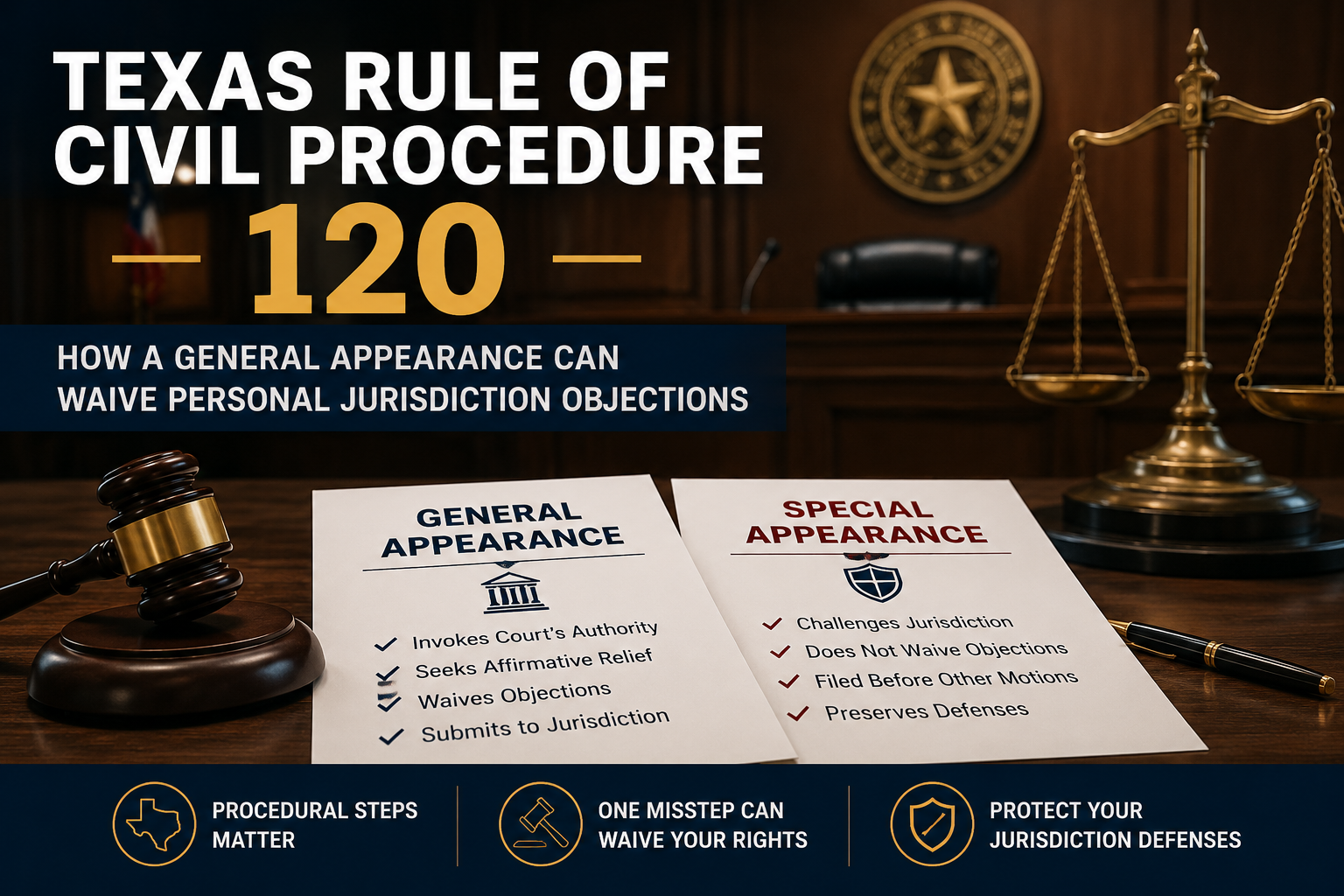
When lawyers discuss jurisdictional challenges in Texas, most attention goes to Texas Rule of Civil Procedure 120a, which governs special appearances. However, Rule 120 itself is equally important because it explains how a party enters a general appearance—and how that appearance can unintentionally waive objections to personal jurisdiction.
For litigants and attorneys alike, understanding Rule 120 is critical. A party may have a valid argument that a Texas court lacks personal jurisdiction, only to lose that argument by taking actions that amount to a general appearance.
What Does Rule 120 Say?
Texas Rule of Civil Procedure 120 provides:
"The defendant may, in person, or by attorney, or by his duly authorized agent, enter an appearance in open court. Such appearance shall be noted by the judge upon his docket and entered in the minutes."
Although the rule itself is brief, Texas courts have developed a substantial body of case law defining what constitutes a general appearance and the consequences that follow.
Why Does an Appearance Matter?
Personal jurisdiction concerns a court's authority over a particular defendant. A defendant who lacks sufficient contacts with Texas may seek dismissal through a special appearance under Rule 120a.
However, if the defendant first enters a general appearance, the objection is ordinarily waived.
This principle exists because a party who asks the court for affirmative relief is effectively recognizing the court's authority over them.
What Is a General Appearance?
Texas courts generally hold that a party enters a general appearance when the party:
- Invokes the judgment of the court on a question other than jurisdiction;
- Recognizes by its acts that an action is properly pending; or
- Seeks affirmative action from the court.
The key question is whether the party's conduct demonstrates an intention to submit to the court's jurisdiction.
Common Examples of General Appearances
The following actions may constitute a general appearance:
- Filing an answer without preserving a special appearance;
- Requesting affirmative relief from the court;
- Filing certain motions unrelated to jurisdiction;
- Participating in hearings on substantive matters;
- Seeking rulings on the merits of the case.
Once a general appearance occurs, the defendant may no longer challenge personal jurisdiction through a special appearance.
The Relationship Between Rule 120 and Rule 120a
Rule 120a expressly states that a special appearance must be filed before any other plea, pleading, or motion.
This sequencing requirement is strict.
A defendant who files a counterclaim, requests substantive relief, or otherwise seeks the court's assistance before presenting a special appearance may inadvertently waive the jurisdictional challenge.
As a result, lawyers frequently treat special appearances as emergency procedural matters requiring immediate attention.
Why This Matters in Business Litigation
The issue often arises in cases involving:
- Out-of-state companies;
- Nonresident business owners;
- Internet-based transactions;
- Contract disputes involving forum selection provisions;
- Real estate investments involving non-Texas parties.
A defendant may believe Texas lacks jurisdiction, yet lose that argument through procedural missteps occurring within days of being served.
Practical Litigation Considerations
The safest approach for a defendant questioning Texas jurisdiction is to:
- Analyze jurisdiction immediately upon service;
- Determine whether a special appearance is appropriate;
- File the special appearance before seeking any other relief;
- Avoid conduct that could be construed as recognizing the court's authority over the merits of the dispute.
Because waiver can occur through procedural actions, jurisdictional strategy often must be decided before any substantive defense is presented.
Conclusion
Texas Rule of Civil Procedure 120 appears simple, but it plays a significant role in determining whether a defendant has submitted to a Texas court's jurisdiction. A general appearance can have far-reaching consequences, particularly when a party intends to challenge personal jurisdiction under Rule 120a.
In Texas litigation, jurisdictional defenses are often won or lost not on the underlying facts, but on procedural timing. Understanding the distinction between a general appearance and a special appearance can prevent a costly waiver and preserve a potentially dispositive defense.
At David C. Barsalou, Attorney at Law, PLLC, we help clients navigate business, family, tax, estate planning, and real estate matters ranging from document drafting to litigation with clarity and confidence. If you’d like guidance on your situation, schedule a consultation today. Call us at (713) 397-4678, email barsalou.law@gmail.com, or reach us through our Contact Page. We’re here to help you take the next step.