When people imagine a civil lawsuit, they usually picture the trial itself: witnesses taking the stand, lawyers questioning them, exhibits being shown to a judge or jury, and ultimately a verdict or judgment.
But by the time a Texas civil case actually reaches trial, many of the important decisions about how that trial will proceed may already have been made.
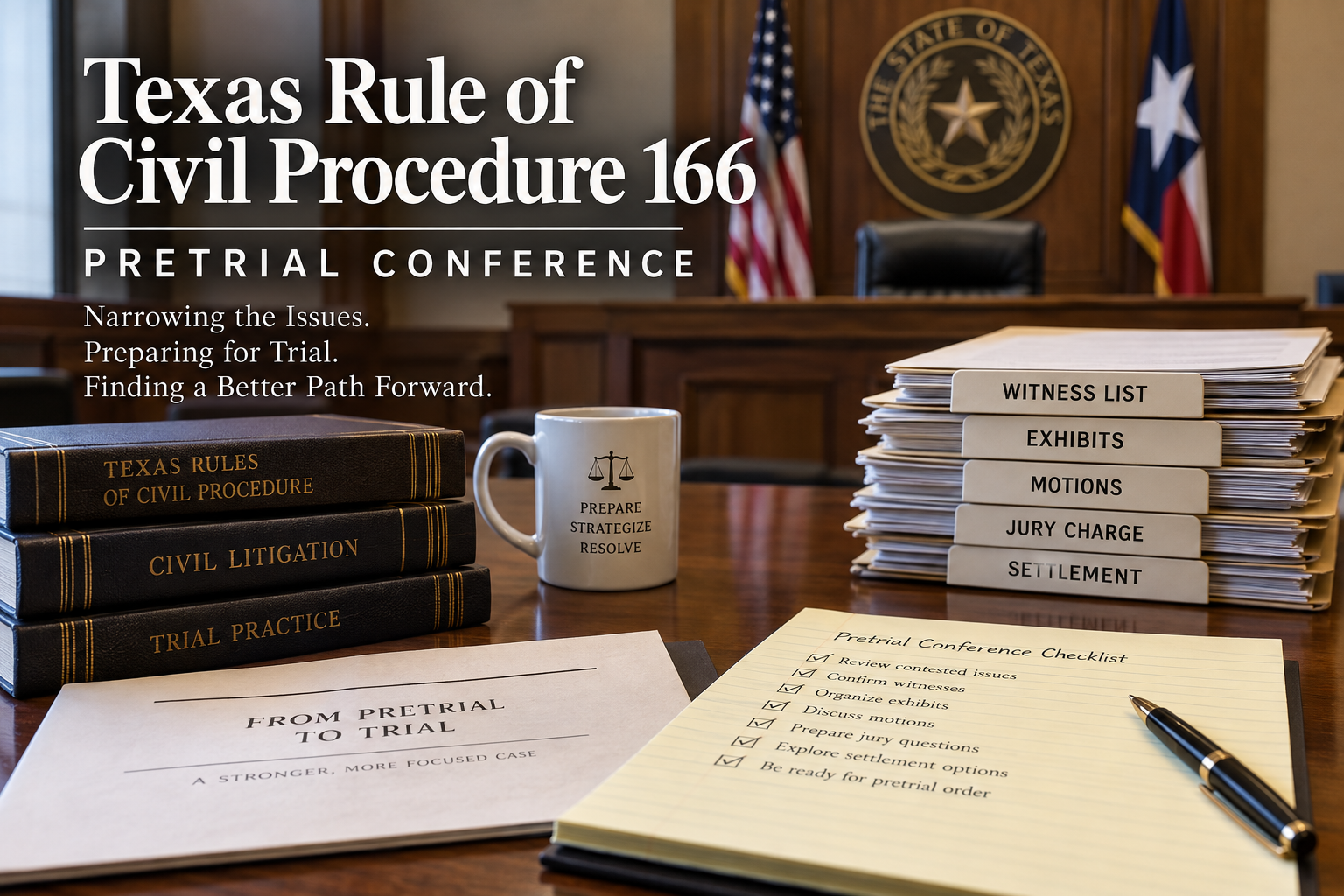
One important mechanism for making those decisions is the pretrial conference governed by Texas Rule of Civil Procedure 166.
A Rule 166 conference gives the court an opportunity to determine what the parties actually disagree about, what evidence and witnesses they intend to use, what legal issues need to be resolved, and what can be simplified before everyone arrives for trial.
For litigants, that means a pretrial conference should not be treated as a ceremonial court appearance. In the right case, what happens before trial can substantially determine what happens at trial.
What Is a Pretrial Conference in a Texas Civil Case?
Texas Rule of Civil Procedure 166 authorizes a court, in an appropriate case, to direct the attorneys or their authorized representatives to appear for a conference intended to help dispose of the case without unnecessary expense or burden.
The Rule allows the court to address a surprisingly broad range of subjects.
Among other things, Rule 166 permits consideration of pending motions, amendments to pleadings, discovery scheduling, disputed factual issues, stipulations, witnesses, exhibits, legal issues, proposed jury questions, and settlement.
In other words, Rule 166 gives the judge an opportunity to turn a sprawling lawsuit into something that is actually ready to be tried.
The current statewide Texas Rules of Civil Procedure are promulgated by the Supreme Court of Texas, although litigants must also pay attention to applicable local rules and court-specific orders.
The Court Can Narrow the Issues Before Trial
One of the most useful functions of a pretrial conference is identifying what is actually disputed.
A lawsuit may begin with broad allegations and defenses. After months of pleadings, discovery, depositions, and motion practice, however, the real disagreement may be considerably narrower.
Rule 166 expressly allows the court to consider contested factual issues and the “simplification of the issues.”
That can matter enormously at trial.
Suppose two businesses are fighting over a contract. By the time of the pretrial conference, the parties might agree that a valid contract existed and that one party failed to make a particular payment. The actual trial dispute may therefore concern whether performance was excused or how much damage resulted.
There may be little reason to spend valuable trial time proving facts nobody genuinely disputes.
Stipulations Can Eliminate Unnecessary Proof
Rule 166 also contemplates the possibility of obtaining stipulations of fact.
A stipulation is essentially an agreement between the parties concerning a matter that otherwise might have to be proved.
That can make a trial substantially more efficient.
Imagine, for example, that both sides agree that a particular contract is authentic. It may be unnecessary to spend time calling a witness merely to establish that the document is what everyone already agrees it is.
The same concept can apply to dates, records, corporate relationships, property descriptions, amounts paid, and other foundational facts.
The purpose is not to give either side an advantage. It is to identify what actually requires a decision.
Witnesses and Experts May Be Addressed Before Trial
Rule 166 also permits the pretrial process to address witnesses.
Depending upon the case and applicable court orders, parties may need to identify the fact witnesses they intend to call and the subjects on which those witnesses are expected to testify.
Experts can receive similar attention.
That is important because trial should generally not operate like a surprise party.
By the time a mature civil case reaches trial, each side ordinarily should have a reasonably clear understanding of the evidence the opposing party intends to present.
Rule 166 helps organize that information into a trial-ready form.
Exhibits Can Become a Major Pretrial Issue
Documents and other exhibits are another important part of pretrial preparation.
A business lawsuit might involve contracts, invoices, emails, photographs, bank records, accounting records, text messages, or hundreds of pages of business documents.
Simply possessing those documents does not necessarily mean they can all be presented to the jury without objection.
Rule 166 allows the pretrial process to include the marking and exchange of exhibits and consideration of their authenticity or admissibility.
This can prevent the trial from grinding to a halt every few minutes while the parties argue over documents that could have been addressed beforehand.
Court-specific procedures can make this especially important. For example, Texas court materials show local pretrial requirements that may require witness lists, exhibit lists, proposed jury instructions, and pretrial motions in advance of the conference.
Rule 166 Can Address the Jury Charge Before the Jury Is Even Selected
One particularly interesting feature of Rule 166 is that the parties may have to think seriously about the ultimate decision the jury will make before the trial begins.
The Rule contemplates proposed jury charge questions, instructions, and definitions in a jury case.
That may sound technical, but it goes directly to the heart of the lawsuit.
The jury charge determines the questions the jury will actually answer.
A plaintiff may spend days presenting evidence, but ultimately the jury is not simply asked, “Who do you think should win?”
Instead, jurors ordinarily answer specific questions tied to the legal claims and defenses presented in the case.
Thinking about those questions before trial can force both sides to confront an important issue:
What exactly must I prove to obtain the judgment I want?
That is one reason experienced trial lawyers often think about the jury charge long before anyone walks into the courtroom for trial.
What About a Bench Trial?
The same general principle applies when the judge, rather than a jury, will decide the facts.
Rule 166 contemplates proposed findings of fact and conclusions of law in nonjury cases.
Again, this encourages the parties to identify the factual findings and legal conclusions that would actually support the judgment they are requesting.
A trial is much easier to understand when the parties know precisely what decisions the factfinder will ultimately have to make.
Can Settlement Be Discussed at a Pretrial Conference?
Yes.
Rule 166 expressly permits consideration of:
“Settlement and the use of special procedures to assist in resolving the dispute.”
That does not mean a party necessarily has to accept a settlement it does not want.
It does mean, however, that as trial approaches, the court can examine whether some method of alternative dispute resolution or settlement discussion could resolve the case without the expense and uncertainty of trial.
The timing makes sense.
By the pretrial stage, the parties often know substantially more than they did when the lawsuit began. Discovery may be complete. Important witnesses may have been deposed. Major motions may have been decided.
The strengths and weaknesses of the case may therefore be much clearer.
The Pretrial Order May Be More Important Than Litigants Realize
Perhaps the most important practical lesson is that what happens at a Rule 166 conference does not necessarily disappear when everyone leaves the courtroom.
Rule 166 provides for the court to enter an order reflecting the matters addressed at the conference.
Historically, Texas Rule 166 has emphasized that the resulting order controls the subsequent course of the case unless the court modifies it to prevent manifest injustice. Texas courts also use docket-control and pretrial orders to establish the procedures and deadlines that will govern the approaching trial.
That is why lawyers take pretrial orders seriously.
If the court establishes deadlines for exhibits, witnesses, motions, proposed jury questions, or other trial materials, missing those deadlines can create substantial problems.
Local Rules and Individual Court Procedures Matter
Rule 166 provides the statewide framework, but it is not necessarily the end of the inquiry.
Texas trial courts may have local rules, standing orders, scheduling orders, and specific pretrial procedures that impose additional requirements.
The Texas Judicial Branch maintains a statewide database for local rules, forms, and standing orders, and explains that properly adopted local rules and orders are publicly accessible through that system.
One judge may require exhibits several days before the conference. Another may have specific requirements for motions in limine. Another may require proposed jury charges in a particular electronic format.
For lawyers and self-represented litigants alike, reading the judge's actual scheduling and pretrial orders is therefore essential.
What Happens If You Ignore a Pretrial Conference?
Potential consequences depend on the circumstances, the court's orders, and what was missed.
But ignoring a properly ordered pretrial conference is not a good strategy.
Some Texas court orders expressly warn that failing to appear or failing to comply with pretrial requirements may lead to sanctions or other serious consequences. One published district-court pretrial order, for example, warns parties that nonappearance can potentially result in pleadings or a jury demand being struck.
The precise remedy is case-specific, and courts must operate within the applicable procedural rules and due-process requirements.
The broader lesson is simpler: “pretrial” does not mean “unimportant.”
A Pretrial Conference Is Where a Lawsuit Starts Becoming a Trial
Early in litigation, a lawsuit can be enormous.
There may be dozens of factual allegations, thousands of pages of documents, numerous legal theories, multiple witnesses, and discovery disputes going in several directions at once.
Trial cannot realistically operate that way.
Eventually, somebody has to identify the witnesses who will actually testify, the exhibits that will actually be offered, the claims and defenses that remain disputed, and the questions the judge or jury will actually decide.
Rule 166 provides one of the mechanisms Texas courts use to accomplish that transition.
In that sense, the pretrial conference is not merely an administrative meeting before the “real” proceeding begins.
It is part of the process by which the court determines what the real proceeding will actually be.
Talk to a Texas Civil Litigation Attorney
Pretrial preparation can have a significant effect on the outcome of a Texas civil lawsuit. Witnesses, exhibits, motions, disputed legal issues, jury questions, deadlines, and court-specific requirements may all need to be addressed before trial begins.
If you are involved in a civil lawsuit in Texas and have questions about preparing for a pretrial conference, complying with a scheduling order, or getting your case ready for trial, an experienced Texas civil litigation attorney can help you understand the procedural requirements and develop an appropriate strategy.
At David C. Barsalou, Attorney at Law, PLLC, we help clients navigate business, family, tax, estate planning, and real estate matters ranging from document drafting to litigation with clarity and confidence. If you’d like guidance on your situation, schedule a consultation today. Call us at (713) 397-4678, email barsalou.law@gmail.com, or reach us through our Contact Page. We’re here to help you take the next step.
