One of the most powerful procedural tools available in Texas civil litigation is the no-evidence motion for summary judgment under Texas Rule of Civil Procedure 166a(i). Unlike a traditional summary judgment motion, which requires the movant to produce evidence, a no-evidence motion allows a party to challenge the opponent's case by asserting that there is no evidence supporting one or more essential elements of a claim or defense.
However, there is an important limitation that is often overlooked by non-lawyers and even some attorneys: a no-evidence motion may only be filed "[a]fter adequate time for discovery."
That seemingly simple phrase has generated substantial litigation in Texas courts and can determine whether a case survives or is dismissed before trial.
What Does Rule 166a(i) Actually Say?
Texas Rule of Civil Procedure 166a(i) provides:
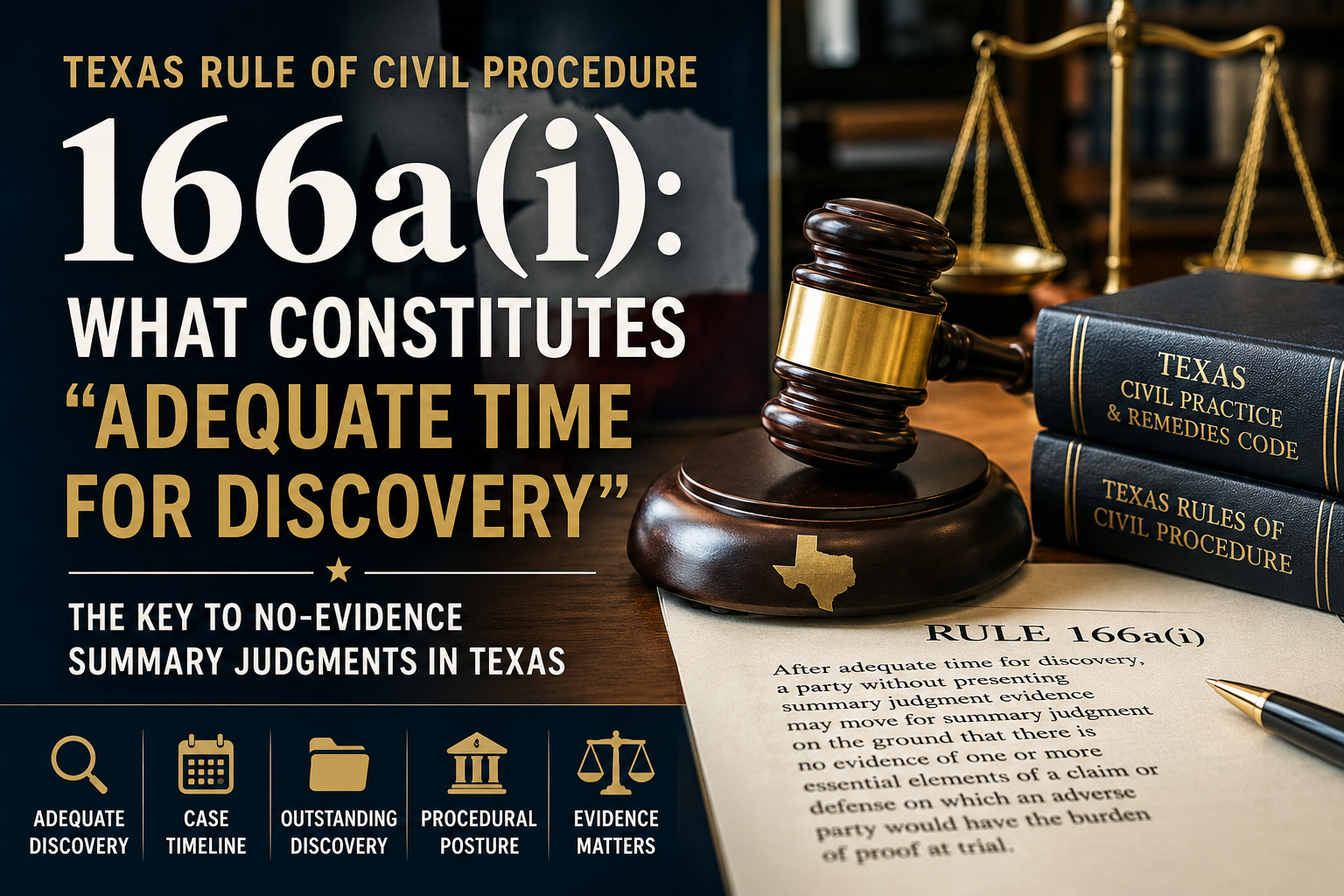
"After adequate time for discovery, a party without presenting summary judgment evidence may move for summary judgment on the ground that there is no evidence of one or more essential elements of a claim or defense on which an adverse party would have the burden of proof at trial."
The rule further provides:
"The court must grant the motion unless the respondent produces summary judgment evidence raising a genuine issue of material fact."
This procedure is frequently used in business disputes, real estate litigation, family-related property litigation, probate disputes, employment matters, and many other civil cases.
Why the “Adequate Time for Discovery” Requirement Matters
The purpose of Rule 166a(i) is not to permit a party to file a motion immediately after a lawsuit begins and force the opposing party to prove its entire case before meaningful discovery has occurred.
Instead, the rule is intended to allow courts to eliminate claims that remain unsupported after the parties have had a fair opportunity to investigate the facts.
For example, suppose a plaintiff files a fraud lawsuit and the defendant immediately files a no-evidence motion before any depositions, document production, or written discovery occur. In many situations, the plaintiff may have a strong argument that discovery has not progressed far enough to satisfy Rule 166a(i).
How Texas Courts Determine Whether Discovery Has Been Adequate
There is no fixed number of days that automatically constitutes an adequate time for discovery.
Instead, Texas courts examine the circumstances of each case.
Common factors include:
- The length of time the case has been on file;
- The nature of the case;
- The amount of discovery already completed;
- Whether discovery deadlines have expired;
- Whether trial is approaching;
- Whether discovery has been actively pursued;
- Whether outstanding discovery remains unresolved.
As a practical matter, courts are more likely to find adequate time for discovery when a case has been pending for many months and the parties have had a meaningful opportunity to obtain evidence.
Conversely, courts are often skeptical of no-evidence motions filed shortly after suit is filed, particularly when little or no discovery has occurred.
The Burden on the Party Opposing the Motion
Many litigants mistakenly assume that merely arguing "we need more discovery" is enough.
It is not.
If a party believes discovery has been inadequate, that party should generally create a record showing:
- What discovery remains outstanding;
- Why the discovery is material;
- Why the evidence cannot currently be obtained;
- How additional discovery is reasonably expected to produce relevant evidence.
Failure to develop this record can result in waiver of the complaint on appeal.
Strategic Considerations for Plaintiffs
For plaintiffs, Rule 166a(i) creates pressure to develop evidence early.
Waiting until shortly before trial to conduct discovery can be dangerous because a defendant may file a no-evidence motion and force the plaintiff to come forward with evidence supporting every challenged element.
A lawsuit is not won merely by filing a petition. Evidence must eventually support the allegations.
Plaintiffs should therefore focus on:
- Written discovery;
- Depositions;
- Third-party records;
- Expert testimony where necessary;
- Preservation of documentary evidence.
The stronger the evidentiary record, the less threatening a no-evidence motion becomes.
Strategic Considerations for Defendants
For defendants, Rule 166a(i) can be an exceptionally effective tool.
Rather than disproving a claim, the defendant may simply challenge the plaintiff to produce evidence on essential elements such as:
- Causation;
- Damages;
- Reliance;
- Ownership;
- Standing;
- Breach;
- Fiduciary duty.
If the plaintiff cannot produce more than a scintilla of evidence, dismissal may follow without the expense of trial.
The rule is particularly effective in cases where allegations sound compelling in a pleading but discovery reveals little factual support.
What Evidence Is Enough?
The nonmovant does not need to conclusively prove the entire case.
Instead, the response must present evidence raising a genuine issue of material fact.
Texas courts frequently describe the standard as requiring more than a scintilla of evidence.
Evidence amounts to more than a scintilla when reasonable and fair-minded people could differ in their conclusions based on the proof presented.
Mere suspicion, speculation, or conclusory statements generally will not suffice.
Final Thoughts
Texas Rule of Civil Procedure 166a(i) is one of the most significant procedural mechanisms in modern Texas litigation. While the rule permits courts to dispose of unsupported claims efficiently, it also contains an important safeguard: a no-evidence motion may only be filed after an adequate time for discovery.
Because Texas courts evaluate adequacy on a case-by-case basis, litigants must pay close attention to the status of discovery, outstanding evidence, and the procedural posture of the case. Whether you are asserting claims or defending against them, understanding the "adequate time for discovery" requirement can make the difference between reaching trial and seeing your case dismissed before it ever gets there.
Disclaimer: This article is for informational purposes only and does not constitute legal advice. Reading this article does not create an attorney-client relationship. Individuals facing legal issues should consult qualified counsel regarding their specific circumstances.
At David C. Barsalou, Attorney at Law, PLLC, we help clients navigate business, family, tax, estate planning, and real estate matters ranging from document drafting to litigation with clarity and confidence. If you’d like guidance on your situation, schedule a consultation today. Call us at (713) 397-4678, email barsalou.law@gmail.com, or reach us through our Contact Page. We’re here to help you take the next step.