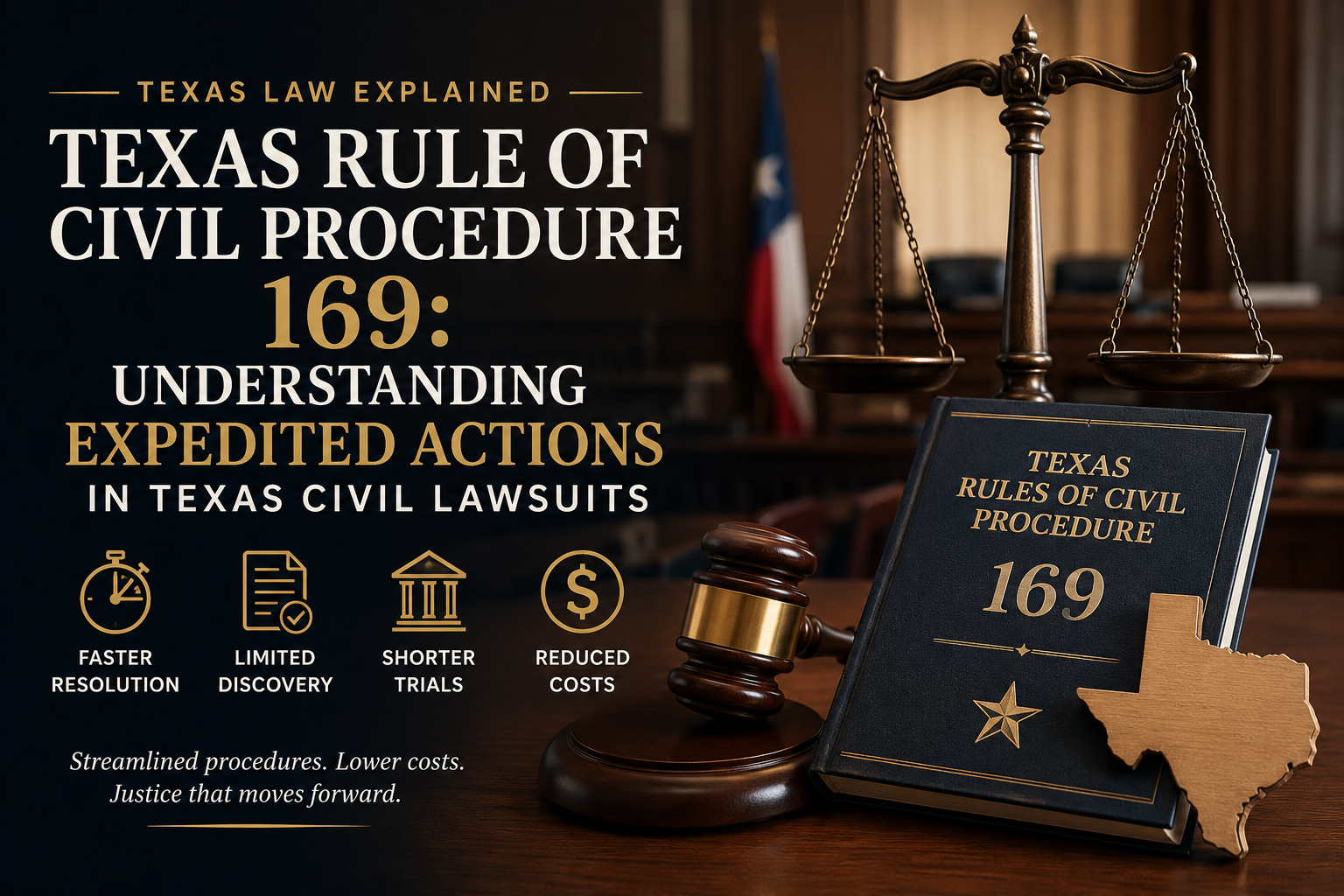
Not every lawsuit in Texas requires years of litigation, dozens of depositions, or expensive discovery battles. For certain lower-value cases, the Texas Rules of Civil Procedure provide a streamlined process designed to reduce costs and resolve disputes more efficiently.
That process is found in Texas Rule of Civil Procedure 169, which governs Expedited Actions.
If your lawsuit qualifies, Rule 169 can dramatically affect discovery, trial preparation, litigation costs, and overall strategy.
What Is Rule 169?
Texas Rule of Civil Procedure 169 establishes an expedited litigation process for qualifying civil cases.
The Rule provides in relevant part:
"This rule governs actions in which all claimants, other than counter-claimants, affirmatively plead that they seek only monetary relief aggregating $250,000 or less, excluding interest, statutory or punitive damages and penalties, attorney fees and costs."
Tex. R. Civ. P. 169(a)(1).
In other words, if the plaintiff limits the amount sought to the jurisdictional threshold established by Rule 169, the lawsuit generally proceeds under an expedited set of procedures.
Why Was Rule 169 Created?
Traditional litigation can become extraordinarily expensive.
Multiple depositions, expert witnesses, lengthy discovery disputes, and multi-week jury trials often cost far more than the amount actually in controversy.
Rule 169 attempts to solve this problem by:
- reducing litigation costs;
- encouraging faster resolution;
- limiting unnecessary discovery;
- shortening trials; and
- increasing access to the court system for smaller disputes.
Rather than spending years litigating a relatively modest case, Rule 169 seeks to move qualifying cases through the system efficiently.
Which Cases Qualify?
Rule 169 generally applies when the plaintiff affirmatively limits monetary relief to the amount specified by the Rule.
Importantly, the calculation generally excludes:
- interest;
- statutory penalties;
- punitive damages;
- attorney's fees; and
- court costs.
The primary focus is the amount of compensatory monetary relief being sought.
Cases involving requests for significant non-monetary relief may not qualify.
What Makes an Expedited Action Different?
Perhaps the biggest practical difference is that the lawsuit proceeds under significantly reduced procedural burdens.
Compared to traditional litigation, parties typically encounter:
- more limited discovery;
- fewer depositions;
- shorter trial settings;
- stricter time limits; and
- lower overall litigation expenses.
For many businesses and individuals, these limitations can make litigation financially worthwhile when it otherwise would not be.
Discovery Is More Limited
One of the principal goals of Rule 169 is proportionality.
Discovery should be reasonably related to the size and complexity of the dispute.
Instead of permitting virtually unlimited discovery, expedited actions generally impose meaningful limitations that help prevent litigation costs from eclipsing the value of the case.
This often encourages attorneys to focus on the truly important evidence rather than conducting expensive fishing expeditions.
Trial Time Is Significantly Shorter
Rule 169 also limits the amount of time available for trial.
Rather than allowing lengthy presentations over several days or weeks, expedited actions are designed to be tried much more quickly.
This benefits:
- the parties;
- jurors;
- witnesses; and
- the court system.
A streamlined trial also places greater importance on careful preparation and efficient presentation of evidence.
Strategic Considerations
Choosing whether to proceed under Rule 169 is an important strategic decision.
A plaintiff may prefer expedited procedures because they:
- reduce attorney's fees;
- create settlement pressure;
- reach trial sooner; and
- reduce litigation uncertainty.
On the other hand, plaintiffs with substantial damages may choose not to limit their recovery simply to obtain expedited procedures.
Likewise, defendants should evaluate whether the limitations on discovery help or hinder their ability to defend the case.
The appropriate strategy depends on the specific facts of each lawsuit.
Can a Case Leave the Expedited Process?
Yes.
If the pleadings are amended so that the case no longer qualifies under Rule 169, the litigation may transition into the ordinary procedural framework.
Because of this possibility, attorneys should continuously evaluate whether the claims being asserted remain consistent with the expedited-action requirements.
Why Rule 169 Matters
Rule 169 reflects an important policy decision by the Texas Supreme Court: not every lawsuit requires maximum litigation.
Many disputes can be resolved fairly while using fewer judicial resources and imposing lower costs on the parties.
For businesses, landlords, property owners, contractors, professionals, and individuals involved in relatively modest civil disputes, understanding Rule 169 can significantly affect both litigation costs and case strategy.
Final Thoughts
Texas Rule of Civil Procedure 169 provides an efficient alternative to traditional civil litigation for qualifying cases. By limiting discovery, shortening trials, and encouraging proportional litigation, the Rule seeks to balance fairness with efficiency.
Whether an expedited action is advantageous depends on the value of the claims, the complexity of the facts, and the overall litigation strategy. An experienced Texas litigation attorney can help determine whether proceeding under Rule 169 is in your best interest and how to maximize the procedural advantages available under the Rule.
Disclaimer: This article is for general informational purposes only and does not constitute legal advice. Every lawsuit presents unique facts, and you should consult a qualified attorney regarding your specific situation.
At David C. Barsalou, Attorney at Law, PLLC, we help clients navigate business, family, tax, estate planning, and real estate matters ranging from document drafting to litigation with clarity and confidence. If you’d like guidance on your situation, schedule a consultation today. Call us at (713) 397-4678, email barsalou.law@gmail.com, or reach us through our Contact Page. We’re here to help you take the next step.