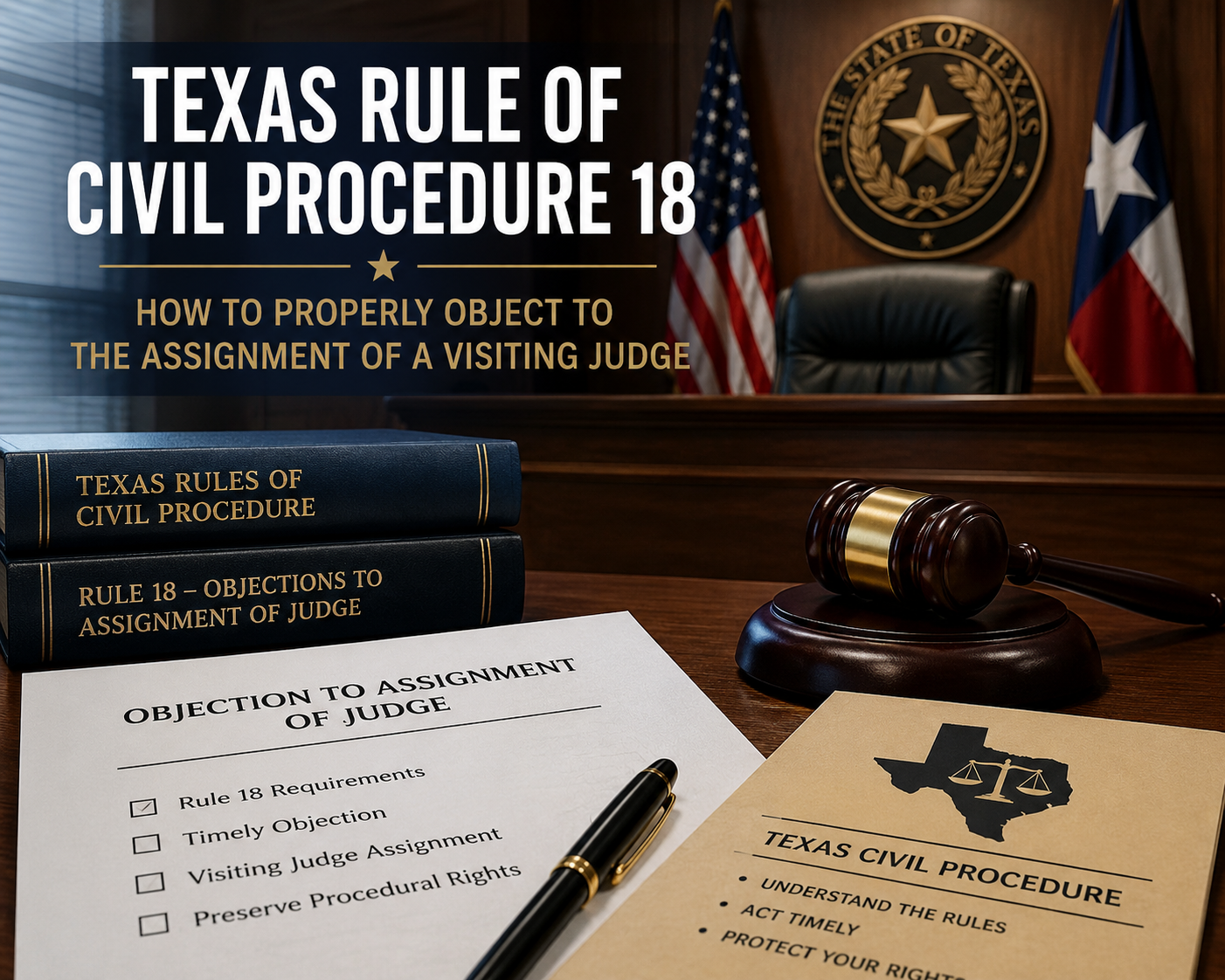
Many Texans assume that once a judge has been assigned to hear their case, there is nothing they can do about who presides over the lawsuit. In reality, Texas law provides a limited procedural mechanism for objecting to the assignment of certain visiting judges.
Importantly, this is not the same thing as asking that a judge recuse himself or herself because of bias. Instead, Texas Rule of Civil Procedure 18 provides a procedural right to object to certain assigned judges without proving prejudice.
Because the deadlines are extremely short, parties who do not understand Rule 18 may unintentionally waive an objection forever.
What Is a Visiting Judge?
Texas frequently uses visiting or assigned judges to help manage crowded court dockets.
Assignments commonly occur when:
- an elected judge is absent;
- a judge is recused;
- a court has an unusually heavy caseload;
- another court requires temporary assistance.
Most assigned judges are experienced former judges or judges serving by assignment under the Texas Government Code.
Texas Rule of Civil Procedure 18
Texas Rule of Civil Procedure 18 provides, in part:
"Any party to a civil case may object to the assignment of a judge."
The Rule then establishes strict procedural requirements concerning:
- when the objection must be filed;
- who may hear the objection;
- circumstances in which the objection is unavailable.
Unlike a motion to recuse, Rule 18 generally does notrequire proof that the assigned judge is biased.
Instead, it grants a procedural right to object to certain assignments if exercised timely.
Rule 18 Is Different From Rule 18a
This distinction is frequently misunderstood.
Rule 18
- Challenges the assignment of certain visiting judges.
- Generally does not require proof of bias.
- Operates through strict procedural deadlines.
Rule 18a
- Seeks recusal or disqualification.
- Requires legally recognized grounds.
- Usually focuses on impartiality or constitutional disqualification.
These rules address completely different legal issues even though their numbering is similar.
Timing Is Everything
One of the biggest traps under Rule 18 is timing.
A party generally must object promptly after learning that a visiting judge has been assigned. Waiting until the day of trial—or after the assigned judge has already made substantive rulings—may waive the objection.
Texas courts routinely enforce these procedural deadlines.
Not Every Judge Can Be Challenged Under Rule 18
Rule 18 does not apply to every judge who hears a case.
Instead, it generally concerns judges serving through assignment procedures authorized by Texas law.
The elected judge assigned to a court is generally not subject to Rule 18 simply because a litigant dislikes prior rulings.
Strategic Considerations
Although Rule 18 provides an important procedural right, it should not be used simply to delay litigation.
Experienced attorneys usually consider several factors before filing an objection:
- whether the judge is actually subject to Rule 18;
- whether the objection is timely;
- whether objecting could delay important hearings;
- whether another assigned judge may ultimately hear the case anyway.
Like many procedural tools, Rule 18 can be powerful when properly used but ineffective if misunderstood.
Common Misconceptions
"I can object because I don't like the judge."
No. Rule 18 concerns qualifying assignments—not dissatisfaction with judicial rulings.
"I can wait until trial."
Usually not. Missing the deadline often waives the objection.
"Rule 18 proves the judge is biased."
Not at all. Rule 18 generally does not require any showing of bias.
"This is the same as a recusal."
No. Recusal and assignment objections are governed by different rules and serve different purposes.
Why Rule 18 Matters
Procedural rules frequently determine the outcome of litigation before the merits of the dispute are ever reached.
Texas Rule of Civil Procedure 18 is one of those rules that many litigants—and even some lawyers who rarely litigate—may overlook.
Understanding the distinction between objecting to an assigned judge and seeking recusal can preserve important procedural rights and prevent unnecessary waiver.
If you are involved in Texas civil litigation and have questions about judicial assignments, objections, or other procedural issues, consulting with an attorney familiar with the Texas Rules of Civil Procedure can help ensure that important deadlines are not missed.
At David C. Barsalou, Attorney at Law, PLLC, we help clients navigate business, family, tax, estate planning, and real estate matters ranging from document drafting to litigation with clarity and confidence. If you’d like guidance on your situation, schedule a consultation today. Call us at (713) 397-4678, email barsalou.law@gmail.com, or reach us through our Contact Page. We’re here to help you take the next step.
