When most people think about collecting an unpaid debt, they assume they must file a standard breach of contract lawsuit and prove every element of their case through testimony and documentary evidence. In Texas, however, certain businesses have access to a powerful procedural shortcut known as a Suit on Sworn Account.
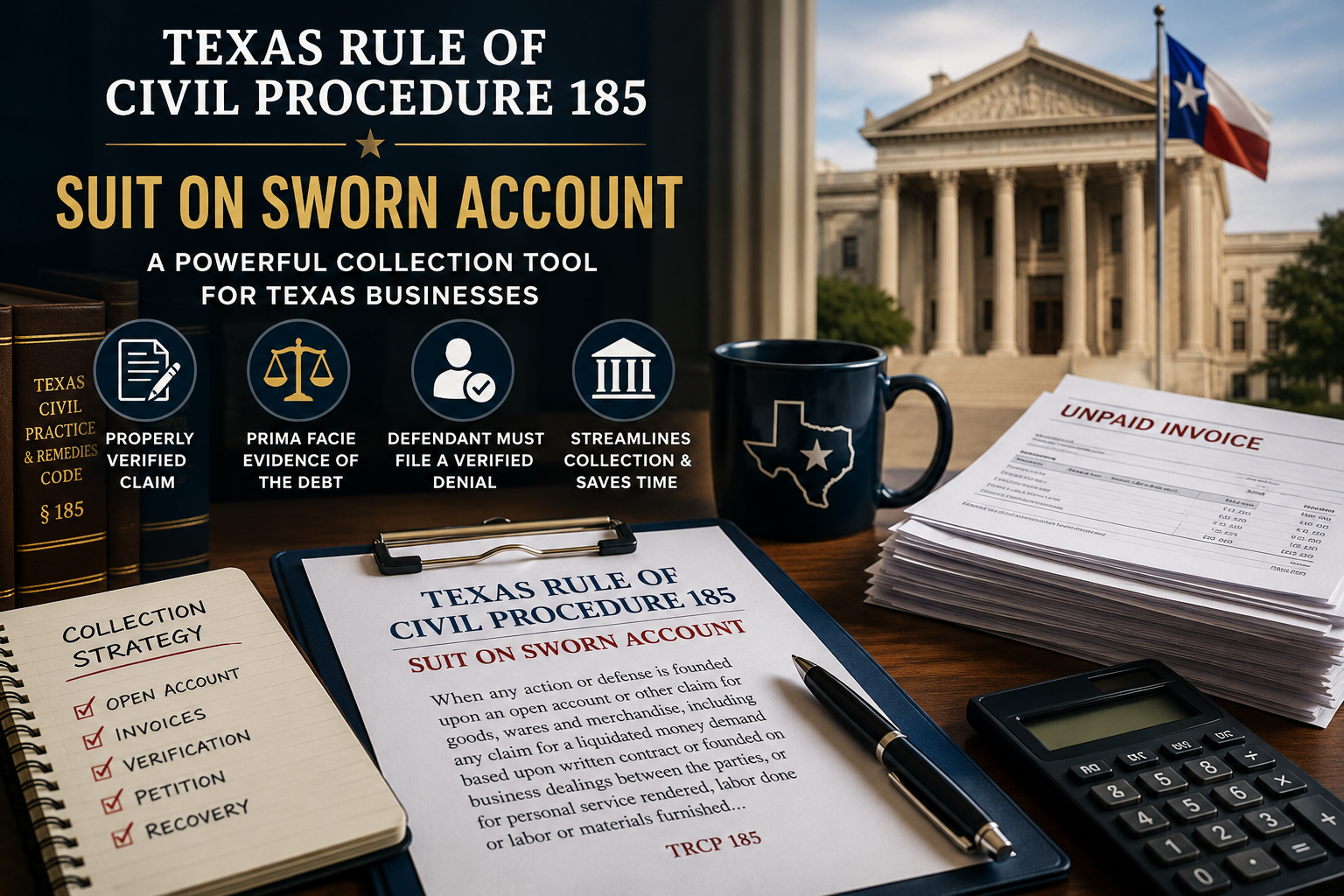
Found in Texas Rule of Civil Procedure 185, this procedure can dramatically shift the burden onto the defendant and, in some cases, make collection substantially easier.
What Is a Suit on Sworn Account?
A suit on sworn account is a procedural device that allows certain claims for money owed to be established through a properly verified pleading.
Texas Rule of Civil Procedure 185 provides:
"When any action or defense is founded upon an open account or other claim for goods, wares and merchandise, including any claim for a liquidated money demand based upon written contract or founded on business dealings between the parties, or for personal service rendered, labor done or labor or materials furnished..." TRCP 185.
In plain English, the rule allows businesses that regularly provide goods or services to rely upon verified business records and a sworn petition to establish a prima facie case.
What Types of Claims Qualify?
Not every unpaid debt qualifies.
Common examples include:
- Unpaid contractor invoices
- Construction material accounts
- Professional service fees
- Commercial vendor accounts
- Business-to-business transactions
- Certain unpaid rent obligations
- Service agreements involving fixed charges
The rule is frequently used by suppliers, service companies, contractors, repair businesses, and professionals who routinely bill customers.
Why Is the Rule So Powerful?
The real power of Rule 185 comes from what happens if the defendant fails to properly respond.
The rule states:
"The account shall be taken as prima facie evidence thereof, unless the party resisting such claim shall file a written denial, under oath." TRCP 185.
This means a defendant cannot simply file a general denial and expect to force the plaintiff to prove everything at trial.
Instead, the defendant must file a verified denialchallenging the account.
Without a sworn denial, the plaintiff's verified account may constitute prima facie proof of the debt.
What Must the Plaintiff Include?
To invoke Rule 185, the plaintiff must generally:
- Maintain records showing the charges;
- State that the claim is just and true;
- State that all lawful offsets, payments, and credits have been allowed; and
- Verify the claim through a proper affidavit.
The petition should attach supporting documentation whenever practical.
Because Rule 185 is procedural, courts often focus heavily on technical compliance.
What Happens If the Defendant Files a Proper Verified Denial?
A verified denial does not automatically defeat the claim.
Instead, it removes the evidentiary shortcut and places the parties back into a more traditional litigation posture.
The plaintiff may still prevail through:
- Contracts;
- Invoices;
- Payment histories;
- Witness testimony;
- Business records affidavits; and
- Other admissible evidence.
The defendant merely regains the ability to contest the debt.
Common Defendant Mistakes
Many defendants make one of three errors:
1. Filing Only a General Denial
A general denial is often insufficient against a properly pleaded sworn account.
2. Ignoring the Verification Requirement
The denial itself must generally be verified under oath.
3. Waiting Too Long
Once deadlines pass, procedural advantages may be lost.
Because Rule 185 operates alongside other pleading rules, a defendant who overlooks the verification requirement can unintentionally concede significant ground before discovery even begins.
Why Businesses Should Care
For businesses that regularly extend credit or invoice customers, Rule 185 can be an effective collection mechanism.
It often:
- Simplifies proof;
- Reduces litigation costs;
- Creates early leverage for settlement;
- Narrows disputed issues; and
- Encourages prompt resolution of legitimate debts.
In many cases, the procedural battle is won or lost before the parties ever reach trial.
Final Thoughts
Texas Rule of Civil Procedure 185 remains one of the most underutilized procedural tools in Texas civil litigation. For businesses attempting to collect unpaid invoices, service fees, or commercial debts, a properly pleaded sworn account can significantly streamline the path to recovery.
Likewise, defendants who receive a lawsuit alleging a sworn account should pay careful attention to the rule's verification requirements. A simple general denial may not be enough.
As with many areas of Texas civil procedure, understanding the technical rules can make the difference between winning and losing a case long before a jury ever hears the dispute.
At David C. Barsalou, Attorney at Law, PLLC, we help clients navigate business, family, tax, estate planning, and real estate matters ranging from document drafting to litigation with clarity and confidence. If you’d like guidance on your situation, schedule a consultation today. Call us at (713) 397-4678, email barsalou.law@gmail.com, or reach us through our Contact Page. We’re here to help you take the next step.