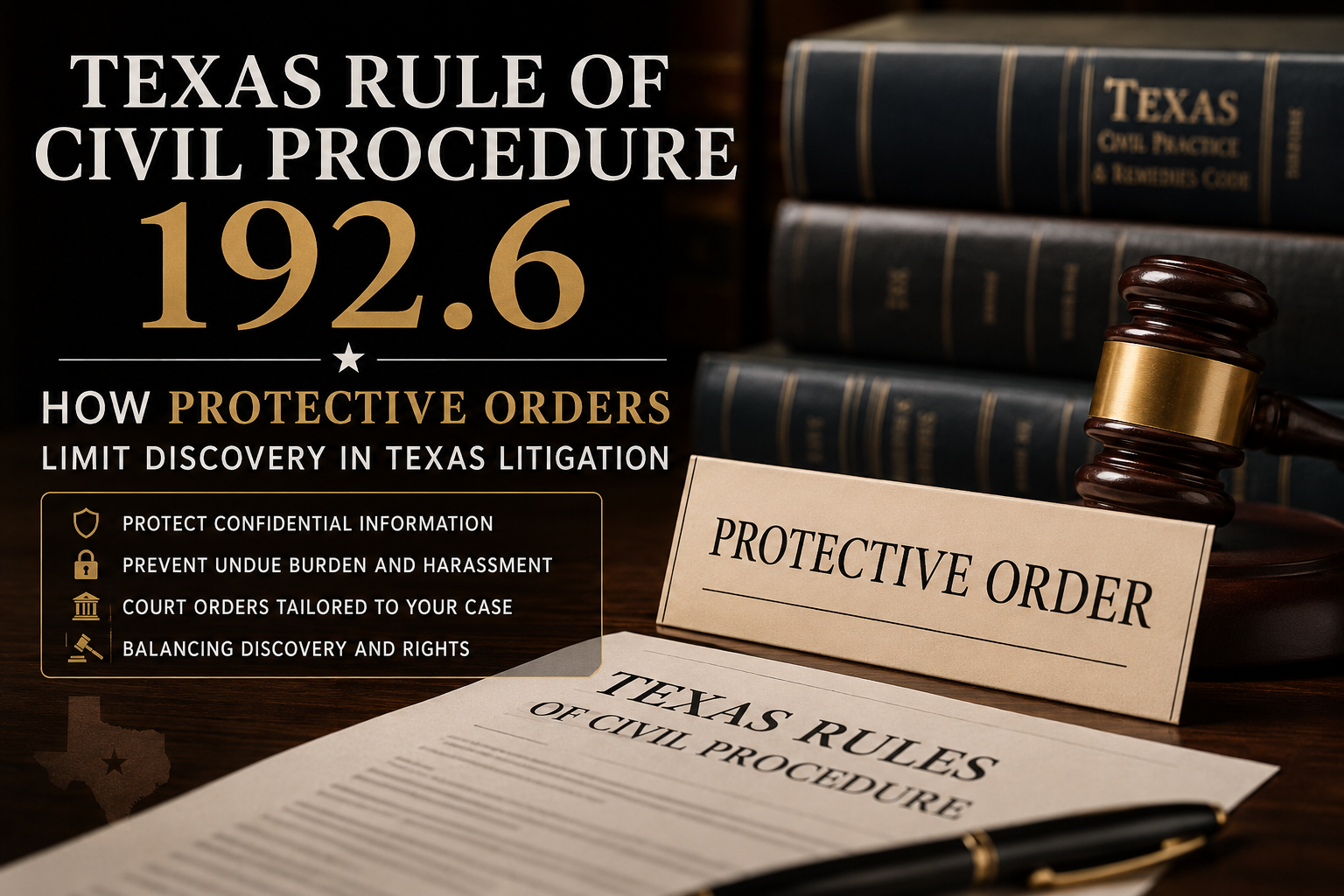
Discovery is intentionally broad in Texas civil litigation. Parties are generally entitled to obtain information that is relevant to the subject matter of a lawsuit, even if that information may not ultimately be admissible at trial. However, broad discovery is not unlimited discovery. When requests become unduly burdensome, invade legitimate privacy interests, or seek confidential business information, Texas Rule of Civil Procedure 192.6gives courts the authority to issue protective orders.
Understanding how Rule 192.6 works can save litigants significant time, expense, and frustration while protecting legitimate legal interests.
What Is a Protective Order?
A protective order is an order issued by the court that limits, conditions, or prohibits certain discovery. Its purpose is not to prevent parties from discovering relevant evidence, but rather to prevent discovery from becoming abusive, oppressive, or unnecessarily expensive.
Texas Rule of Civil Procedure 192.6(a) provides:
"A person from whom discovery is sought, and any other person affected by the discovery request, may move within the time permitted for response for an order protecting that person from the discovery sought."
Importantly, the rule is available not only to parties but also to non-parties whose rights may be affected by discovery.
When Can a Court Grant a Protective Order?
Rule 192.6(b) authorizes a court to make any order necessary to protect a person from:
- Unnecessary expense;
- Harassment;
- Annoyance;
- Embarrassment;
- Oppression;
- Invasion of personal, constitutional, or property rights; or
- Other undue burden or expense.
The rule recognizes that litigation should uncover the truth—not become a weapon for intimidation or needless cost.
Examples of Protective Orders
Protective orders appear in many different forms.
A court may:
- prohibit certain discovery entirely;
- limit the scope of requested documents;
- require documents to be produced only after redactions;
- restrict who may view confidential information;
- require documents to be filed under seal;
- designate information as confidential;
- limit the number or duration of depositions;
- require discovery to occur only under specified conditions; or
- postpone discovery until another issue is resolved.
Rather than issuing an "all or nothing" ruling, Texas courts often tailor protective orders to balance both parties' interests.
Confidential Business Information
One of the most common uses of Rule 192.6 involves confidential commercial information.
Businesses frequently possess:
- customer lists;
- pricing formulas;
- proprietary software;
- trade secrets;
- internal financial records;
- research and development materials; and
- confidential operating procedures.
Even if these materials are discoverable, courts frequently restrict how they may be used.
For example, a court may order that:
- only attorneys may review the information;
- experts must sign confidentiality agreements;
- documents cannot be copied except as necessary for litigation; and
- all confidential materials must be returned or destroyed after the case concludes.
These provisions help ensure that litigation does not become a vehicle for obtaining a competitor's confidential information.
Medical and Personal Records
Protective orders are also common when discovery seeks highly personal information.
Examples include:
- mental health records;
- unrelated medical history;
- financial account information;
- tax returns;
- children's sensitive records; and
- private communications.
Texas courts generally require discovery to remain proportional to the issues actually being litigated.
Depositions Can Also Be Limited
Protective orders are not limited to written discovery.
A court may:
- limit deposition length;
- prevent repetitive questioning;
- change the location of the deposition;
- require remote testimony;
- restrict attendance by unnecessary third parties; or
- prohibit inquiry into privileged matters.
These orders help prevent depositions from becoming abusive while still allowing legitimate examination.
Timing Matters
Rule 192.6 specifically allows a motion for protection to be filed within the time allowed for responding to discovery.
Waiting too long can create unnecessary disputes and may even waive certain objections. In many situations, filing the motion before producing the requested information is the safest course.
The Court Has Broad Discretion
Texas trial courts enjoy substantial discretion when deciding discovery disputes.
Judges generally attempt to balance competing interests by asking questions such as:
- Is the information relevant?
- Is the request proportional?
- Is there a less intrusive way to obtain the information?
- Does the burden outweigh the likely benefit?
- Can confidentiality concerns be addressed through limitations rather than outright denial?
Because every case is different, protective orders are often customized rather than standardized.
Protective Orders Are Not a Way to Hide Evidence
A common misconception is that filing a motion for protective order automatically prevents discovery.
It does not.
The party seeking protection generally bears the burden of demonstrating why protection is appropriate. Mere inconvenience or dislike of the discovery process is usually insufficient.
Instead, courts expect a concrete showing that the requested discovery creates an undue burden, invades protected interests, or exceeds the proper scope of discovery.
Practical Advice for Texas Litigants
If you receive discovery requests that seem extraordinarily broad or intrusive, do not assume you must simply comply.
Likewise, if you need confidential information from the opposing party, understand that courts may require reasonable safeguards before allowing production.
Protective orders often allow litigation to proceed efficiently while preserving legitimate privacy and business interests.
Final Thoughts
Texas discovery is designed to encourage the exchange of relevant information—not to facilitate harassment or needless expense. Texas Rule of Civil Procedure 192.6 gives trial courts the flexibility to ensure discovery remains fair, proportional, and focused on the actual issues in dispute.
Whether you are an individual, a business owner, or involved in a complex commercial lawsuit, understanding protective orders can make a significant difference in protecting your rights while complying with your discovery obligations.
Disclaimer: This article is provided for general educational purposes only and does not constitute legal advice. Every lawsuit presents unique facts and legal issues. If you are involved in Texas litigation or have questions regarding discovery disputes or protective orders, consult a qualified Texas attorney.
At David C. Barsalou, Attorney at Law, PLLC, we help clients navigate business, family, tax, estate planning, and real estate matters ranging from document drafting to litigation with clarity and confidence. If you’d like guidance on your situation, schedule a consultation today. Call us at (713) 397-4678, email barsalou.law@gmail.com, or reach us through our Contact Page. We’re here to help you take the next step.