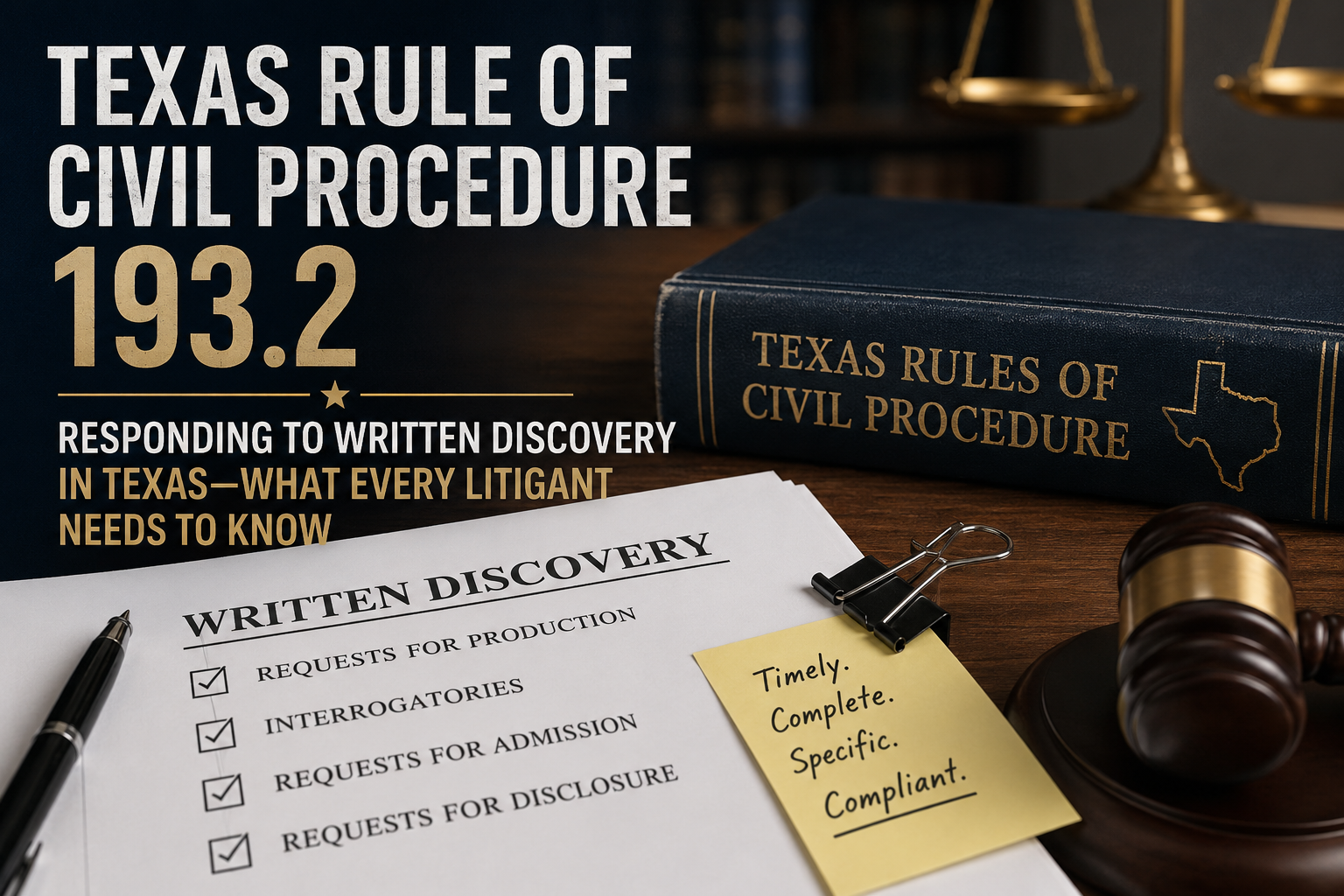
When people think about lawsuits, they usually imagine dramatic courtroom testimony. In reality, many cases are won—or lost—long before trial through the discovery process. One of the most important yet overlooked procedural rules governing discovery responses is Texas Rule of Civil Procedure 193.2.
Whether you are involved in a business dispute, contract lawsuit, real estate litigation, probate matter, or family law case, understanding your obligations when responding to written discovery can prevent unnecessary sanctions, waived objections, and costly litigation mistakes.
What Is Rule 193.2?
Texas Rule of Civil Procedure 193.2 governs how parties must respond to written discovery requests, including:
- Requests for Production
- Requests for Disclosure
- Interrogatories
- Requests for Admission
- Other written discovery authorized by the Texas Rules of Civil Procedure
The rule establishes both the form and substance of proper responses.
The Rule Requires Complete Written Responses
Rule 193.2(a) provides in part:
"A party must respond in writing to written discovery."
Although this sounds straightforward, the practical implications are significant. Responses are not merely correspondence between attorneys—they become part of the litigation record and frequently determine what evidence may later be used at trial.
Incomplete, evasive, or boilerplate responses often lead to motions to compel and requests for sanctions.
Objections Must Be Specifically Stated
Rule 193.2 requires that objections be stated specifically.
General objections such as:
- "Overly broad"
- "Unduly burdensome"
- "Irrelevant"
without explaining why they apply are often ineffective.
Texas courts generally expect objections to identify the precise legal basis and explain how the discovery request is objectionable.
This promotes the discovery rules' overall purpose of reducing gamesmanship while encouraging the exchange of relevant information.
Partial Responses Are Required
One common misconception is that if part of a request is objectionable, a party may refuse to answer altogether.
Not so.
Texas discovery rules generally require a responding party to answer the non-objectionable portion of a request whenever reasonably possible.
For example, if a request seeks documents over a twenty-year period but only the last five years are relevant, the responding party should ordinarily produce the relevant documents while specifically explaining the objection to the remainder.
Verification Requirements
Certain discovery responses—particularly interrogatories—must be verified.
Verification means the responding party signs under oath that the factual responses are true to the best of his or her knowledge.
An attorney generally may sign objections, but factual answers requiring verification ordinarily must be verified by the client.
Discovery Responses Matter at Trial
Discovery is not merely an administrative exercise.
Responses can:
- Limit the evidence you may later present.
- Become admissions against your interests.
- Be used to impeach witnesses.
- Influence settlement negotiations.
- Support summary judgment motions.
Inconsistent discovery responses frequently become powerful impeachment evidence.
The Cost of Inadequate Responses
Failure to properly respond can expose a party to serious consequences, including:
- Motions to compel.
- Monetary sanctions.
- Orders requiring payment of attorney's fees.
- Exclusion of evidence.
- In extreme circumstances, case-dispositive sanctions.
Texas courts generally expect parties to participate in discovery in good faith rather than through delay or obstruction.
Practical Tips
If you receive written discovery:
- Calendar your response deadline immediately.
- Read every request carefully.
- Preserve potentially relevant documents and electronic data.
- Make objections only when supported by law.
- Answer every non-objectionable portion completely.
- Supplement your responses if they later become incomplete or incorrect.
Small procedural mistakes made early in litigation often become much larger problems as trial approaches.
Final Thoughts
Texas Rule of Civil Procedure 193.2 serves an important purpose: ensuring that litigation proceeds through the fair exchange of information rather than surprise and gamesmanship. Well-prepared discovery responses not only satisfy the Rules of Civil Procedure but also strengthen your credibility before both opposing counsel and the court.
If you have been served with written discovery in a Texas lawsuit—or believe the opposing party has failed to respond properly—obtaining legal guidance early can often save significant time, expense, and frustration later in the case.
Disclaimer: This article is intended for general educational purposes only and does not constitute legal advice. Every case presents unique facts, and you should consult a qualified Texas attorney regarding your specific circumstances.
At David C. Barsalou, Attorney at Law, PLLC, we help clients navigate business, family, tax, estate planning, and real estate matters ranging from document drafting to litigation with clarity and confidence. If you’d like guidance on your situation, schedule a consultation today. Call us at (713) 397-4678, email barsalou.law@gmail.com, or reach us through our Contact Page. We’re here to help you take the next step.