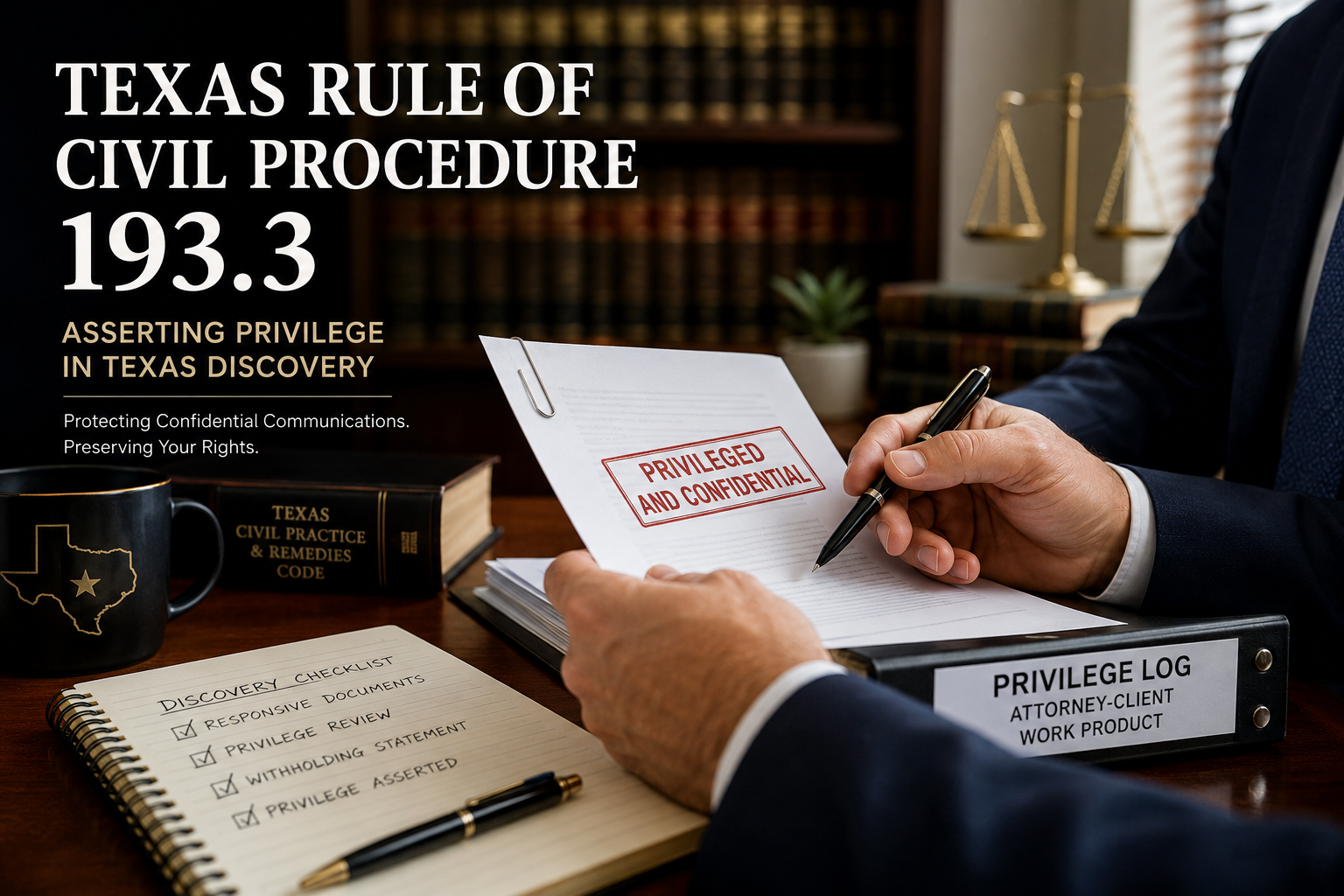
Discovery is intended to uncover relevant evidence—not every piece of confidential information a party possesses. Texas law recognizes several important privileges that protect certain communications and materials from disclosure. However, simply claiming that information is "privileged" is not enough.
Texas Rule of Civil Procedure 193.3 establishes the procedure for asserting privilege during discovery. Failing to follow the rule can result in waiver of important protections or expensive motion practice.
Whether you are involved in commercial litigation, a business dispute, probate litigation, family litigation, or a real estate lawsuit, understanding Rule 193.3 can be critical.
What Does Rule 193.3 Say?
Texas Rule of Civil Procedure 193.3 provides in part:
"A party may withhold privileged material or information from discovery if the party states—in the response (or an amended or supplemental response) or in a separate document—that:
(1) information or material responsive to the request has been withheld;
(2) the request to which the information or material relates; and
(3) the privilege or privileges asserted."
Unlike older discovery practice, the rule generally does notrequire a party to immediately produce a detailed privilege log with every discovery response.
Instead, the responding party must properly identify that responsive material has been withheld and specify the privilege being asserted.
Why Rule 193.3 Exists
The rule attempts to balance competing interests.
On one hand, litigants should have broad access to relevant evidence.
On the other hand, longstanding privileges protect important societal interests, including encouraging clients to communicate openly with their attorneys and allowing lawyers to prepare cases without revealing litigation strategy.
Rule 193.3 provides the procedural mechanism for preserving those protections.
Common Privileges Asserted
Several privileges commonly arise in Texas litigation.
Attorney-Client Privilege
Perhaps the best-known privilege protects confidential communications between lawyer and client made for the purpose of obtaining or providing legal advice.
Not every communication involving a lawyer is privileged. The communication must satisfy the legal requirements for the privilege.
Attorney Work Product
Texas also protects certain materials prepared in anticipation of litigation.
Core work product—including an attorney's mental impressions, legal theories, and litigation strategy—receives especially strong protection.
Other Privileges
Depending on the circumstances, additional privileges may apply, including:
- Physician-patient privilege
- Mental health information
- Clergy communications
- Certain accountant communications
- Trade secrets (subject to applicable procedures)
- Mediation confidentiality
Each privilege has its own legal requirements and exceptions.
Is a Privilege Log Automatically Required?
Not necessarily.
One of the most misunderstood aspects of Rule 193.3 is that a detailed privilege log is generally not automatically due with the initial discovery responses.
Instead, Rule 193.3(b) provides that, after receiving a proper withholding statement, the requesting party may serve a written request requiring identification of the withheld material.
The responding party must then provide information sufficient to allow the requesting party to assess the privilege claim without revealing the privileged information itself.
What Happens If Someone Challenges the Privilege?
Privilege disputes frequently result in hearings before the court.
The judge may require:
- briefing,
- affidavits,
- privilege logs,
- or an in camera inspection, where the judge privately reviews the disputed documents without allowing the opposing party to see them.
The burden generally rests on the party asserting the privilege to establish that the privilege actually applies.
Common Mistakes
Several errors repeatedly appear in discovery disputes.
Failing to Identify That Documents Were Withheld
A party cannot simply remain silent while withholding responsive documents.
Rule 193.3 requires disclosure that responsive material has been withheld.
Making Blanket Objections
Statements such as "all responsive documents are privileged" rarely resolve the issue.
The privilege asserted must be identified with enough specificity to comply with the rule.
Waiting Too Long
Privilege should ordinarily be asserted in the discovery response (or in an amended or supplemental response).
Waiting until after discovery deadlines—or after documents have already been produced—may create difficult waiver issues.
Producing Privileged Documents Accidentally
Modern litigation often involves thousands of electronic documents.
Careful privilege review before production is essential because inadvertent disclosure can lead to expensive litigation over whether the privilege has been waived.
Strategic Considerations
Privilege disputes can significantly affect the outcome of litigation.
Emails between business owners and counsel, internal investigations, litigation strategy memoranda, expert communications, and settlement analyses frequently become the subject of contested privilege claims.
A properly prepared privilege response can narrow disputes, reduce unnecessary hearings, and preserve valuable legal protections throughout the case.
Final Thoughts
Texas Rule of Civil Procedure 193.3 is procedural, but its practical impact is substantial. Properly asserting privilege protects confidential legal advice while allowing discovery to proceed efficiently. Because privilege issues often involve nuanced factual and legal questions, parties should exercise care before producing—or withholding—responsive materials.
If you are involved in Texas litigation and have questions regarding discovery obligations, privilege assertions, or discovery disputes, consulting an experienced Texas litigation attorney early can help avoid costly procedural mistakes.
Disclaimer: This article is provided for educational purposes only and does not constitute legal advice. Reading this article does not create an attorney-client relationship. Every case presents unique facts, and you should consult an attorney regarding your specific circumstances.
At David C. Barsalou, Attorney at Law, PLLC, we help clients navigate business, family, tax, estate planning, and real estate matters ranging from document drafting to litigation with clarity and confidence. If you’d like guidance on your situation, schedule a consultation today. Call us at (713) 397-4678, email barsalou.law@gmail.com, or reach us through our Contact Page. We’re here to help you take the next step.