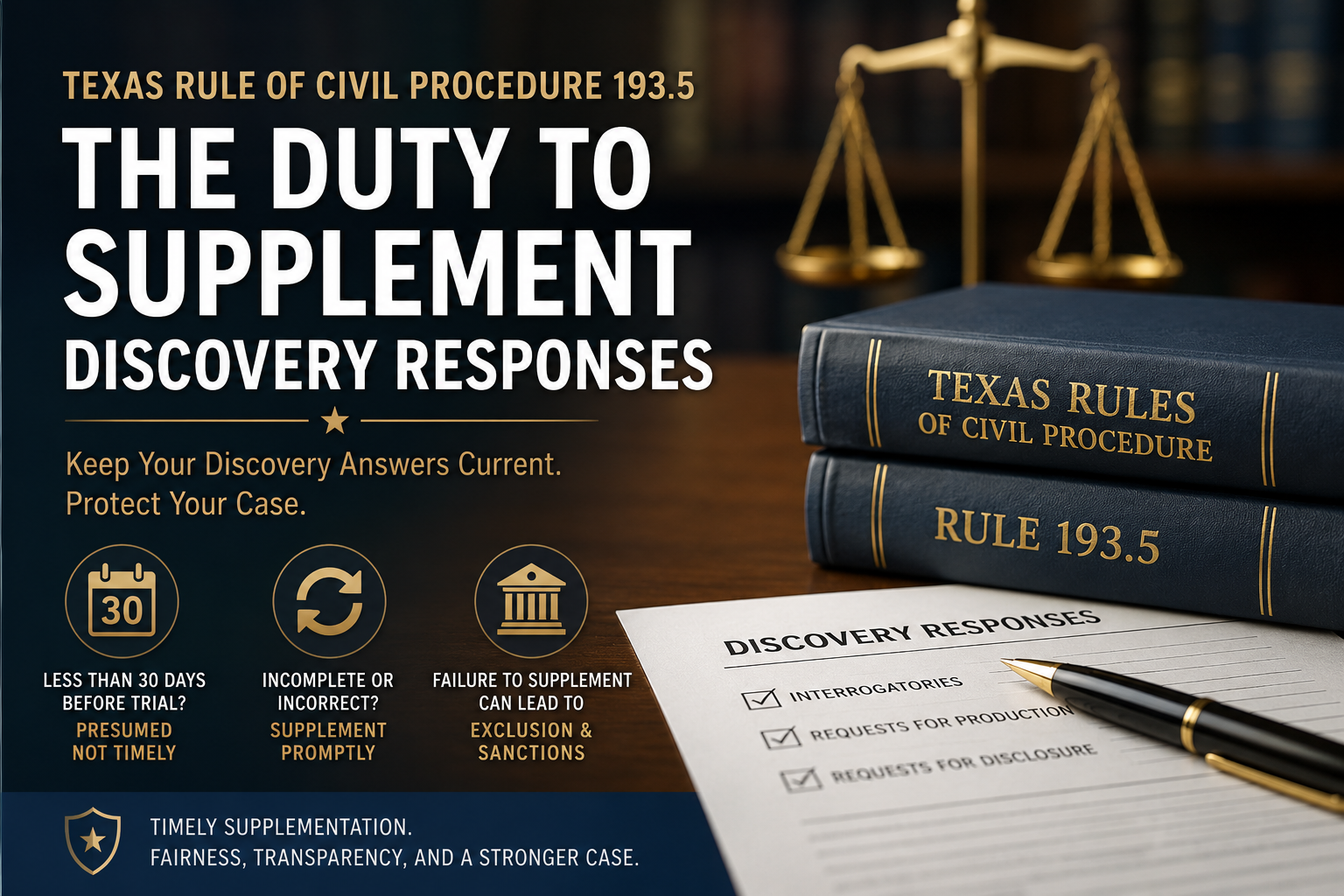
One of the most misunderstood obligations in Texas litigation is that discovery responses are not "one and done." A party who provides interrogatory answers, produces documents, or responds to requests for disclosure may later discover that the responses were incomplete or have become inaccurate.
Texas law imposes an ongoing duty to correct those responses.
Failing to do so can result in evidence being excluded, witnesses being barred from testifying, sanctions, or even serious damage to an otherwise strong case.
Whether you are involved in a business dispute, divorce, probate contest, landlord-tenant case, or real estate litigation, understanding the duty to supplement discovery responses is critical.
What Is Rule 193.5?
Texas Rule of Civil Procedure 193.5 provides:
"If a party learns that the party's response to written discovery was incomplete or incorrect when made, or, although complete and correct when made, is no longer complete and correct, the party must amend or supplement the response."
The Rule further provides that supplementation should be made "reasonably promptly after the party discovers the necessity for such a response."
The rule recognizes a simple reality:
Facts change.
People discover additional documents.
Witnesses emerge.
Damages evolve.
The discovery process is intended to keep both sides informed so that cases are decided on their merits rather than by surprise.
What Must Be Supplemented?
The duty extends to virtually every form of written discovery, including:
- Interrogatory answers
- Requests for production
- Requests for disclosure
- Requests for admission (where appropriate)
- Expert information
- Damage calculations
- Identification of witnesses
- Documents that were overlooked or later discovered
For example:
You answer an interrogatory identifying only two witnesses.
Three months later you discover another eyewitness.
You generally cannot simply wait until trial and call that witness.
Rule 193.5 requires supplementation.
When Is Supplementation Required?
The Rule does not impose a fixed number of days.
Instead, supplementation must occur "reasonably promptly."
The Rule also creates an important presumption:
A supplementation made less than 30 days before trial is presumed not to have been made reasonably promptly.
That does not automatically make the supplementation untimely, but it shifts the burden to the party seeking to use the late-disclosed evidence.
The closer the case gets to trial, the more dangerous delay becomes.
Why Does This Matter?
Discovery is designed to eliminate trial by ambush.
If one side withholds important information until the eve of trial, the opposing party has little opportunity to:
- investigate;
- take depositions;
- retain experts;
- gather rebuttal evidence; or
- prepare cross-examination.
Texas courts strongly discourage surprise litigation.
What Happens If You Fail to Supplement?
The consequences can be severe.
Although Rule 193.5 creates the duty, the enforcement mechanism largely comes through Texas Rule of Civil Procedure 193.6, which generally prohibits a party from introducing evidence or witnesses that were not timely disclosed unless the party can establish:
- good cause; or
- that the failure will not unfairly surprise or unfairly prejudice the opposing party.
This exclusion can apply to:
- witnesses;
- photographs;
- contracts;
- medical records;
- business records;
- expert testimony;
- damage calculations; and
- numerous other categories of evidence.
A party may have a winning case but lose valuable evidence simply because discovery was not updated.
Examples
Example One
A plaintiff initially claims $25,000 in damages.
Later, additional repairs increase the damages to $90,000.
The plaintiff should supplement the discovery responses.
Example Two
A defendant locates text messages after responding to requests for production.
Those messages should generally be produced through supplementation.
Example Three
An expert changes an opinion after reviewing additional testing.
The expert disclosures should be supplemented before trial.
Does Supplementing Hurt Your Case?
Many clients worry that updating discovery somehow weakens their position.
Usually, the opposite is true.
Timely supplementation often increases credibility with the court and reduces the likelihood of costly discovery disputes.
Courts understand that information changes during litigation.
What they dislike is concealment.
Practical Advice
If you become involved in litigation:
- Keep copies of all discovery responses.
- Notify your attorney whenever new facts emerge.
- Save newly discovered documents.
- Inform your attorney if your damages change.
- Identify new witnesses immediately.
- Never assume that an old discovery response remains accurate months later.
Litigation is dynamic, and discovery should evolve with it.
Final Thoughts
Texas Rule of Civil Procedure 193.5 is one of those procedural rules that rarely receives public attention, yet it can determine whether crucial evidence is admitted or excluded.
Parties who treat discovery as an ongoing obligation place themselves in a far stronger position than those who ignore the duty to supplement. Waiting until the last minute can jeopardize months—or even years—of preparation. In many cases, prompt supplementation is not merely good practice; it is essential to protecting your ability to fully present your case.
At David C. Barsalou, Attorney at Law, PLLC, we help clients navigate business, family, tax, estate planning, and real estate matters ranging from document drafting to litigation with clarity and confidence. If you’d like guidance on your situation, schedule a consultation today. Call us at (713) 397-4678, email barsalou.law@gmail.com, or reach us through our Contact Page. We’re here to help you take the next step.