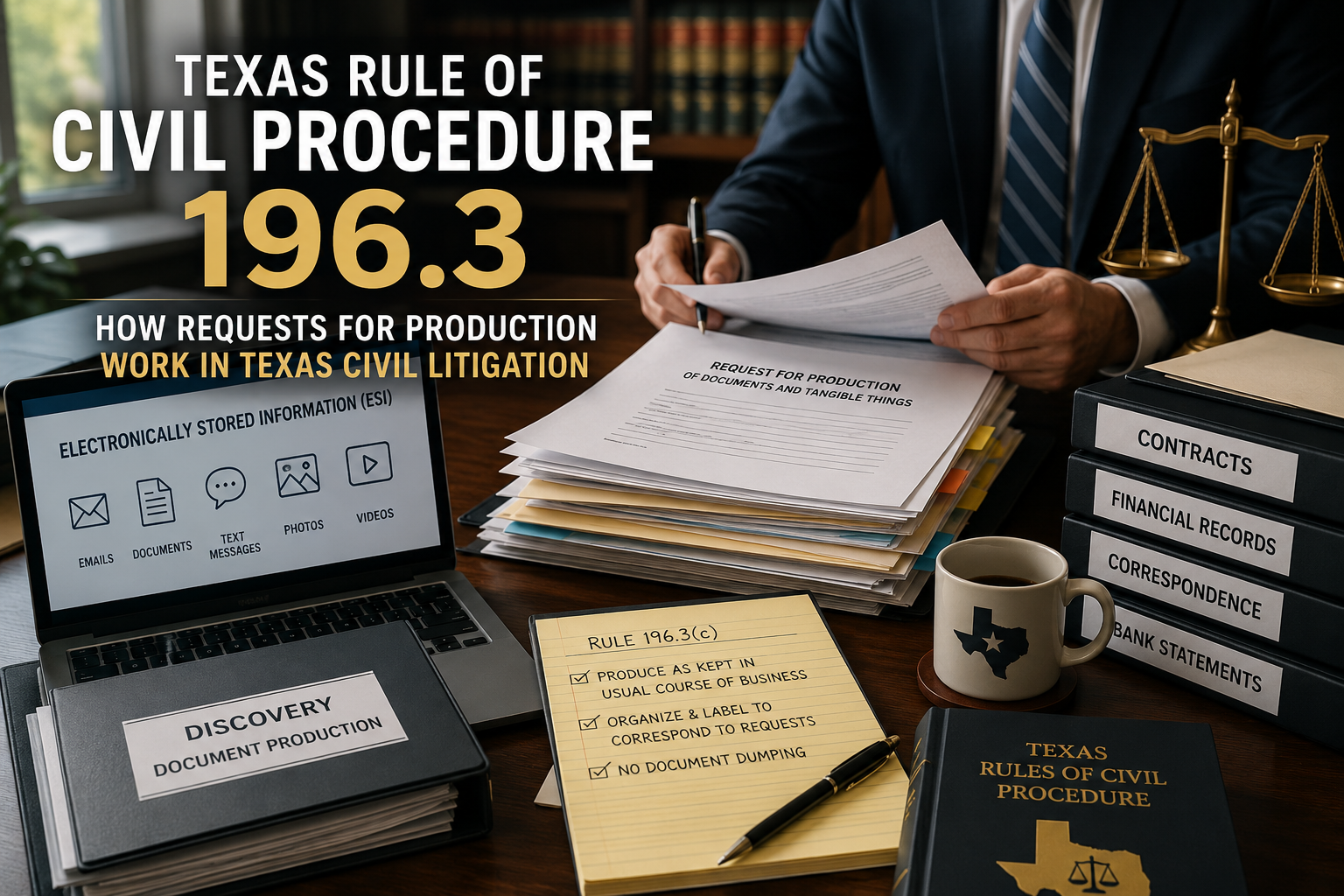
Discovery is often where Texas lawsuits are won or lost. While depositions and interrogatories receive much of the attention, Requests for Production under Texas Rule of Civil Procedure 196.3 frequently provide the documents, photographs, electronic records, contracts, communications, and other evidence that ultimately determine the outcome of a case.
Whether you are involved in a business dispute, divorce involving financial records, real estate litigation, probate litigation, or a contract lawsuit, understanding Rule 196.3 can help you appreciate both your rights and your obligations during discovery.
What Is Rule 196.3?
Texas Rule of Civil Procedure 196.3 governs requests for the production or inspection of documents and tangible things.
The Rule provides:
"The responding party must produce documents as they are kept in the usual course of business or must organize and label them to correspond with the categories in the request."
Tex. R. Civ. P. 196.3(c).
Although deceptively simple, this language prevents parties from overwhelming their opponent with disorganized records while also allowing businesses to produce records in their normal filing systems.
What Can Be Requested?
Rule 196 allows parties to request inspection or production of numerous types of evidence, including:
- Contracts
- Emails
- Text messages
- Financial records
- Bank statements
- Tax returns (when discoverable)
- Medical records (when relevant)
- Corporate records
- Property records
- Photographs
- Videos
- Audio recordings
- Electronic data
- Social media content
- Physical objects involved in the lawsuit
The scope of production remains subject to the general discovery limitations contained in the Texas Rules of Civil Procedure, including relevance, proportionality, privilege, and applicable objections.
Organization Matters
One of the most overlooked portions of Rule 196.3 concerns how documents must be produced.
The responding party generally has two options:
- Produce documents exactly as maintained in the ordinary course of business; or
- Organize and label the documents so they correspond to each numbered request.
This requirement discourages "document dumps," where thousands of pages are produced with no meaningful organization in an effort to make useful evidence difficult to locate.
Electronic Documents Are Included
Modern litigation rarely involves only paper documents.
Requests frequently seek:
- PDFs
- Microsoft Office files
- Accounting software exports
- Emails
- Cloud storage documents
- Cell phone data
- Text messages
- Metadata
- Digital photographs
- Surveillance videos
Texas courts increasingly expect parties to preserve electronically stored information (ESI) once litigation is reasonably anticipated. Failure to do so may expose a party to sanctions or spoliation arguments.
Inspection of Tangible Items
Rule 196 is not limited to paperwork.
A requesting party may seek inspection of:
- Damaged property
- Construction materials
- Vehicles
- Equipment
- Machinery
- Physical evidence
- Products involved in liability claims
In appropriate cases, inspection may provide evidence that cannot be captured through photographs alone.
Common Objections
Not every request must be answered exactly as written.
Proper objections may include:
- Attorney-client privilege
- Attorney work product
- Overbreadth
- Undue burden
- Lack of relevance
- Confidential or proprietary information
- Requests seeking information outside the permissible scope of discovery
However, blanket objections are generally disfavored. Texas discovery rules typically require parties to make objections with sufficient specificity so the requesting party and the court understand the basis for withholding information.
Why Rule 196.3 Matters
Many lawsuits are decided not because of dramatic courtroom testimony, but because documents reveal what actually occurred.
Emails establish timelines.
Bank records trace money.
Contracts define obligations.
Text messages reveal intent.
Corporate records identify decision-makers.
The careful use of Requests for Production often allows attorneys to evaluate liability, damages, credibility, and settlement value long before trial.
Final Thoughts
Texas Rule of Civil Procedure 196.3 may appear technical, but it plays a central role in virtually every civil lawsuit. Properly drafted Requests for Production can uncover critical evidence, while improperly responding to them can expose a party to motions to compel, sanctions, or unnecessary expense.
Whether your case involves commercial litigation, probate disputes, real estate conflicts, family law, or contract claims, understanding how Rule 196.3 operates is essential to effective litigation strategy.
Disclaimer: This article is provided for educational purposes only and does not constitute legal advice. Every case presents unique facts and legal issues. If you are involved in litigation or anticipate a lawsuit, consult a qualified Texas attorney regarding your specific circumstances.
At David C. Barsalou, Attorney at Law, PLLC, we help clients navigate business, family, tax, estate planning, and real estate matters ranging from document drafting to litigation with clarity and confidence. If you’d like guidance on your situation, schedule a consultation today. Call us at (713) 397-4678, email barsalou.law@gmail.com, or reach us through our Contact Page. We’re here to help you take the next step.