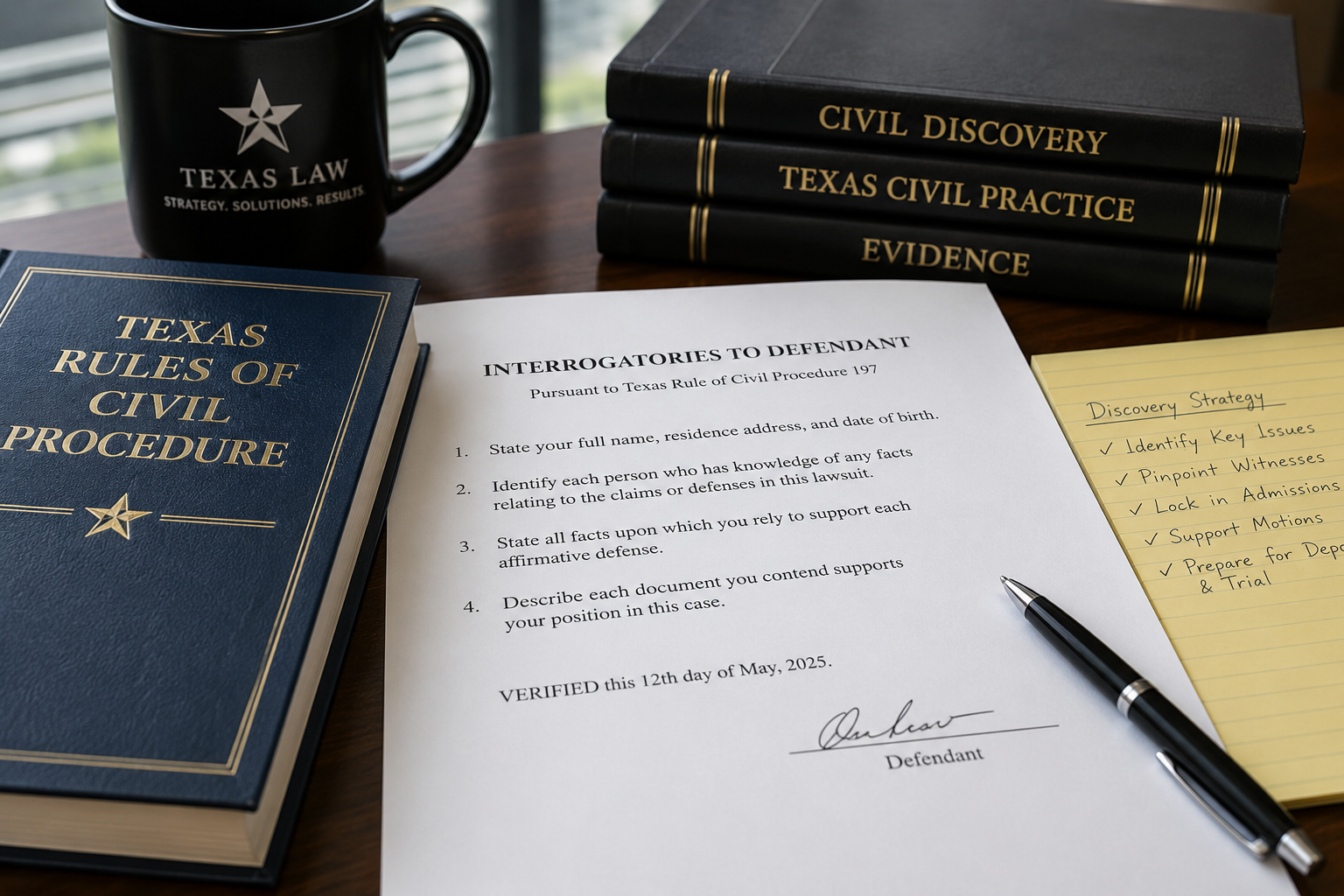
Most people picture litigation as dramatic courtroom testimony or aggressive depositions. In reality, many cases are won or lost long before trial through written discovery. One of the most important—and frequently misunderstood—tools is the interrogatory.
Texas Rule of Civil Procedure 197 allows parties to require their opponents to answer written questions under oath. Although interrogatories appear simple, they often lock parties into positions, identify witnesses, uncover defenses, and create impeachment material that can become invaluable later in the case.
Whether you are involved in a business dispute, real estate litigation, family-related property litigation, or a contract case, understanding Rule 197 is essential.
What Is an Interrogatory?
An interrogatory is a written question served by one party on another party to the lawsuit. Unlike requests for production, interrogatories seek information rather than documents.
The responding party must answer each interrogatory separately and fully unless a proper objection is made.
Texas Rule of Civil Procedure 197.2 provides:
"Each interrogatory must be answered separately and fully in writing under oath, unless it is objected to, in which event the objecting party shall state the legal basis for the objection and respond to the extent the interrogatory is not objectionable."
Because the answers are verified under oath, they carry significant weight throughout the litigation.
Who May Receive Interrogatories?
Rule 197 only applies to parties to the lawsuit.
If information is needed from someone who is not a party, other discovery tools—such as subpoenas under Rule 205 or depositions—are generally required.
This distinction is important because lawyers occasionally attempt to obtain information from nonparties using improper discovery requests.
Numerical Limits Matter
Texas places limits on interrogatories.
For most Level 1 and Level 2 discovery cases, Rule 190 limits each party to 25 written interrogatories, excluding interrogatories asking only about the identity and location of persons with knowledge of relevant facts or the authenticity of documents.
Because the number is limited, every interrogatory should be carefully drafted to obtain meaningful information rather than asking unnecessary or repetitive questions.
Verification Is Required
One of the most overlooked aspects of Rule 197 is that answers generally must be verified.
Verification means the responding party signs under oath that the responses are true based upon the party's knowledge and belief.
This requirement gives interrogatory responses evidentiary significance that ordinary attorney argument does not possess.
False or misleading verified answers may expose a party to impeachment, sanctions, or other consequences if discovered later.
Objections Must Be Specific
General objections are disfavored in Texas discovery practice.
Rule 197.2 requires the responding party to state the legal basis for any objection while answering any portion of the interrogatory that is not objectionable.
For example, if only part of an interrogatory seeks privileged information, the responding party ordinarily cannot refuse to answer the entire question.
Proper objections often involve:
- Attorney-client privilege
- Attorney work product
- Overbreadth
- Undue burden
- Lack of relevance proportional to the needs of the case
- Vagueness or ambiguity
Simply objecting without explaining the legal basis may create problems if the dispute reaches the court.
When Must Interrogatories Be Answered?
Rule 197.2 generally requires responses within the deadlines established by the Texas Rules of Civil Procedure unless modified by agreement or court order.
Missing discovery deadlines can have serious consequences, including motions to compel, sanctions, or limitations on presenting evidence later in the litigation.
Strategic Uses of Interrogatories
Experienced litigators often use interrogatories to:
- Identify all persons with relevant knowledge.
- Discover legal theories asserted by the opposing party.
- Determine how damages are being calculated.
- Identify expert witnesses.
- Learn about affirmative defenses.
- Preserve admissions before depositions occur.
- Lock a party into factual positions before trial.
Because responses are made under oath, later inconsistent testimony may significantly affect credibility.
Can Interrogatory Answers Be Changed?
Yes.
Texas Rule of Civil Procedure 193.5 imposes a duty to supplement or amend discovery responses if a party later learns that a response was incomplete or incorrect.
Failing to supplement may result in exclusion of evidence or testimony that was not properly disclosed.
Common Mistakes
Some of the most common discovery mistakes include:
- Using boilerplate objections without legal support.
- Failing to verify answers.
- Giving evasive or incomplete responses.
- Waiting until the deadline to gather information.
- Treating interrogatories as insignificant because they are "only paperwork."
In reality, experienced trial lawyers frequently use interrogatory answers during depositions, mediation, summary judgment proceedings, and cross-examination at trial.
Practical Takeaway
Texas Rule of Civil Procedure 197 may not receive as much attention as depositions or summary judgment motions, but it remains one of the most effective discovery devices available in Texas litigation.
Properly drafted interrogatories can uncover critical facts, narrow disputed issues, preserve testimony, and expose weaknesses in an opponent's case long before anyone steps into a courtroom.
Conversely, careless answers can create admissions that follow a party throughout the lawsuit.
If you are involved in Texas civil litigation, consulting an attorney early in the discovery process can help ensure that interrogatories are drafted strategically, answered correctly, and used to strengthen—not weaken—your case.
Disclaimer: This article is for informational purposes only and does not constitute legal advice. Every lawsuit presents unique facts and legal issues. If you have questions regarding Texas discovery procedures or any civil litigation matter, consult a qualified Texas attorney.
At David C. Barsalou, Attorney at Law, PLLC, we help clients navigate business, family, tax, estate planning, and real estate matters ranging from document drafting to litigation with clarity and confidence. If you’d like guidance on your situation, schedule a consultation today. Call us at (713) 397-4678, email barsalou.law@gmail.com, or reach us through our Contact Page. We’re here to help you take the next step.