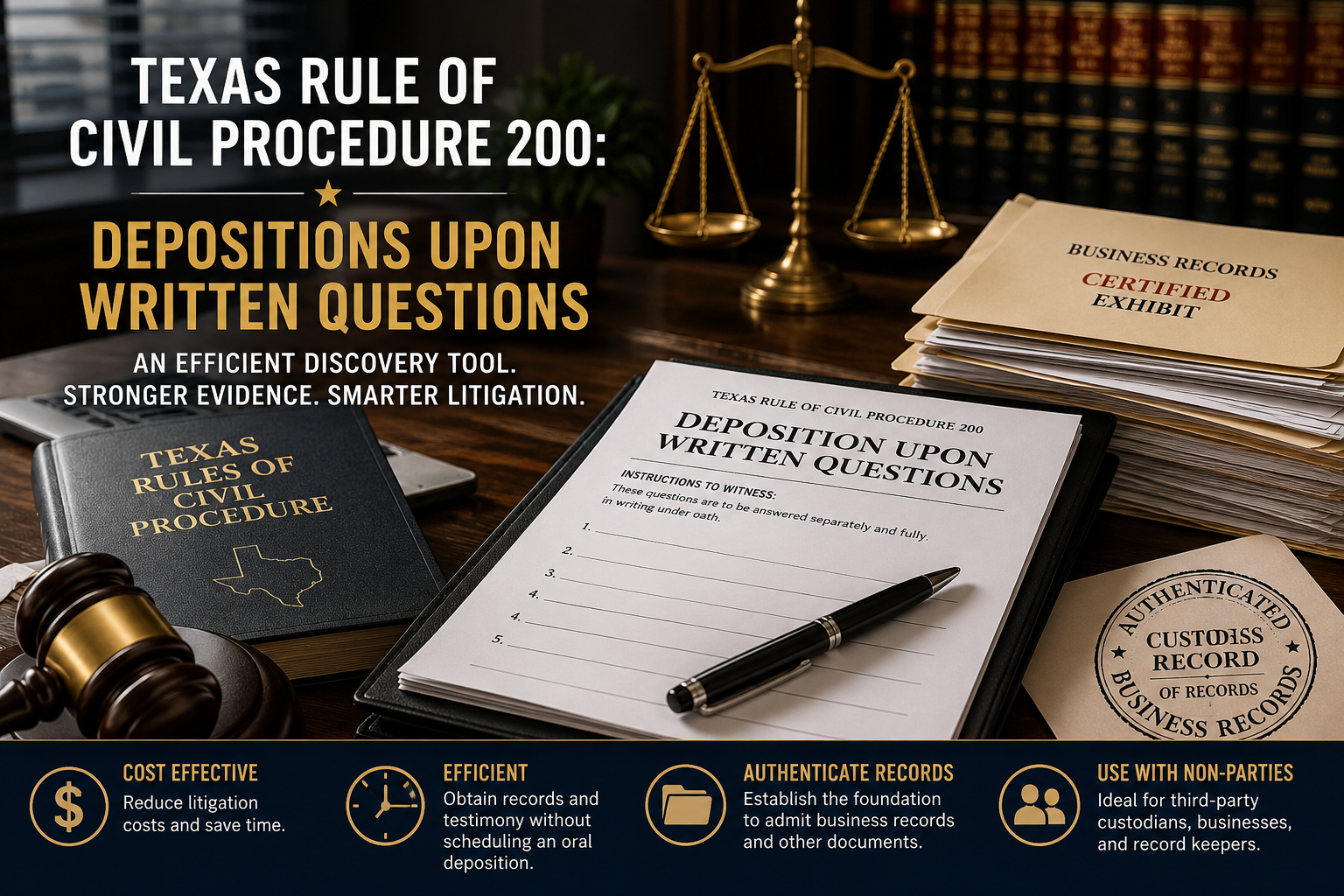
When most people think of depositions, they imagine attorneys questioning witnesses in a conference room while a court reporter records every answer. Texas law, however, recognizes another type of deposition that is frequently overlooked but remains extremely useful in the right case: the Deposition Upon Written Questions (DWQ).
Although oral depositions receive most of the attention, written-question depositions are commonly used to obtain business records, authenticate documents, establish routine facts, and reduce litigation costs. For attorneys handling commercial disputes, landlord-tenant matters, probate litigation, contract disputes, and family law cases involving records, understanding Texas Rule of Civil Procedure 200 is essential.
What Is a Deposition Upon Written Questions?
A deposition upon written questions allows testimony to be taken through a series of written questions rather than live oral examination.
Texas Rule of Civil Procedure 200.1 provides:
"A party may take the testimony of any person or entity by deposition upon written questions before any person authorized by law to take depositions."
Unlike an oral deposition under Rule 199, the witness is not questioned by attorneys in real time. Instead, a deposition officer asks the written questions exactly as submitted, records the witness's sworn answers, and prepares the official deposition.
Why Are Depositions Upon Written Questions Used?
DWQs are particularly effective when the goal is not to challenge credibility but simply to establish objective facts.
Common examples include:
- Obtaining medical records
- Authenticating business records
- Obtaining employment records
- Collecting banking records
- Proving billing records
- Authenticating governmental records
- Gathering records from third-party custodians
In practice, many Texas lawyers encounter Rule 200 most often when requesting certified records accompanied by a business-records affidavit.
What Must the Notice Include?
Texas Rule of Civil Procedure 200.1 requires notice identifying:
- the witness;
- the deposition officer;
- the written questions; and
- the time and place designated for the deposition.
The notice must also comply with applicable service requirements under the Texas Rules of Civil Procedure.
Because opposing counsel receives the written questions beforehand, the process is transparent and allows all parties to participate.
Cross-Questions Are Permitted
One significant difference between oral and written depositions is that every party has an opportunity to submit additional written questions.
The Rules permit:
- Cross-questions
- Redirect questions
- Recross questions
This structured procedure ensures each side has an opportunity to develop the record even without appearing in person.
Can DWQs Be Used Against Non-Parties?
Yes.
Rule 200 is frequently used alongside subpoena procedures when obtaining testimony or records from non-party custodians.
For example, attorneys routinely obtain:
- hospital records;
- employer payroll records;
- telephone records;
- insurance claim files;
- accounting records; and
- property management records.
Because the deposition is conducted under oath, the resulting testimony and certified documents frequently satisfy evidentiary requirements that would otherwise require live testimony.
Advantages of Depositions Upon Written Questions
Rule 200 offers several practical advantages.
Lower Cost
No conference room, multiple attorneys, or lengthy examination is required.
Efficiency
Routine records can often be obtained without scheduling an oral deposition months in advance.
Reduced Discovery Disputes
Because the questions are exchanged beforehand, objections can often be resolved before the deposition occurs.
Authentication of Records
One of the greatest advantages of a DWQ is that it often provides the foundation necessary to admit business records into evidence without requiring the records custodian to testify live at trial.
When Is an Oral Deposition Better?
A written deposition is usually not the proper tool when credibility is important.
If the attorney needs to:
- observe demeanor,
- ask spontaneous follow-up questions,
- confront inconsistent testimony,
- evaluate credibility,
- or explore unexpected answers,
an oral deposition under Rule 199 is generally far superior.
Written questions cannot easily adapt to unexpected testimony because every question has already been prepared before the deposition begins.
Strategic Considerations
Experienced Texas litigators generally reserve Rule 200 for situations involving objective evidence rather than contested factual disputes.
Examples include:
- authenticating records;
- proving routine business practices;
- obtaining employment files;
- collecting financial records;
- documenting medical treatment; or
- establishing chain of custody.
Using Rule 200 in these circumstances can substantially reduce litigation expenses while still creating admissible evidence.
Practical Takeaway
Although Depositions Upon Written Questions receive far less attention than oral depositions, they remain one of the most efficient discovery devices available under the Texas Rules of Civil Procedure. Understanding when to use Rule 200—and when not to—can save clients significant time and expense while simplifying proof at trial.
For attorneys handling commercial litigation, real estate disputes, probate matters, family law, creditor actions, or landlord-tenant litigation, Rule 200 is a procedural tool worth mastering.
Disclaimer: This article is for general educational purposes only and does not constitute legal advice. Every case is unique. If you are involved in Texas litigation, consult a qualified attorney regarding the specific facts of your case.
At David C. Barsalou, Attorney at Law, PLLC, we help clients navigate business, family, tax, estate planning, and real estate matters ranging from document drafting to litigation with clarity and confidence. If you’d like guidance on your situation, schedule a consultation today. Call us at (713) 397-4678, email barsalou.law@gmail.com, or reach us through our Contact Page. We’re here to help you take the next step.
