When physical injuries or mental health claims become part of a lawsuit, many people assume the opposing party has an automatic right to demand a medical examination. That is not how Texas law works.
Instead, Texas Rule of Civil Procedure 204 places significant limits on when a court may order a party to undergo a physical or mental examination. The rule attempts to balance two competing interests: the need to discover relevant evidence and an individual's right to bodily privacy.
Whether you are the plaintiff or the defendant, understanding Rule 204 can have a significant impact on your litigation strategy.
What Is Texas Rule of Civil Procedure 204?
Texas Rule of Civil Procedure 204 governs court-ordered physical and mental examinations during civil litigation.
Rule 204.1(a) provides:
"A party may—by motion served on the person to be examined and all parties—request that the court order another party or a person in the other party's legal control to submit to a physical or mental examination by a qualified physician or psychologist."
Unlike many forms of discovery, an examination under Rule 204 generally requires a court order rather than simply serving discovery requests.
The Court Must Find Good Cause
One of the most important protections contained in Rule 204 is the requirement that the moving party demonstrate good cause.
The court does not automatically grant examinations simply because someone alleges an injury.
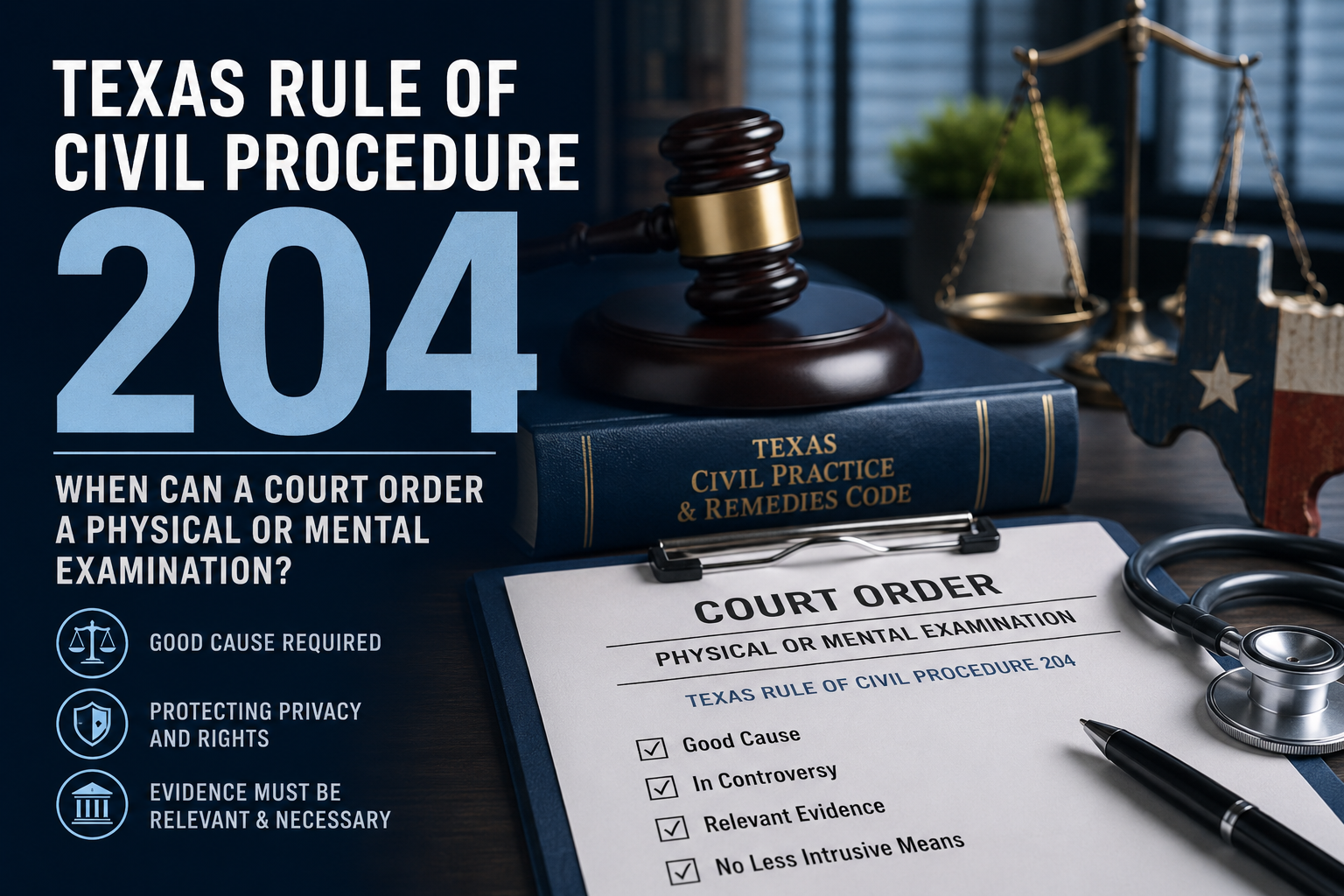
Instead, the moving party generally must show that:
- the person's physical or mental condition is genuinely in controversy;
- the requested examination is reasonably calculated to produce relevant evidence; and
- the information cannot be obtained through less intrusive means.
Texas courts recognize that compelled medical examinations are invasive and therefore require more than mere curiosity or speculation.
What Must the Motion Include?
Rule 204 requires specificity.
The motion should identify the:
- time of the examination;
- place of the examination;
- manner of the examination;
- conditions of the examination;
- scope of the examination; and
- identity and qualifications of the examiner.
These requirements allow the opposing party to object if the requested examination exceeds what is reasonably necessary.
Who Can Perform the Examination?
Rule 204 generally authorizes examinations by a qualified physician or psychologist, depending upon the nature of the condition being examined.
The examiner is expected to evaluate—not treat—the individual.
The examination is performed for litigation purposes, not for medical care.
Is Every Injury Enough?
No.
Simply alleging pain does not necessarily entitle the opposing party to a Rule 204 examination.
For example, if a plaintiff claims only minor injuries that are well documented through existing medical records, a court may conclude that a compelled examination is unnecessary.
Conversely, substantial claims involving permanent disability, traumatic brain injury, psychological damages, or future impairment frequently present stronger arguments for an examination.
Each case turns on its own facts.
Mental Examinations
Mental examinations receive particularly careful scrutiny.
If emotional distress is merely incidental to a lawsuit, courts may determine that a compelled psychological examination is unwarranted.
However, when a party affirmatively places a significant mental condition at issue—such as alleging serious psychological injury or seeking extensive mental anguish damages—the likelihood of a Rule 204 examination increases.
What Happens After the Examination?
The examining professional typically prepares a written report.
That report may later become evidence, and the examiner may testify as an expert witness concerning his or her opinions.
Because these examinations often become central evidence at trial, attorneys frequently retain consulting experts to review the findings and identify weaknesses in the examination methodology.
Can You Object?
Yes.
A party may oppose a Rule 204 motion by arguing, among other things:
- the physical or mental condition is not actually in controversy;
- the moving party has failed to establish good cause;
- existing medical records already provide the necessary information;
- the requested examination is overly broad;
- the proposed examiner lacks appropriate qualifications; or
- the requested procedures are unnecessarily invasive.
The trial court has broad discretion to tailor the examination to protect the rights of the individual being examined.
Practical Considerations
For plaintiffs, a Rule 204 examination should not be viewed as merely another doctor's appointment. The examiner has been retained for litigation and is evaluating issues relevant to the lawsuit.
For defendants, Rule 204 examinations can provide an independent evaluation of claimed injuries and may reveal inconsistencies between subjective complaints and objective medical findings.
Either way, preparation matters.
Final Thoughts
Texas Rule of Civil Procedure 204 provides an important safeguard against unnecessary intrusions into a person's physical and mental privacy while still allowing litigants access to evidence when genuine medical issues are in dispute.
Whether an examination should be ordered often depends upon careful legal analysis of the claims being asserted, the available medical evidence, and whether the requesting party can establish the required showing of good cause.
If you are involved in Texas civil litigation and questions arise regarding court-ordered medical or psychological examinations, consulting an experienced Texas litigation attorney early in the case can help protect your rights while ensuring compliance with the Texas Rules of Civil Procedure.
Disclaimer: This article is for general educational purposes only and does not constitute legal advice. Every case is unique. If you need advice regarding a specific dispute, consult a qualified Texas attorney.
At David C. Barsalou, Attorney at Law, PLLC, we help clients navigate business, family, tax, estate planning, and real estate matters ranging from document drafting to litigation with clarity and confidence. If you’d like guidance on your situation, schedule a consultation today. Call us at (713) 397-4678, email barsalou.law@gmail.com, or reach us through our Contact Page. We’re here to help you take the next step.