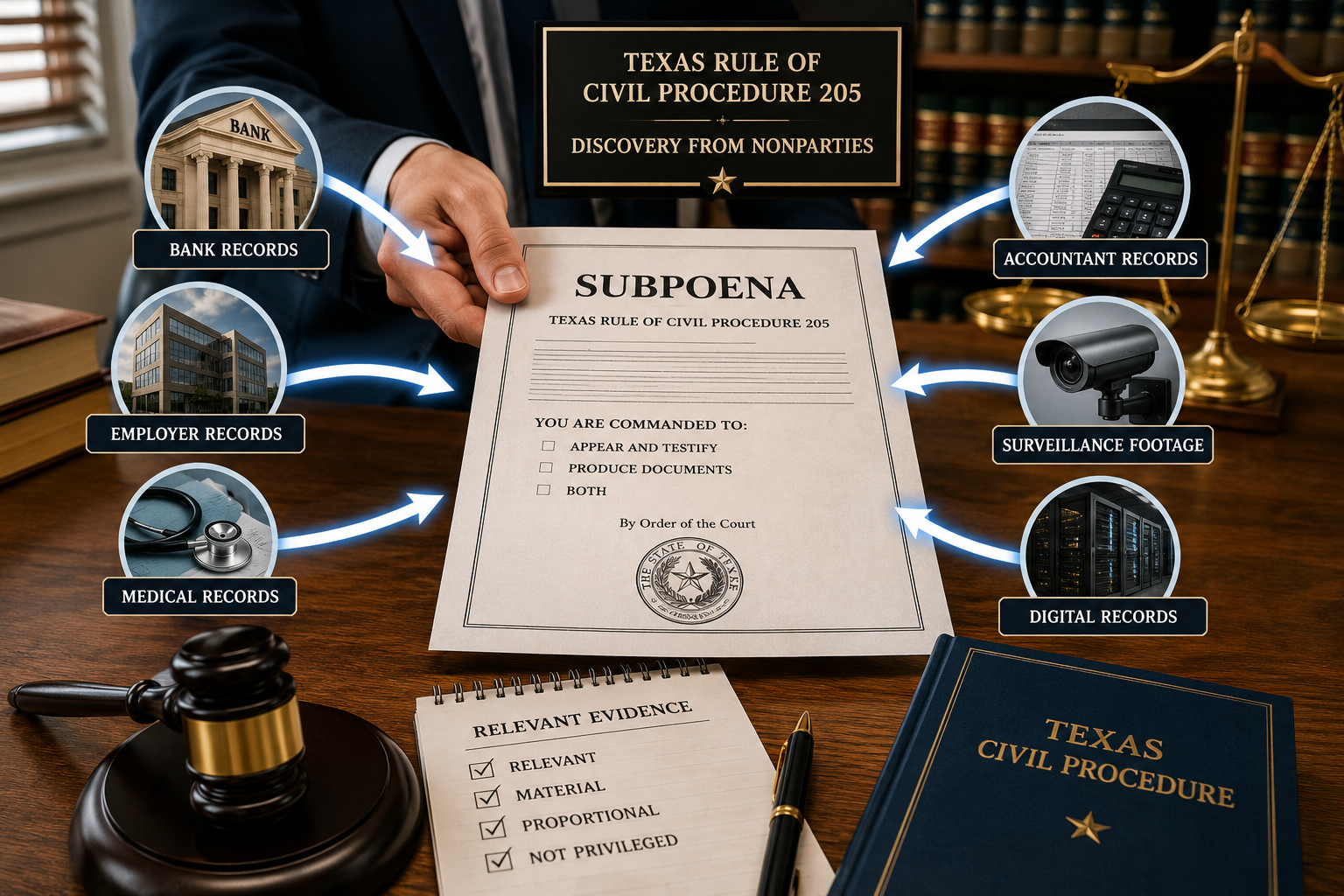
Understanding Texas Rule 205 and Nonparty Discovery
Many lawsuits involve people or businesses that are not parties to the case but still possess critical evidence. Bank records, employment files, medical records, surveillance footage, and business documents are often held by third parties who have no stake in the litigation. In Texas, obtaining this information requires compliance with Texas Rule of Civil Procedure 205.
Failure to follow the rule can result in objections, motions to quash, sanctions, and the exclusion of important evidence. Understanding how Rule 205 works is therefore essential for both litigants and attorneys.
What Is a Nonparty?
A nonparty is any person or entity that is not currently a plaintiff, defendant, petitioner, respondent, intervenor, or other formal participant in the lawsuit.
Examples include:
- Banks
- Employers
- Medical providers
- Accountants
- Property managers
- Internet service providers
- Social media companies
- Business vendors
Even though these individuals or entities are not parties to the case, they may possess evidence relevant to the claims or defenses being litigated.
The Rule
Texas Rule of Civil Procedure 205.1 provides:
"A party may compel discovery from a nonparty—that is, a person who is not a party or subject to a party's control—by serving a subpoena under Rule 176."
The rule is deceptively simple. The key takeaway is that nonparty discovery is generally enforced through the subpoena process.
The Three Methods of Nonparty Discovery
Rule 205.1 authorizes discovery from nonparties through:
- Oral deposition;
- Written deposition; or
- Production of documents and tangible things.
A subpoena may command a nonparty to appear for deposition, produce documents, or both.
Notice Requirements Matter
One of the most common mistakes attorneys make is failing to provide proper notice before serving a nonparty subpoena.
Texas Rule of Civil Procedure 205.2 requires notice to all parties before the subpoena is served on the nonparty. The notice must describe the materials sought with reasonable particularity.
This requirement serves an important purpose. Opposing parties are entitled to object before sensitive records are disclosed.
For example, if one side seeks years of bank statements from a third-party bank, the opposing party may challenge the request as overly broad before the bank produces the records.
Document-Only Subpoenas
Not every subpoena requires a deposition.
Many litigants simply need records.
Examples include:
- Employment records
- Bank records
- Property records
- Telephone records
- Business records
- Insurance claim files
In such cases, the subpoena can require production of documents without requiring anyone to appear for testimony.
This often makes nonparty discovery faster and less expensive.
The Scope of Discovery Still Applies
Just because documents are held by a nonparty does not mean everything is discoverable.
Texas Rule of Civil Procedure 192.3 broadly permits discovery regarding matters that are relevant to the subject matter of the action.
However, discovery requests must still be proportional and reasonably tailored.
Courts frequently quash subpoenas seeking:
- Every document a company possesses
- Unlimited time periods
- Entire personnel files without justification
- Irrelevant financial information
The fact that a request is directed to a nonparty often causes courts to scrutinize it more carefully because the recipient did not voluntarily place itself into the litigation.
Privacy Concerns Frequently Arise
Certain records require special attention.
Examples include:
- Medical records
- Financial records
- Tax returns
- Personnel records
Texas courts generally recognize privacy interests in these materials.
A subpoena may therefore trigger objections, protective orders, confidentiality agreements, or in-camera review by the court.
Attorneys should narrowly tailor requests and seek only information genuinely relevant to the dispute.
Motions to Quash and Protective Orders
Nonparties are not powerless.
A subpoena recipient may object or seek judicial protection.
Texas Rule of Civil Procedure 176.6 permits objections and motions to quash.
Common grounds include:
- Overbreadth
- Undue burden
- Irrelevance
- Privilege
- Insufficient notice
- Excessive compliance costs
Courts frequently balance the need for discovery against the burden imposed upon the nonparty.
Practical Example
Suppose a plaintiff claims a former business partner diverted company funds.
The defendant denies wrongdoing.
The plaintiff may subpoena bank records directly from the financial institution rather than relying solely upon the defendant's production.
If properly noticed and narrowly tailored, Rule 205 provides a powerful mechanism for obtaining evidence directly from the source.
Strategic Considerations
Nonparty discovery can dramatically strengthen a case because third-party records are often perceived as more reliable than records produced by an interested litigant.
However, attorneys should avoid fishing expeditions.
Well-crafted subpoenas are:
- Narrowly tailored;
- Limited in time;
- Directed at specific categories of records; and
- Closely tied to pleaded claims and defenses.
A targeted subpoena is far more likely to survive judicial scrutiny than a broad demand for "everything."
Final Thoughts
Texas Rule of Civil Procedure 205 is one of the most important discovery tools available to litigants. It allows parties to obtain evidence directly from banks, employers, medical providers, businesses, and other third parties that possess relevant information.
At the same time, Texas courts expect attorneys to comply with notice requirements, respect privacy concerns, and avoid imposing unnecessary burdens on nonparties. When used correctly, Rule 205 can uncover evidence that may determine the outcome of an entire lawsuit.
At David C. Barsalou, Attorney at Law, PLLC, we help clients navigate business, family, tax, estate planning, and real estate matters ranging from document drafting to litigation with clarity and confidence. If you’d like guidance on your situation, schedule a consultation today. Call us at (713) 397-4678, email barsalou.law@gmail.com, or reach us through our Contact Page. We’re here to help you take the next step.