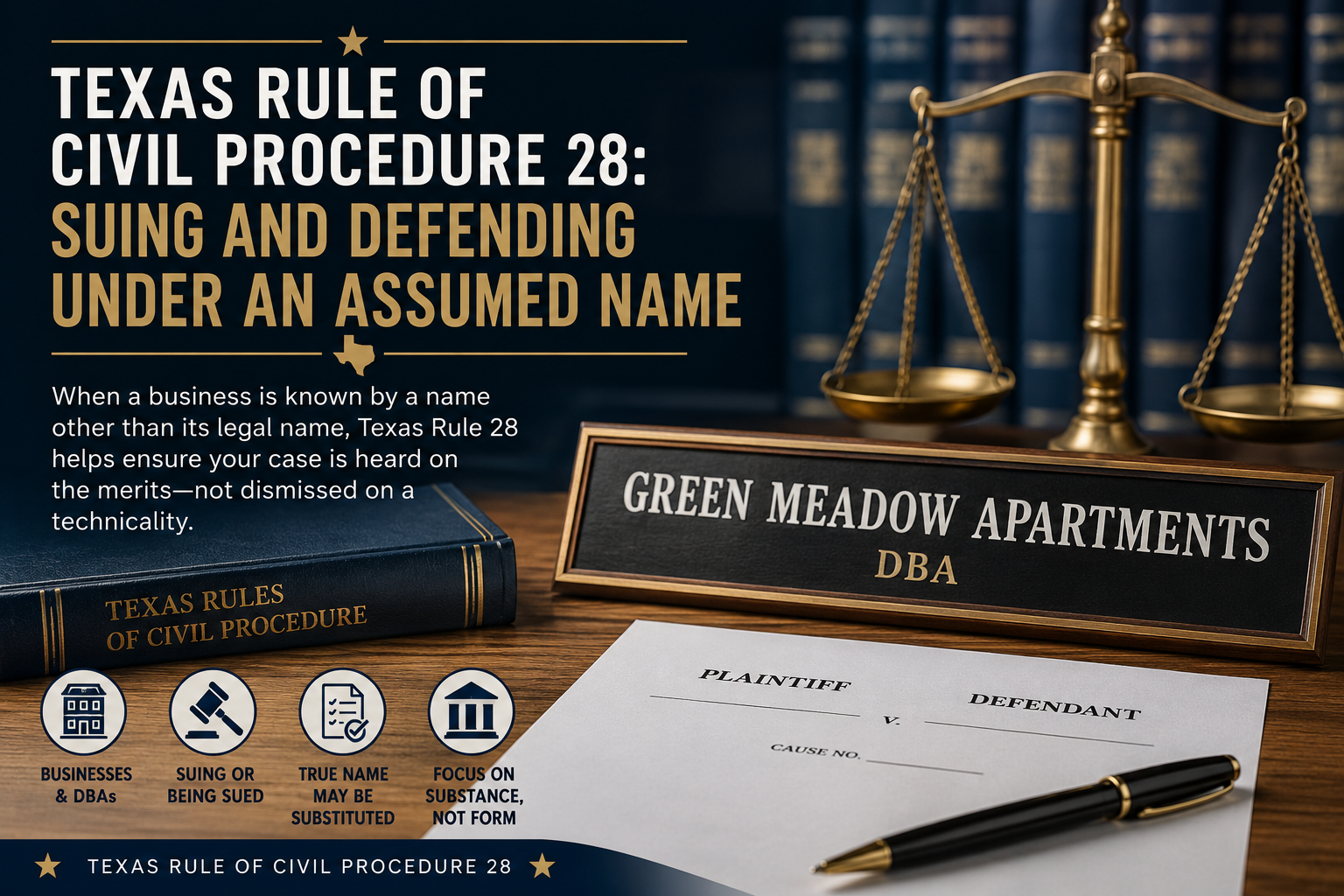
Many Texas businesses operate under names that are not their actual legal names. Apartment complexes, construction companies, property management firms, restaurants, and family-owned businesses frequently conduct business under a "doing business as" (DBA) or assumed name.
This creates an interesting procedural question:
What happens when a lawsuit is filed against the business name everyone knows, but that name is not the actual legal entity?
Texas Rule of Civil Procedure 28 provides the answer.
The Rule
Texas Rule of Civil Procedure 28 states:
"Any partnership, unincorporated association, private corporation, or individual doing business under an assumed name may sue or be sued in its partnership, assumed or common name for the purpose of enforcing for or against it a substantive right, but on a motion by any party or on the court's own motion the true name may be substituted."
— Tex. R. Civ. P. 28
This deceptively short rule has enormous practical consequences.
Why Rule 28 Exists
The rule recognizes a simple reality: people often know businesses by the name displayed on a sign, website, invoice, lease, or advertisement rather than by the legal entity that owns the business.
For example:
- "ABC Apartments" may actually be owned by XYZ Holdings, LLC.
- "Smith Construction" may be operated by Smith Builders, Inc.
- "Joe's Plumbing" may simply be an assumed name used by an individual proprietor.
Without Rule 28, lawsuits could be derailed merely because a plaintiff sued the name by which the business publicly held itself out.
The rule prevents substance from being defeated by form.
What Is an Assumed Name?
Texas law generally requires the filing of assumed name certificates when a person or entity conducts business under a name other than its legal name.
An assumed name is not a separate legal entity.
Instead, it is merely another name used by the actual person or entity conducting business.
For example:
- Legal Entity: Smith Property Holdings, LLC
- Assumed Name: Green Meadow Apartments
The apartment complex itself does not usually have a separate legal existence.
Rule 28 allows litigation to begin under the commonly known name while permitting correction of the true legal name later.
Who Can Use Rule 28?
The rule expressly applies to:
- Partnerships
- Unincorporated associations
- Private corporations
- Individuals doing business under assumed names
Texas courts have broadly applied Rule 28 to situations involving businesses operating under trade names and DBAs.
Why This Matters in Real Estate Litigation
Rule 28 frequently appears in landlord-tenant and real estate disputes.
Suppose a tenant signs a lease with:
"Green Meadow Apartments"
The tenant may have no idea that the actual owner is:
"Green Meadow Apartments Holdings, LLC"
or
"ABC Multifamily Fund III, LP"
If litigation arises, Rule 28 often permits suit under the name used in the ordinary course of business.
The actual legal entity can then be identified and substituted if necessary.
Rule 28 and Collection Cases
The same issue frequently arises in debt collection matters.
Invoices, contracts, and purchase orders often reference a trade name rather than the legal entity.
When a plaintiff sues using the business name appearing on the contract, Rule 28 may allow the lawsuit to proceed even before the precise legal identity of the defendant is clarified.
Rule 28 Is Not a Substitute for Identifying the Correct Party
Lawyers should not become complacent.
Although Rule 28 is forgiving, identifying the correct legal entity remains important.
Several problems can arise:
- Service issues
- Collection difficulties
- Judgment enforcement problems
- Questions regarding ownership of assets
The safest practice is always to determine the true legal identity of the business whenever possible.
The Connection to Misnomer and Misidentification
Rule 28 is often discussed alongside the doctrines of misnomer and misidentification.
A misnomer occurs when the correct party is sued but is described incorrectly.
A misidentification occurs when the wrong legal entity is sued altogether.
Rule 28 often helps avoid misnomer problems because it allows suit in the assumed name under which the business actually operates.
However, the rule does not automatically cure every instance of misidentification.
If a plaintiff truly sues the wrong legal entity, significant problems can still arise.
Practical Litigation Strategy
When representing a plaintiff:
- Review assumed name filings.
- Review contracts carefully.
- Search Texas Secretary of State records.
- Examine public property records.
- Confirm ownership before judgment.
When representing a defendant:
- Determine whether the named defendant is merely a DBA.
- Consider filing a verified pleading if identity is disputed.
- Seek substitution of the correct legal name where appropriate.
- Ensure the judgment accurately reflects the true legal entity.
Final Thoughts
Texas Rule of Civil Procedure 28 is one of those procedural rules that rarely attracts attention until it suddenly becomes critical.
Businesses often operate under names that differ from their legal identities. Rule 28 allows Texas courts to focus on the substance of a dispute rather than technical naming issues while still providing a mechanism for correcting the record when necessary.
For litigants, property owners, contractors, landlords, and business operators, understanding Rule 28 can mean the difference between a procedural detour and a successful lawsuit.
At David C. Barsalou, Attorney at Law, PLLC, we help clients navigate business, family, tax, estate planning, and real estate matters ranging from document drafting to litigation with clarity and confidence. If you’d like guidance on your situation, schedule a consultation today. Call us at (713) 397-4678, email barsalou.law@gmail.com, or reach us through our Contact Page. We’re here to help you take the next step.
