A Technical Rule That Frequently Determines Whether a Judgment Survives Appeal
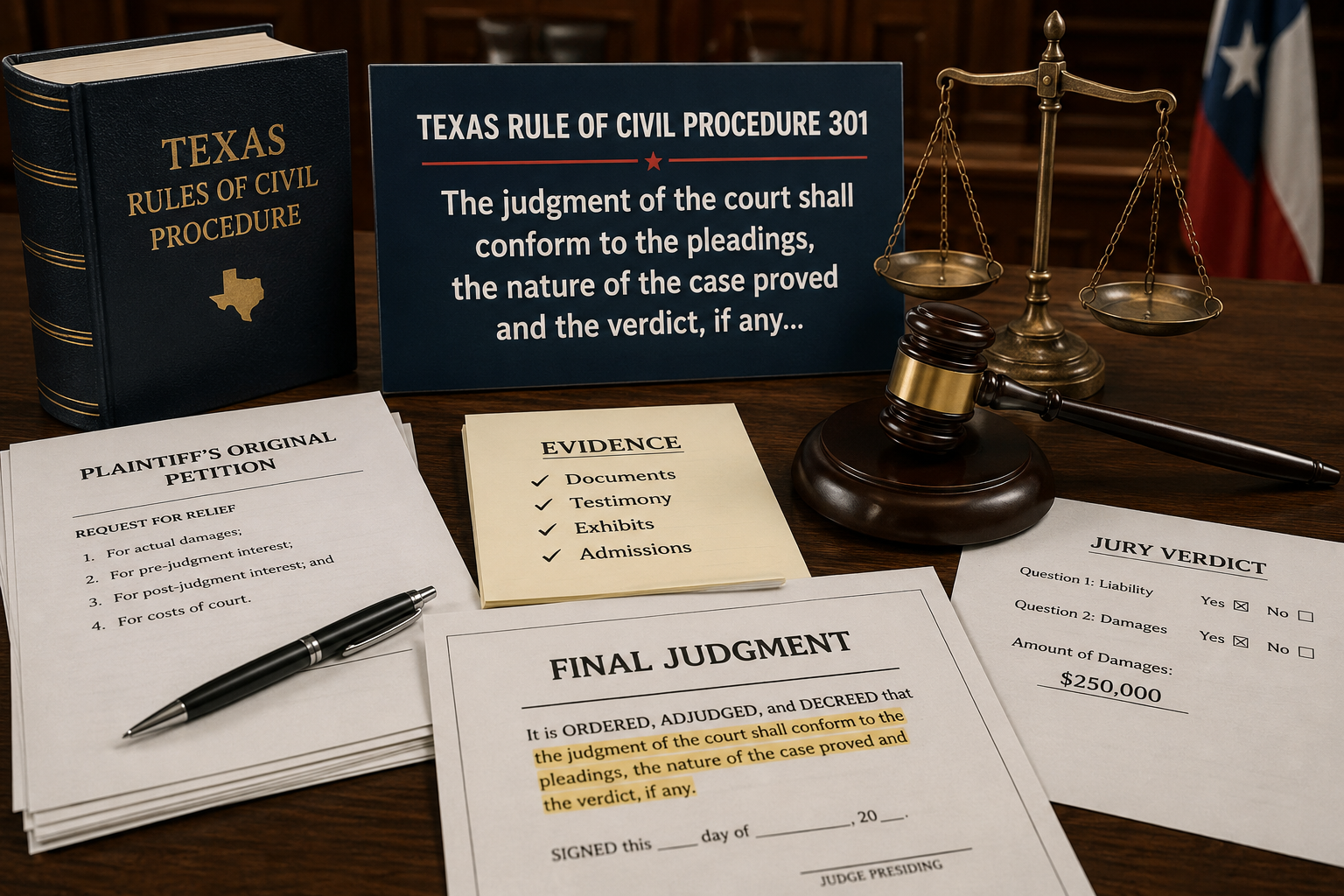
Most people assume that once a judge signs a judgment, the case is effectively over. In reality, Texas law imposes important limitations on what a court may include in a final judgment. One of the most overlooked is Texas Rule of Civil Procedure 301, which requires that a judgment conform to the pleadings, the evidence, and—where applicable—the jury's verdict.
This seemingly technical rule has significant consequences in civil litigation, family law, probate disputes, contract cases, real estate litigation, and appeals. A judgment that grants relief not requested in the pleadings may be reversible. Likewise, a judgment that differs from the jury's findings may be vulnerable on appeal.
Understanding Rule 301 can help litigants avoid costly mistakes and preserve important rights.
The Text of Rule 301
Texas Rule of Civil Procedure 301 provides in relevant part:
"The judgment of the court shall conform to the pleadings, the nature of the case proved and the verdict, if any..."
This simple sentence embodies a fundamental principle of due process: parties are entitled to notice of the claims being asserted against them and the relief being sought.
A court generally cannot award relief that was never pleaded simply because the judge believes it would be equitable or appropriate.
Why Pleadings Matter
Texas follows a notice pleading system. The purpose of pleadings is to inform the opposing party of the claims being asserted and the remedies being sought.
If a plaintiff sues for breach of contract and requests $50,000 in damages, the defendant is entitled to prepare a defense to that claim. If the court later awards an entirely different form of relief that was never pleaded, the defendant may have been deprived of fair notice.
As a result, Texas courts routinely examine whether the relief awarded in a judgment was actually requested in the live pleadings.
The Rule Applies Beyond Jury Trials
Many attorneys associate Rule 301 exclusively with jury verdicts, but the rule applies far more broadly.
For example:
- Bench trials;
- Default judgments;
- Probate proceedings;
- Declaratory judgment actions;
- Family law cases;
- Commercial litigation;
- Real estate disputes.
Even when no jury is involved, the judgment must generally remain within the scope of the pleadings and the evidence presented.
Default Judgments Are Especially Vulnerable
The conformity requirement is particularly strict in default judgment cases.
When a defendant fails to answer, the court may generally grant only the relief specifically requested in the petition.
This principle protects absent defendants from being surprised by relief they never had notice was being sought.
For example, if a petition requests monetary damages but does not request declaratory relief or injunctive relief, a default judgment granting those additional remedies may be vulnerable to attack.
Trial by Consent: An Important Exception
Texas law recognizes a limited exception known as "trial by consent."
When both parties actually litigate an issue during trial without objection—even though the issue was not formally pleaded—the pleadings may effectively be deemed amended.
Texas Rule of Civil Procedure 67 provides:
"Issues not raised by the pleadings which are tried by express or implied consent of the parties shall be treated in all respects as if they had been raised in the pleadings."
This doctrine prevents parties from remaining silent during trial and then complaining later that an issue was technically omitted from the pleadings.
However, Texas courts apply trial-by-consent cautiously. Mere evidence relevant to pleaded issues usually is not enough.
The Relationship Between Rule 301 and Due Process
At its core, Rule 301 protects constitutional due-process rights.
The United States Constitution and the Texas Constitution both require fair notice before a person can be deprived of property or subjected to a court order.
When a judgment awards relief beyond what was pleaded, courts often view the problem as more than a procedural defect—it can become a due-process violation.
That is one reason appellate courts take conformity challenges seriously.
Common Examples of Non-Conforming Judgments
Examples include:
Awarding Unpleaded Damages
A plaintiff pleads for actual damages but obtains punitive damages without pleading for exemplary relief.
Granting Unrequested Injunctions
The court enters an injunction even though no request for injunctive relief appears in the pleadings.
Awarding Property Not at Issue
In a property dispute, the judgment affects real property interests not described in the pleadings.
Entering Relief Contrary to Jury Findings
A jury finds no liability, yet the judgment awards damages anyway.
Granting Relief Against the Wrong Party
A judgment imposes obligations on an individual or entity not properly named in the lawsuit.
How Lawyers Preserve Error
When a judgment does not conform to the pleadings or verdict, attorneys frequently preserve error through:
- Objections to the proposed judgment;
- Motions to modify judgment;
- Motions for new trial;
- Requests for findings of fact and conclusions of law;
- Appellate briefing.
Because post-judgment deadlines in Texas are often short, prompt action is essential.
Why Rule 301 Matters in Probate and Family Law
The conformity doctrine frequently appears in probate and family-law litigation.
For example:
- A probate court generally cannot grant relief regarding property interests not placed in controversy by the pleadings.
- A divorce court must ordinarily remain within the issues presented by the parties.
- A court may encounter reversal when a final order awards relief beyond what was requested.
These issues often arise unexpectedly because courts are attempting to craft equitable solutions to complicated family or estate disputes.
Practical Takeaway
Texas Rule of Civil Procedure 301 embodies a deceptively simple principle: courts generally may not award relief that was never requested, never proved, or never found by the factfinder.
Although the rule occupies only a single sentence, it serves as an important safeguard for notice, due process, and the integrity of the judicial system.
Whether you are involved in a business dispute, probate proceeding, real estate lawsuit, or family-law matter, understanding the conformity requirement can help prevent unpleasant surprises and preserve valuable appellate rights.
Disclaimer
This article is provided for informational purposes only and does not constitute legal advice. Every case is different. If you are involved in litigation and have questions about a judgment entered against you, consult a qualified Texas attorney regarding your specific circumstances.
At David C. Barsalou, Attorney at Law, PLLC, we help clients navigate business, family, tax, estate planning, and real estate matters ranging from document drafting to litigation with clarity and confidence. If you’d like guidance on your situation, schedule a consultation today. Call us at (713) 397-4678, email barsalou.law@gmail.com, or reach us through our Contact Page. We’re here to help you take the next step.