Introduction
In Texas civil litigation, the way you plead damages at the outset can quietly control everything—from jurisdiction to discovery scope to trial strategy. Texas Rule of Civil Procedure 47 (“TRCP 47”) requires plaintiffs to plead damages within specific monetary ranges, rather than stating a precise amount.
This rule is often overlooked, but it has real consequences. If you mis-plead your damages, you can limit your recovery, complicate jurisdiction, or create strategic disadvantages that follow you through trial.
The Statutory Framework: TRCP 47(c)
Texas Rule of Civil Procedure 47(c) provides:
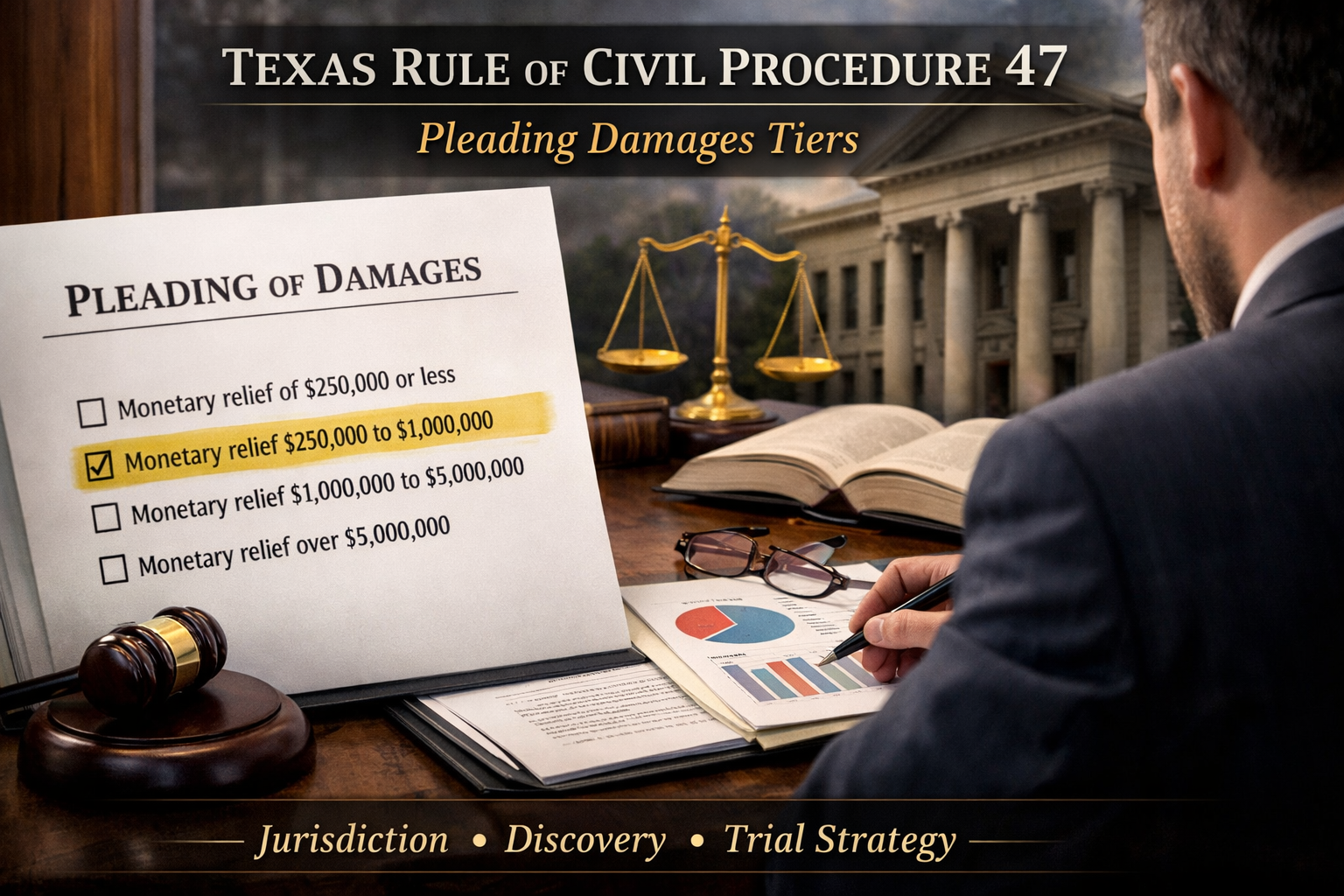
“An original pleading which sets forth a claim for relief… shall contain… a statement that the party seeks:
(1) only monetary relief of $250,000 or less…
(2) monetary relief of $250,000 or less and non-monetary relief;
(3) monetary relief over $250,000 but not more than $1,000,000;
(4) monetary relief over $1,000,000 but not more than $5,000,000; or
(5) monetary relief over $5,000,000.”
This tiered structure replaced the old “within the jurisdictional limits of the court” language and was designed to give fair notice of the magnitude of the case.
Why This Rule Matters More Than You Think
1. It Affects Jurisdictional Strategy
While TRCP 47 itself does not determine jurisdiction, it interacts with it.
- Justice Courts: Limited to $20,000
- County Courts at Law: Typically up to $250,000 (varies)
- District Courts: No upper limit
If you plead a higher tier than your chosen court allows, you create tension that opposing counsel can exploit through:
- Pleas to the jurisdiction
- Motions to transfer
- Attacks on credibility
2. It Controls Discovery Limitations
Under Texas Rule of Civil Procedure 190, discovery levels are tied to the nature and size of the case.
For example:
- Smaller damage tiers often correlate with Level 1 discovery (expedited)
- Larger tiers push the case into Level 2 or 3, expanding:
- Interrogatories
- Depositions
- Requests for production
A careless damages tier can unintentionally:
- Increase litigation costs
- Invite more aggressive discovery
- Escalate the case unnecessarily
3. It Shapes Settlement Expectations
Opposing counsel—and more importantly, insurance carriers—read your pleading as a signal.
- Plead too low → you anchor the case downward
- Plead too high → you risk losing credibility or inviting removal strategies (in federal cases)
Even though Texas no longer requires a specific dollar figure, the range itself becomes a negotiation baseline.
4. It Can Limit Recovery at Trial
Texas follows a fair notice pleading standard, but your pleadings still matter.
Courts have held that a party generally cannot recover damages outside the scope of what was pleaded. If your damages grow during litigation, you must amend.
Failing to amend can lead to:
- Objections to evidence
- Limitations on jury questions
- Reduced recovery
Strategic Considerations for Texas Practitioners
Be Intentional with Your Tier
Do not treat TRCP 47 as a formality. Instead:
- Evaluate realistic damages early
- Consider venue and jurisdiction
- Anticipate discovery burdens
- Think about jury perception
Amend When the Case Evolves
Texas rules are liberal with amendments, but timing matters.
Under TRCP 63:
“Parties may amend their pleadings… provided that such amendment… shall not operate as a surprise to the opposite party.”
Late-stage increases in damages can trigger:
- Motions to strike
- Claims of unfair surprise
- Continuance requests
Coordinate with Your Causes of Action
Your damages tier should align with your claims:
- DTPA claims (with treble damages) may justify a higher tier
- Contract claims with capped damages may not
Mismatch between legal theory and damages tier is a credibility problem.
Common Mistakes Under TRCP 47
1. “Over-Pleading” Without Support
Lawyers sometimes default to the highest tier to “keep options open.” This can:
- Inflate expectations
- Increase defense aggression
- Undermine settlement credibility
2. Forgetting to Amend
Cases evolve. Medical bills increase. Lost profits develop. If you don’t amend:
- You risk being boxed into your original tier
3. Ignoring Discovery Consequences
Higher tiers = broader discovery. That means:
- More cost
- More time
- More exposure
Practical Example
A plaintiff files a business dispute case and pleads:
“Monetary relief over $1,000,000 but not more than $5,000,000.”
But discovery reveals:
- Actual damages: ~$180,000
- No viable lost profits claim
Now the plaintiff:
- Looks inflated and unreasonable
- Faces aggressive discovery
- Loses credibility in mediation
A properly pled $250k–$1M tier would have been cleaner and more strategic.
Final Thoughts
Texas Rule of Civil Procedure 47 is one of those rules that seems procedural—but is actually strategic.
It quietly affects:
- Jurisdiction
- Discovery
- Settlement leverage
- Trial outcomes
If you treat it like a checkbox, it will work against you. If you treat it like a strategic lever, it can shape the entire trajectory of your case.
At David C. Barsalou, Attorney at Law, PLLC, we help clients navigate business, family, tax, estate planning, and real estate matters ranging from document drafting to litigation with clarity and confidence. If you’d like guidance on your situation, schedule a consultation today. Call us at (713) 397-4678, email barsalou.law@gmail.com, or reach us through our Contact Page. We’re here to help you take the next step.