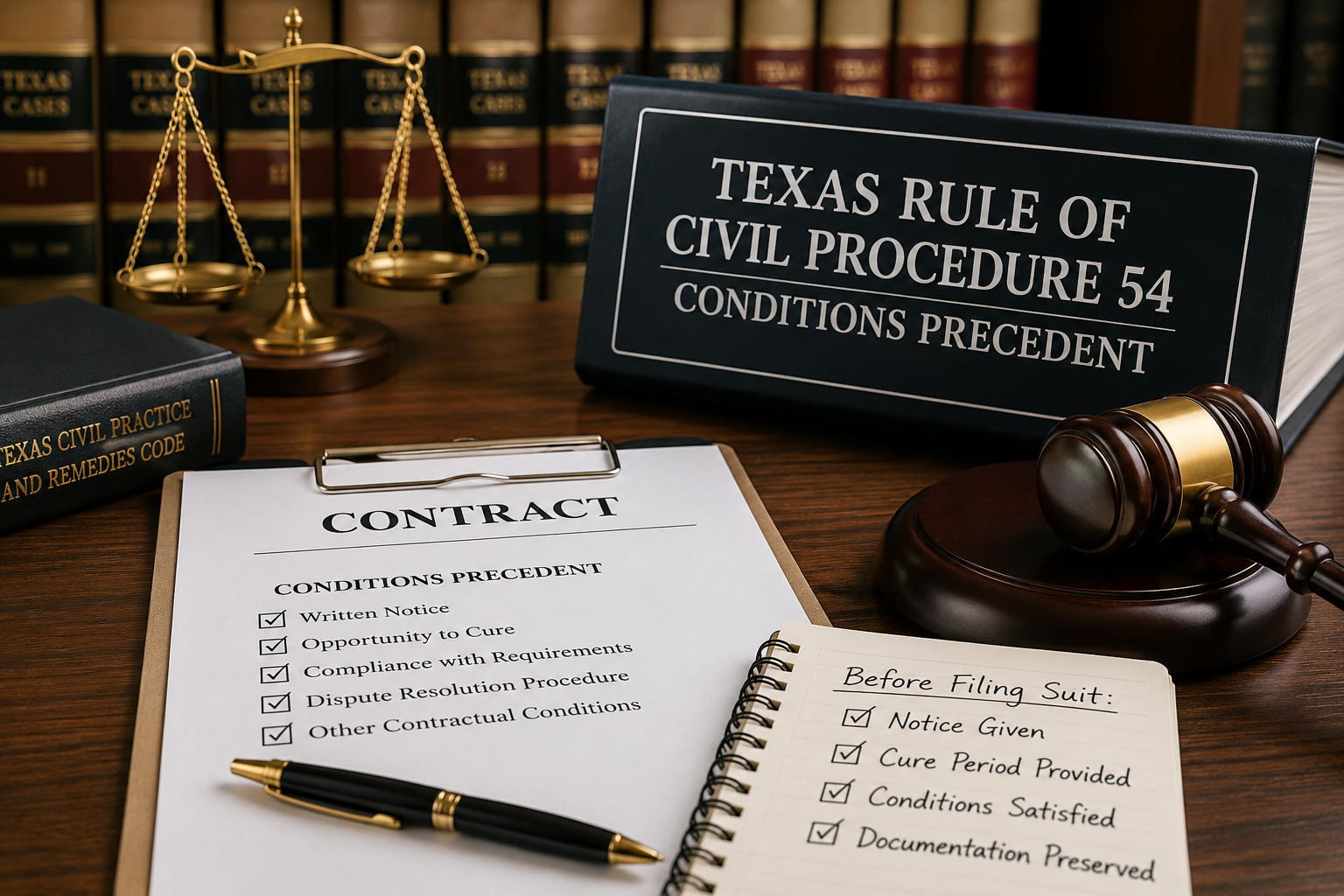
What Are Conditions Precedent Under Texas Law?
Many contracts require certain events to occur before one party has the right to sue. These events are known as conditions precedent.
Examples include:
- Providing written notice before filing suit;
- Allowing an opportunity to cure a default;
- Submitting a claim to an insurance carrier;
- Completing a contractual dispute-resolution procedure;
- Making a required payment or tender.
A party who fails to satisfy a condition precedent may lose an otherwise valid claim.
In Texas litigation, however, proving compliance with every condition precedent is often much easier than many people realize because of Texas Rule of Civil Procedure 54.
The Text of Rule 54
Texas Rule of Civil Procedure 54 provides:
"In pleading the performance or occurrence of conditions precedent, it shall be sufficient to aver generally that all conditions precedent have been performed or have occurred. When such performances or occurrences have been so pleaded, the party so pleading same shall be required to prove only such of them as are specifically denied by the opposite party."
This rule dramatically simplifies pleading requirements.
Rather than listing every condition precedent individually, a plaintiff may generally allege that all conditions precedent have been satisfied.
Why Rule 54 Matters
Rule 54 shifts part of the burden to the defendant.
If a plaintiff properly alleges that all conditions precedent have occurred, the defendant cannot merely file a general denial and later argue that some contractual prerequisite was not satisfied.
Instead, the defendant must specifically identify the condition precedent that allegedly failed.
Without a proper specific denial, the condition precedent is generally deemed admitted.
This procedural rule can substantially alter the course of litigation.
Common Examples of Conditions Precedent
Notice Requirements
Many contracts require one party to provide written notice before pursuing legal remedies.
For example, a construction contract may require notice of defective work before filing suit.
A commercial lease may require written notice of default before termination.
A lender may be required to provide notice before accelerating a promissory note.
Opportunity to Cure
Business contracts frequently require the breaching party to receive an opportunity to correct the problem before litigation begins.
Failure to provide a contractual cure period may jeopardize a lawsuit.
Insurance Claims
Insurance policies often contain extensive conditions precedent, including:
- Proof-of-loss requirements;
- Timely reporting obligations;
- Cooperation requirements;
- Examination-under-oath provisions.
Disputes frequently arise over whether these requirements were satisfied.
How Defendants Must Respond
A defendant who intends to challenge a condition precedent must do more than simply deny liability.
Texas Rule of Civil Procedure 54 requires a specific denial.
For example, a defendant might plead:
"Defendant specifically denies Plaintiff's allegation that all conditions precedent have occurred and specifically alleges that Plaintiff failed to provide the written notice required by Section 12.3 of the parties' contract."
This puts the plaintiff on notice regarding the disputed issue.
The Strategic Consequences of Failing to Specifically Deny
Many litigants overlook Rule 54.
When that happens, significant defenses may effectively disappear.
A defendant who fails to specifically deny a condition precedent may be unable to force the plaintiff to prove compliance with that condition.
In practical terms, an otherwise strong defense may be waived through defective pleadings.
This is one reason why careful drafting of an answer remains critical even in seemingly straightforward lawsuits.
Conditions Precedent in Real Estate and Construction Cases
Conditions precedent frequently appear in:
- Real estate purchase contracts;
- Commercial leases;
- Construction agreements;
- Home improvement contracts;
- Financing agreements.
Texas lawyers regularly litigate whether required notices were sent, cure opportunities were provided, or contractual procedures were followed before suit was filed.
Because these disputes often involve technical procedural issues rather than the underlying merits, Rule 54 can become outcome-determinative.
Conditions Precedent and Summary Judgment
Rule 54 issues often surface during summary judgment practice.
If a defendant properly raises a specific denial regarding a condition precedent, the plaintiff may need to present evidence establishing compliance.
Examples include:
- Certified mail receipts;
- Emails transmitting notice;
- Affidavits regarding delivery;
- Contractual correspondence;
- Business records.
Failure to produce sufficient evidence may result in dismissal or adverse summary judgment.
Practical Lessons for Texas Litigants
Whether you are filing a lawsuit or defending one, conditions precedent deserve careful attention.
Plaintiffs should:
- Include a Rule 54 allegation in their pleadings;
- Maintain records showing compliance with contractual requirements;
- Preserve notices and communications.
Defendants should:
- Review contracts carefully;
- Identify any unmet prerequisites;
- Plead specific denials when appropriate.
A procedural oversight at the pleading stage can have lasting consequences throughout the litigation.
Conclusion
Texas Rule of Civil Procedure 54 is a short rule with enormous practical significance. By allowing parties to generally plead the occurrence of conditions precedent while requiring specific denials from opponents, the rule streamlines litigation and narrows disputes to genuinely contested issues.
Whether the case involves a business contract, construction dispute, commercial lease, insurance claim, or real estate transaction, understanding Rule 54 can be the difference between preserving a defense and unintentionally waiving it. Consulting with an experienced Texas attorney early in the process can help ensure that these procedural requirements are properly addressed before they become costly mistakes.
At David C. Barsalou, Attorney at Law, PLLC, we help clients navigate business, family, tax, estate planning, and real estate matters ranging from document drafting to litigation with clarity and confidence. If you’d like guidance on your situation, schedule a consultation today. Call us at (713) 397-4678, email barsalou.law@gmail.com, or reach us through our Contact Page. We’re here to help you take the next step.
