One of the fundamental principles of Texas litigation is that parties are expected to plead their claims and defenses before trial.Pleadings define the issues that will be decided and provide fair notice to everyone involved.
But Texas procedure recognizes an important exception.
Sometimes evidence is introduced during trial concerning an issue that was never pleaded, yet neither side objects. Under the right circumstances, that issue may become part of the lawsuit anyway.
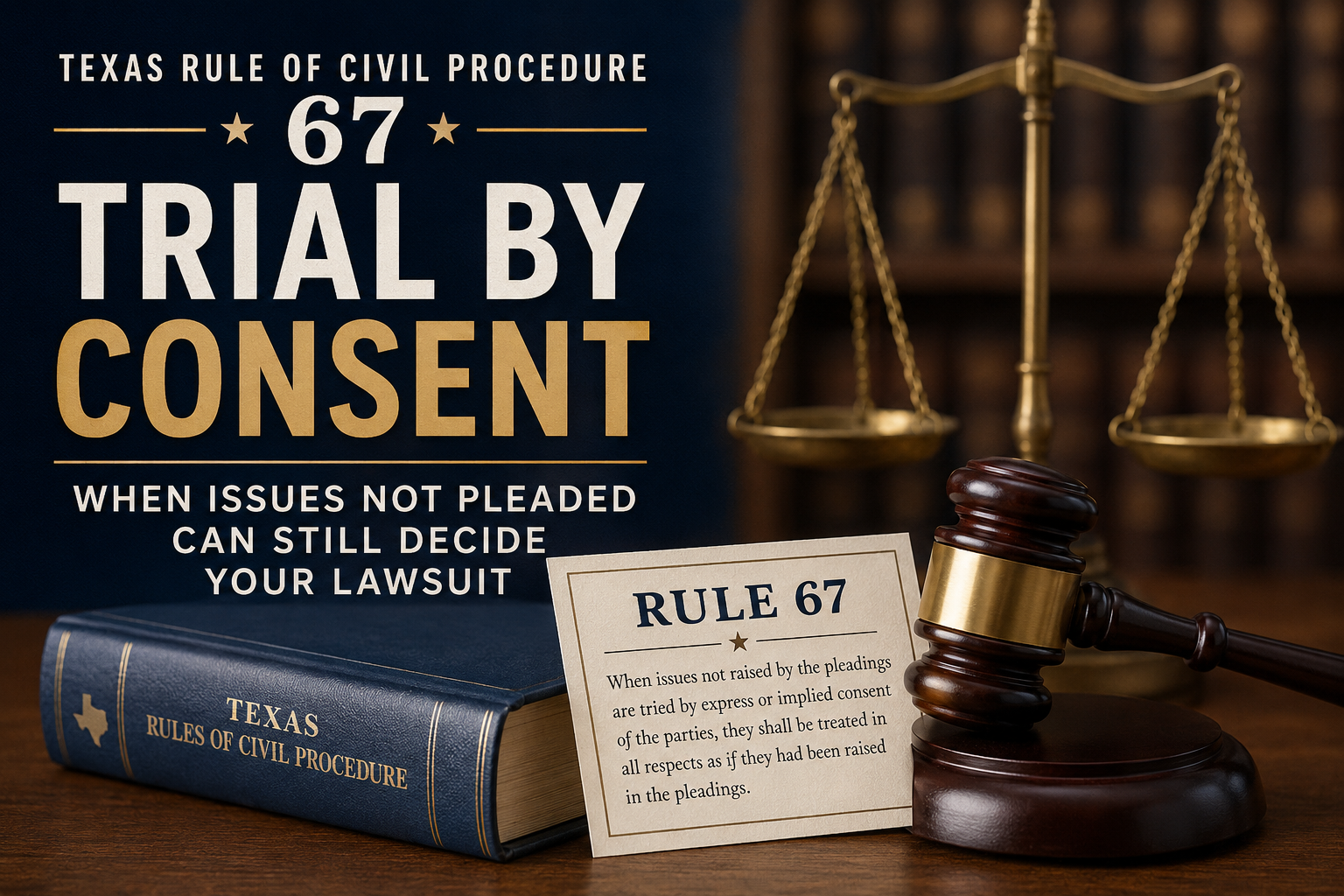
That principle is governed by Texas Rule of Civil Procedure 67, commonly called trial by consent.
Although Rule 67 is relatively short, it can dramatically affect the outcome of a lawsuit.
The Rule
Texas Rule of Civil Procedure 67 provides:
"When issues not raised by the pleadings are tried by express or implied consent of the parties, they shall be treated in all respects as if they had been raised in the pleadings. Such amendment of the pleadings as may be necessary to cause them to conform to the evidence and to raise these issues may be made upon motion of any party at any time, even after judgment; but failure so to amend shall not affect the result of the trial of these issues."
This rule accomplishes two important things:
- It allows pleadings to conform to the evidence.
- It prevents parties from complaining about issues they effectively agreed to litigate.
Why Rule 67 Exists
Trials are dynamic.
Witnesses testify.
Documents are admitted.
Facts develop differently than expected.
Rather than requiring a mistrial every time an unexpected issue appears, Rule 67 allows the lawsuit to evolve when both parties actually litigate the issue.
The rule promotes deciding cases on their merits rather than procedural technicalities.
Express Consent vs. Implied Consent
Rule 67 recognizes two different kinds of consent.
Express Consent
Express consent is straightforward.
Both attorneys openly agree that a new issue is part of the trial.
Examples include:
- stipulations on the record;
- agreements during hearings;
- statements made before the judge.
Implied Consent
Implied consent is much more common.
It occurs when:
- evidence is introduced on an unpleaded issue;
- the opposing party fails to object; and
- both sides actually litigate that issue.
In those circumstances, Texas courts often conclude that everyone effectively agreed to try the new issue.
Silence Can Matter
One of the biggest practical lessons from Rule 67 is this:
Failing to object can change the lawsuit.
Suppose a plaintiff sues only for breach of contract.
During trial, substantial evidence is introduced concerning fraud.
Defense counsel never objects.
The parties question witnesses extensively regarding fraud.
Closing arguments discuss fraud.
A court may determine that the fraud claim was tried by consent even though it never appeared in the petition.
When Rule 67 Does Not Apply
Trial by consent is not automatic.
Texas courts apply the doctrine cautiously.
Rule 67 generally does not apply where:
- the evidence is relevant to an already pleaded issue;
- the opposing party had no notice a new issue was being tried;
- admission of the evidence does not clearly demonstrate consent;
- applying the doctrine would cause unfair surprise.
Simply introducing evidence that overlaps multiple claims is usually not enough.
Amendments May Be Filed Even After Trial
One unusual feature of Rule 67 is that it expressly permits amendments:
- during trial,
- after trial,
- and even after judgment.
The purpose is simply to make the pleadings match what actually happened in court.
Even if no amendment is ever filed, Rule 67 states that failure to amend does not affect the validity of issues tried by consent.
Practical Example
Imagine two business owners litigating a contract dispute.
The pleadings only request payment under the contract.
During trial:
- both sides introduce evidence regarding unjust enrichment;
- witnesses testify extensively about equitable recovery;
- no objections are made;
- both lawyers argue unjust enrichment during closing.
Although unjust enrichment never appeared in the pleadings, a Texas court may conclude that it was tried by consent under Rule 67.
Strategic Considerations
For plaintiffs:
- Monitor whether additional claims naturally develop during trial.
- Consider moving to amend pleadings to match the evidence.
- Remember that Rule 67 is not a substitute for careful pleading.
For defendants:
- Object when testimony exceeds the pleadings.
- Preserve complaints about surprise.
- Avoid unintentionally consenting to entirely new theories of recovery.
Many Rule 67 disputes are won—or lost—not because of dramatic courtroom moments, but because counsel failed to make a timely objection.
Relationship to Texas's Notice Pleading System
Texas generally follows a fair-notice pleading standard.
Rule 67 serves as an exception to that system.
Normally:
- pleadings define the lawsuit.
Under Rule 67:
- the evidence can redefine the lawsuit if both parties effectively litigate the issue.
The doctrine reflects a balance between procedural fairness and deciding disputes on their actual merits.
Conclusion
Texas Rule of Civil Procedure 67 is one of those procedural rules that experienced litigators keep in mind throughout every trial. While pleadings ordinarily determine what claims and defenses are before the court, Rule 67 recognizes that litigation sometimes develops in unexpected ways. When parties expressly—or even impliedly—consent to litigate an issue outside the pleadings, Texas courts may treat that issue exactly as though it had been pleaded from the beginning.
For litigants and attorneys alike, the lesson is simple: pay close attention to the evidence being introduced, object when appropriate, and never assume the pleadings alone define the case once trial has begun.
At David C. Barsalou, Attorney at Law, PLLC, we help clients navigate business, family, tax, estate planning, and real estate matters ranging from document drafting to litigation with clarity and confidence. If you’d like guidance on your situation, schedule a consultation today. Call us at (713) 397-4678, email barsalou.law@gmail.com, or reach us through our Contact Page. We’re here to help you take the next step.
