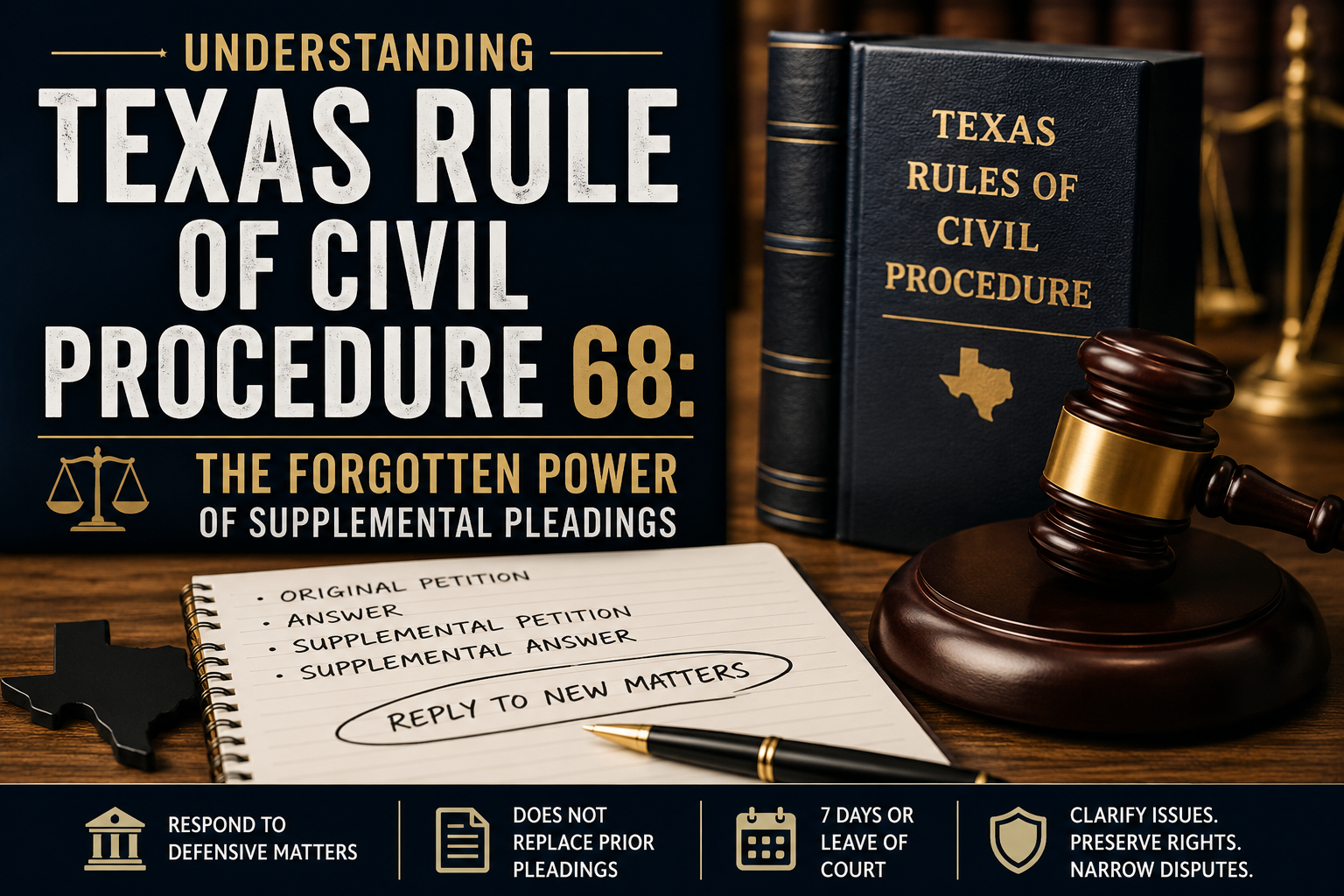
Texas litigation often revolves around pleadings. Most lawyers are familiar with amended petitions and amended answers under the Texas Rules of Civil Procedure. However, one procedural rule receives surprisingly little attention despite serving an important function in litigation: Texas Rule of Civil Procedure 68, which governs supplemental pleadings.
Although supplemental pleadings are less common than amended pleadings, they remain an important procedural tool when new matters arise after the original pleadings have been filed or when a party must respond to allegations contained in an amended pleading.
Understanding the distinction can prevent procedural mistakes and help attorneys present a cleaner record for trial.
The Rule
Texas Rule of Civil Procedure 68 provides:
"The plaintiff's supplemental petitions may reply to any defensive matter alleged by the defendant. The defendant's supplemental answers may reply to any new matter alleged by the plaintiff. No supplemental pleading shall be made except upon leave of the judge, unless the same be filed within seven days after the pleading it supplements is filed."
Unlike amended pleadings, supplemental pleadings are designed to respond to matters raised by the opposing party rather than to replace prior pleadings.
What Is a Supplemental Pleading?
A supplemental pleading does not supersede prior pleadings.
Instead, it simply adds allegations responding to issues raised by another party.
For example:
- Original Petition
- Original Answer
- Plaintiff's First Supplemental Petition
- Defendant's First Supplemental Answer
Each document remains part of the record.
By contrast, amended pleadings generally replace earlier versions.
Supplemental Pleadings vs. Amended Pleadings
This distinction causes considerable confusion.
Amended Pleading
An amended pleading:
- Corrects allegations
- Adds claims
- Removes claims
- Adds parties
- Changes factual allegations
The amended pleading ordinarily supersedes the prior pleading.
Supplemental Pleading
A supplemental pleading:
- Responds to affirmative defenses
- Replies to newly asserted claims
- Avoids waiver of certain matters
- Clarifies issues raised after earlier pleadings
It supplements rather than replaces earlier pleadings.
Why Do Supplemental Pleadings Exist?
Texas follows a notice-pleading system.
Occasionally, one party raises an issue requiring a direct response.
Examples include:
- estoppel
- waiver
- payment
- release
- accord and satisfaction
- arbitration
- illegality
- ratification
- fraud defenses
Rather than rewriting the entire petition, Rule 68 allows the opposing party simply to supplement the pleadings.
Leave of Court
Rule 68 contains an important timing provision.
A supplemental pleading may be filed:
- within seven days after the pleading it supplements is filed; or
- later, with leave of court.
This is similar to several other Texas procedural rules that require judicial permission once litigation has progressed.
Fortunately, Texas courts generally grant leave unless the opposing party demonstrates surprise or prejudice.
Example
Suppose a contractor files suit for unpaid invoices.
The defendant answers by alleging:
- payment,
- fraud,
- accord and satisfaction,
- waiver.
Rather than amending the petition, the contractor may file a First Supplemental Petition denying those affirmative defenses and alleging facts showing why they fail.
The supplemental pleading keeps the procedural record organized while directly addressing the newly asserted issues.
Relationship to Affirmative Defenses
Texas Rule of Civil Procedure 94 requires many affirmative defenses to be specifically pleaded.
Rule 68 complements Rule 94.
After affirmative defenses are pleaded, Rule 68 gives the opposing party an opportunity to respond by supplemental pleading when appropriate.
Together, these rules narrow disputed issues before trial.
Strategic Considerations
Experienced litigators often use supplemental pleadings to:
- clarify contested issues,
- respond to affirmative defenses,
- preserve procedural arguments,
- explain newly discovered facts,
- reduce confusion before trial.
While not every affirmative defense requires a supplemental pleading, there are situations where failing to respond may create unnecessary disputes or allow avoidable factual issues to linger.
Common Misunderstanding
Many lawyers incorrectly believe supplemental pleadings are simply another type of amended pleading.
They are not.
Think of them this way:
Amended pleading
"I want to change what I previously alleged."
Supplemental pleading
"I want to respond to what you alleged."
That distinction is the entire purpose of Rule 68.
Practical Advice
Supplemental pleadings are uncommon, but they remain an important procedural mechanism in Texas practice.
Whenever an opposing party raises significant new defensive matters, attorneys should consider whether Rule 68 provides the proper procedural vehicle rather than automatically filing another amended pleading.
Knowing when to amend—and when to supplement—can streamline litigation, reduce procedural disputes, and help ensure the court has a complete picture of the issues before trial.
Conclusion
Texas Rule of Civil Procedure 68 is one of the less frequently discussed rules of Texas civil practice, yet it serves a valuable role by allowing parties to respond to newly asserted matters without replacing their earlier pleadings. Although supplemental pleadings are less common than amended pleadings, understanding the distinction can improve litigation strategy and help maintain a well-organized record throughout the life of a lawsuit.
At David C. Barsalou, Attorney at Law, PLLC, we help clients navigate business, family, tax, estate planning, and real estate matters ranging from document drafting to litigation with clarity and confidence. If you’d like guidance on your situation, schedule a consultation today. Call us at (713) 397-4678, email barsalou.law@gmail.com, or reach us through our Contact Page. We’re here to help you take the next step.